Showing posts with label Insurance Investigators. Show all posts

May 29, 2013

Upcoming Spy DVDs: Wonder Women

BayView Entertainment (controllers of the Retromedia catalog) will release the rare 1973 spy movie Wonder Women on DVD (a widescreen special edition, no less!) on June 18. Shot on the cheap in the Philippines, Wonder Women is way more entertaining than it has any right to be! It unfolds like a Eurospy movie (and I mean that in the best way possible) and truly makes the most of its nonexistent budget. (There's a wonderful car chase through Manila that simply has to be seen to be believed. And you know these stunts were all done for real! And probably not insured.) While it sports plenty of genre tropes (and trumps Bond by implementing a particular plot device the year before it's done in The Man With the Golden Gun), Wonder Women is the only spy movie I know of whose plot is set into motion by a kidnapped jai-alai star. That plot? Here's the official copy:
When top level athletes start to disappear, the insurance giant Lloyd’s of London hires slick investigator Mike Harber (Ross Hagen) to unravel the mystery. What Mike discovers is an island in the Philippines controlled by the evil Dr. Tsu (Nancy Kwan) where she and her sidekick (Sid Haig) run an organ transplant operation with the help of a deadly, all-girl army.
Yep, it's another one of those insurance-investigator-as-surrogate-secret-agent movies! A surprisingly stylish Sid Haig (sporting his own personal funky theme music) and Greedo from Star Wars also star. (Some may be surprised to learn that it was actually a sexy woman inside that costume.) I'm thrilled that Wonder Women is finally coming to DVD at all, but elated that it's going to be a feature-laden special edition! From the press release:
This terrific slice of 1970’s exploitation movie making comes to DVD sporting an all-new widescreen transfer from 35mm film materials plus extensive bonus materials: audio commentary track with director Robert V. O'Neill, on-set Super 8mm home movies, radio spots, TV spots, theatrical trailers, missing scenes from the European version, video interview with stuntman Erik Cord, still photo gallery from original color slides & negatives, media gallery, and scenes from the uncompleted sequel, Warrior Women.
Scenes from an unfinished sequel?! Wow! I can't wait for this disc! It hits shelves June 18 and retails for $19.99, though it can be pre-ordered from Amazon at a substantial discount.
Read my review of Wonder Women here.

Thanks to Bob for the heads-up on this!

Jun 13, 2011

More New Spy DVDs Out Last Week
On Sale Today Only!

In addition to the sets that I wrote about on Tuesday, there were some other very exciting new spy releases last week. The Warner Archive splurged on spy titles in a nearly all-spy week, including a couple of great Eurospy titles.  And some of them are on sale through tonight (Monday)!

The Double Man
This cool, dark Eurospy entry finds Yul Brynner playing a double role as a tough, cold-blooded CIA agent and his potential doppelganger.  Future Bond Girl Britt Ekland is also on board, though her loyalties are questionable.  The Cold War intrigue unfolds in one of my favorite spy locations: the Swiss Alps.  It's a bit darker than a lot of Eurospy fare, but still delivers just about everything you could hope for from the genre.  The Double Man is available to pre-order from Amazon, and available now directly through The Warner Archive. (At a substantial discount if you act fast!)

Assignment To Kill
Spies get assigned to kill all the time. After all, they've got licenses for that.  But how often do insurance investigators receive an Assignment To Kill?  Quite often, actually, if you've dabbled a bit in the Eurospy genre!  Longtime readers will be aware that I'm a big fan of this particularly curious sub-genre.  For some reason, insurance investigators were so glamorized in the Sixties that European filmmakers tended to use them as proxy spies.  The best Eurospy movie of all, Deadlier Than the Male (review here), isn't about a spy at all, but an insurance investigator.  Other movies in this mold include Ring Around the World (review here) and 1968's Assignment To Kill, though the latter has been rather elusive until now.  Patrick O'Neal plays ultra-cool insurance investigator Richard Cutter, and a globe-trotting probe into big-time fraud takes him into contact with such spy movie regulars as Herbert Lom, John Gielgud, Peter van Eyck, Eric Portman and Oscar Homolka. The action unfolds against the same great Swiss backdrop as The Double Man.  Assignment To Kill is available now from The Warner Archive, and available to pre-order on Amazon.

Avalanche Express
I've never seen Avalanche Express (1979), but I do love spy movies on trains, so I'm eager to give it a go!  Lee Marvin plays CIA agent Harry Wargrave, whose assignment is to escort a Soviet defector (played by Robert Shaw, a seasoned veteran of train-based espionage!) on Europe’s Milan-to-Rotterdam express, then cross the Atlantic and deliver his charge to Washington. But enemy agents are out to stop him–and won't think twice about causing a devastating avalanche to do so! Other passengers on the train (some of whom are bound to be foreign spies) include such nefarious types as Maximilian Schell, Mike Connors, Horst Buchholz and the ubiquitous Vladek Sheybal. Avalanche Express is available for pre-order from Amazon at $18.99 or available now directly.

24 Hours To Kill
24 Hours To Kill doesn't have former Tarzan and Eurospy dabbler Lex Barker playing an actual spy, but as an international thriller set primarily in that favorite Eurospy location, the "Paris of the Middle East," Beirut, it's essentially part of the genre. The plot concerns smuggling, and the cast includes Mickey Rooney and Walter Slezak. 24 Hours To Kill has been available before on a dubious grey market label, but the Warner Archive edition marks its widescreen debut.  This MOD edition is available to pre-order from Amazon and available now directly.

Two more titles in this wave aren't quite spy titles, but they're Sixties adventures with guns and beautiful women, and that puts them close enough in my book.  Dark of the Sun is a 1968 men-on-a-mission movie in which Rod Taylor (The Liquidator) and Jim Brown lead a group of elite commandos on a perilous train journey across the Congo out to rescue endangered civilians and recover a huge cache of diamonds.  And just look at that cover art!  Kona Coast was an unsold pilot for a Hawaiian action series based on a book by John D. Macdonald. The Kremlin Letter's Richard Boone plays a charter boat captain who turns vigilante to avenge the death of his daughter. Finally, Once Before I Die is a war movie and not a spy movie in any sense, but it does star Bond Girl Ursula Andress...

Whew!  Quite a week!  How on earth are we spy fans to keep up with so many releases at once, you might ask?  Well, fortunately The Warner Archive is having a very nice Father's Day sale lasting through the end of the day today (Monday, June 13), in which all of these titles (and many other action movies) are available at a five dollar discount.  To me, that $5 makes all the difference in the world.  The regular Warner Archive retail price of $19.95 always strikes me as prohibitive for a made-on-demand DVD, but $14.95 sounds entirely reasonable–especially with free shipping on orders of two or more!  That's the way to go if you're buying these today, but if you miss the sale or want to hold off, they're all also available to pre-order on Amazon (where they won't be available until July) for $18.99 apiece.  Other titles in the sale that might interest spy fans include Tarzan and the Valley of Gold (a bona fide Tarzan spy movie - review here), Tarzan's Greatest Adventure (co-starring Sean Connery - review here), Brass Bancroft of the Secret Service, The Sell-Out and many, many more.

Jan 23, 2009

Movie Review: Deadlier Than the Male (1967)


Movie Review: Deadlier Than the Male (1967)

Deadlier Than the Male, a Bond-age update of Bulldog Drummond (its title inspired by the Drummond novel The Female of the Species), is my very favorite non-Bond spy movie. (And, as should be evidenced by this blog, I love spy movies!) It’s the best Bond knock-off ever, better than all its Eurospy ilk (enjoyable as they may be), and better even than its more famous Hollywood counterparts like the Flint movies. Of all the imitators 007 spawned in the 1960s, Deadlier Than the Male is the only one that can really go toe-to-toe with Bond.

Of course, even if the toes match, it only gets up to about Connery’s bow tie in production values. The Bond movies were so far ahead of anything else of their era, budget-wise and effects-wise, that all imitators pale in comparison. But of those imitators (and there were many), Deadlier Than the Male comes closest. Even on a relatively large budget for its genre, it can’t duplicate Thunderball’s underwater spectacle or You Only Live Twice’s volcano base, but it does manage to duplicate the style, the glamor and–most importantly–the wry tone of the Bond movies–thanks to the winning team of director Ralph Thomas, producer Betty Box and screenwriters David Osborn, Liz Charles-Williams and Jimmy Sangster (a Hammer stalwart). Other spoofs fell short because they attempted to lampoon what was already tongue-in-cheek (even at that stage), but Deadlier Than the Male manages the same level of playful self-parody that Goldfinger achieves. It’s sheer fun.

Chief among the movie’s assets are the very... assets that the global marketing campaign played up most: Elke Sommer (A Shot in the Dark) and Sylva Koscina (Hercules in the Haunted World). These gorgeous European actresses play a pair of sexy assassins, enforcers for the movie’s mysterious villain, Carl Peterson. (Yes, "Carl Peterson" hardly has the ring of "Ernst Stavro Blofeld" or "Auric Goldfinger," but that’s the name Drummond creator Sapper saddled his hero’s arch-nemesis with, so apparently the film’s scribes were stuck with it. The Ipcress File's Nigel Green makes the most of the name, relishing his role.) Sommer and Koscina play fantastically off of each other, and as good as Richard Johnson is as the hero, the movie completely belongs to these ladies. Sommer is the sultry, no-nonsense blonde Irma Eckman, and Koscina the playful kleptomaniac tease, Penelope. In a running gag, Penelope always steals Irma’s things, much to her companion’s annoyance. "And I told you before not to wear my negligee!" Irma chastises her at one point.

"Oh, I didn’t think you’d mind," pouts Penelope, hurt.

"I do mind!" snaps Irma.

In one of my all-time favorite opening sequences, Malcolm Lockyer’s memorable (and suitably Bondian) "Drummond Theme" plays as we open on a private jetliner, mid-flight. We’re introduced to the beautiful Elke Sommer in the temporary guise of a stewardess aboard said flight. She uses a trick cigar (handily hidden in her garter belt) to assassinate the CEO of a major corporation. Ever dedicated to overkill, she then covers her tracks by setting a bomb to go off on the plane, putting on a parachute, and jumping out! Cue the Walker Brothers’ iconic title song (the best Bond song ever not actually written for a Bond movie*), and the main titles roll as Sommer parachutes away from the exploding aircraft. Koscina (clad in a memorable bikini) pilots a speedboat below, and waves up to her descending companion as if she’s casually greeting her at the beach. There’s something sadistically–yet irresistibly–sexy about the way these women treat their deadly occupation as a lark. Sommer makes a perfect landing on the speedboat, and away they go. (I once had the opportunity to question Charlie’s Angels director McG on whether the opening of that movie was a conscious homage to Deadlier Than the Male, and he confirmed that it was indeed.) And so director Ralph Thomas sets the pitch-perfect tone for the movie to come.


The ladies’ next assassination is equally memorable. Together, they rise out of the Mediterranean onto the private beach of a luxurious Italian villa clad in jaw-dropping bikinis, an image sure to ingrain itself in the memory of any heterosexual male viewer. It’s an Ursula Andress double-act, but deadlier: these women carry spear guns. This vision of perfect beauty is the last one their hapless victim, Mr. Wyngarde, will ever see, as after a brief flirtation, they skewer him. "Oh! Poor Mr. Wyngarde," laments Penelope with concern immediately after firing her harpoon. This iconic scene formed the basis for the film’s successful worldwide marketing campaign.

Back in London, we meet our hero, Hugh "Bulldog" Drummond, ably played by one-time Bond contender Richard Johnson. Drummond himself is not actually a spy, but an insurance investigator. It doesn’t sound very exciting, but if Eurospy movies are to believed, this was the closest profession out there to being James Bond. I’ve discussed the curious "insurance investigator" sub-genre of spy movies before, but of all of them, the Sixties Drummond films are at the top of the heap. In fact, Deadlier Than the Male could well have been the Top Gun of insurance investigator recruitment films. I’d be curious to know if their ranks swelled after its release in 1967. (Perhaps some enterprising grad student will one day draw a direct connection between Elke Sommer in a bikini and a drastic population increase in Hartford, Connecticut, but until then, we can only guess...) Anyway, we meet Drummond just as he’s polishing off a hulking opponent in a karate match, because in the Sixties that’s the sort of thing insurance investigators did. And Johnson looks suave doing it.

Drummond is called in on the case by his boss Sir John, played by Laurence Naismith of Diamonds Are Forever and The Persuaders! He’s told that his friend Wyngarde is dead, and instructed to look into it. Wyngarde was investigating the suspicious deaths of various CEOs insured by their company, including the one killed on the airplane at the beginning. His only clue is a minute fragment of audio tape Wyngarde was recording at the time of his death, with the mysterious phrase "ate the ruler and the ak."

No sooner is Drummond assigned to the case than he becomes the victim of several assassination attempts, including an exciting showdown in a parking garage in which he demonstrates not only a talent for survival, but also the ruthlessness of Connery’s Bond. Instead of the hapless thugs Drummond dispatches so easily, Peterson clearly should have put Irma and Penelope on the job! They’re showing a much better track record across town as they eliminate Leonard Rossiter, the only man who stands in the way of one of their boss’s extortion schemes. Like cats (and in Germany, the film was aptly known as Tödliche Katzen–"Deadly Cats"), they toy with their victims before each kill, bickering all the while. Played differently, their assassinations could power a horror movie, but Sommer and Koscina skillfully keep things light even as they paralyze their victim and then, while he’s unable to move a muscle, toss him to his horrifying doom from a skyscraper balcony. Their killing spree lies somewhere between your standard Avengers episode (which tended to chalk up tremendous body counts, but did so with such style that you hardly noticed) and a giallo; it’s a bit nastier than the former, but less harrowing than the latter.


As Drummond investigates the deadliness of these particular females and dodges death himself, his brash American nephew Robert (Steve Carlson) inflicts himself on his uncle. The role seems modeled on Robert Wagner’s role as David Niven’s nephew in The Pink Panther, and the situations that arise from Robert’s stay in Drummond’s flat mirror that movie as well–but succeed on their own merit. Carlson remains likable while assaying a rather thankless role unfortunately required of many British movies of the period to secure distribution in the States: the token American. (Even worse, the token American youth!) His attempted seduction of the gorgeous Virginia North (when she has her eye set on his cad of an uncle) makes for a welcome farcical setpiece, which culminates (naturally enough) in another one of those pesky assassination attempts.

Mistaken for his uncle, Robert gets caught up in the action–and tied up by Koscina’s Penelope. Koscina lightens the ensuing torture scene by playing it with an appealing, almost childish coquettishness. "We’ve so much to talk about... and do," she breathes, burning him with her cigarette. When he grunts in pain, she cringes, apparently contrite. "Oh!" she squeals breathlessly, "I like you, you know. And I would much rather be nice to you. But Eckman will be back soon. And she will be absolutely livid if you haven’t talked. So be a good boy, please?" She’s playing with a new toy–and indeed duly chastised for it by the sterner Irma. ("That is a very untidy job, Penelope, very untidy.") Whatever her motivations, you can’t really feel too sorry for Robert. The experience clearly isn’t without its pleasures.

In the film’s second half, the action shifts from Swinging London to beautiful, scenic Northern Italy, thanks to that clue about eating the ruler and the ak. It’s ideal Eurospy country–locations just as photogenic as the female stars–and that look great in bold Technicolor. Here we get yachts, speedboats, sports cars and a castle–all the luxuries one hopes for in a Sixties spy movie. Drummond, naturally, is captured in the course of his insurance investigation, and put to the ultimate test: can he resist the allure of the insanely attractive Ms. Sommer, in all of her pulchritudinous, black eyelinered glory? Fortunately he’s aware of her praying mantis-like mating habits, but it would still be a tough choice. Irma proves herself to be quite the proto-Xenia Onatopp.

So we’ve got beautiful women (in bikinis! with spearguns!), ingenious killings, impressive action and breathtaking locations. What else do we need to make this a perfect Sixties spy movie? Oh yes: a life-size, robotic chess set. In one of the quintessential Eurospy finales, Drummond finds himself doing battle with his nemesis on a giant chess board, dodging the looming, stylized chessmen as Peterson commands them to advance on him. (Several of these chessmen, which evidently sat around Pinewood for years after filming, end up in Scaramanga’s funhouse in The Man With the Golden Gun, visible behind Christopher Lee as he searches for his gun at the beginning of the film. I also spotted them, repainted, the the Sweeney episode "Queen's Pawn." I'm sure they've made quite a few cameos over the years.)

This is the movie that opened my eyes to the world of Bond beyond Bond; it showed me that there were still exhilarating places left to go once one had exhausted the Bondian canon many times over. It's the movie that inspired me to write a blog about the wider world of spy movies. It's sheer, unadulterated entertainment that delivers everything I could possibly ask for in a rollicking spy adventure–and delivers in spades. I love it as much as I love the Bond movies of its era. It's a movie I'll never grow tired of watching, and if you've never seen it before (yet are reading this blog), I cannot recommend it enough.

Deadlier Than the Male is mercifully (and surprisingly, given its undeserved obscurity) available on DVD in the United States from Hen’s Tooth video. There are unfortunately no extras on the disc, but the widescreen transfer is gorgeous (if not anamorphic)–as is the cover, which uses artwork from the American half-sheet.

The Region 2 DVD from Network makes up for America’s bare-bones edition by featuring nearly an hour of promotional material from the time of the film's release. There are interviews with the principal stars conducted by a rather silly, blinky British interviewer. They’re not terribly probing or informative (he inquires as to whether or not Elke Sommer is "for glamor in the movies" and asks Sylva Koscina why she has to wear a bikini so often), but they’re still fascinating time capsules, and Sommer is absolutely adorable. On top of that, we’re treated to some black and white B-roll of Sommer filming, Johnson waterskiing and Green snorkeling while on location in Italy. Each interview contains some amusing moments. When asked if its true that she plays a killer, Koscina coyly (and truthfully) distills the essence of her character, claiming, "Oh, but I’m very sweet you know! I kill in a sweet way! With a little smile and with a sexy voice!" and Carlson boasts that he "represents youth and vigor" in the film.

There’s also a pair of excellent vintage promotional featurettes shot on location which give us more behind-the-scenes footage (and more of the ladies in their swimwear), a trailer and (somewhat oddly) the mute, textless elements for the trailer. The featurettes are amazing, showing lots of on-set antics, including Thomas directing, Sommer doing her own hair and makeup, Carlson trying to impress some of his female co-stars with his guitar prowess (that's the youth and vigor he was talking about!) and Johnson conferring with Sapper’s Bulldog inspiration and co-author, Gerard Fairlie. We also see the stars being coached by fightmaster Bob Anderson (a man whose career stretches from Douglas Fairbanks up through Lord of the Rings and Die Another Day, for which he supervised Pierce Brosnan's fencing), rehearsing, and hanging out in their free time. Interestingly, they're allowed to wear their movie swimsuits even when at liesure. The producers really wanted those bikinis on camera whenever possible!

Network’s current version comes bundled as a double feature with the film’s sequel, Some Girls Do. Some Girls Do is enjoyable enough and well worth watching once, but it doesn’t come close to capturing the magic of Deadlier Than the Male–primarily because it’s missing the two key ingrediants to that film’s success. While Johnson returns, even the sexy Dahlia Lavi can’t replace Sommer and Koscina. The sequel also fails to capture the tone that makes the first film so successful, opting instead for a jokier formula that doesn’t gel right. Despite these detractors, though, Some Girls Do makes the ultimate special feature in a great Deadlier Than the Male package! If you have a multi-region DVD player and have the option, this is the version of the film to get. (And it’s on sale for a ridiculously low price through Sunday at Network’s site!)

Stay tuned for more on Deadlier Than the Male later today or tomorrow: Lipstick Feminism: Gender Roles In Deadlier Than The Male (Or: When Is A Speargun Just A Speargun?)

*Lead singer and driving creative force Scott Walker would eventually record an actual Bond song, "Only Myself to Blame" (written by David Arnold and Don Black) for end credits of The World Is Not Enough. The producers regrettably opted not to use it (they went for The James Bond Theme instead), but it did end up as the final track on the released soundtrack CD. The track has spurred a lot of controversy among fans over the years, but I think it’s great and would have been a welcome addition to a fairly lackluster 007 outing. It’s decidedly down-tempo, and maybe more appropriate to a truly downbeat ending like OHMSS or CR than to "I thought Christmas only came once a year," but it has a great world-weary spy edge to it. It’s not a good basis of comparison for "Deadlier Than the Male," though, which is much more in keeping with the classic, up-tempo Bond sound.

May 30, 2007

Advertising Agent

This story breaks new territory for the Double O Section… advertising. Not a subject I generally cover, but when a spy features so prominently in a national campaign, it’s definitely of interest.

The San Francisco Business Times runs a front-page story this week on an, ahem, advertising agent. “Powered by a sexy cartoon spy and its online-only focus, auto insurance specialist Esurance Inc. is adding customers and premium revenue like crazy… Much of that growth has been spurred by pink-haired Erin Esurance, a super spy who stars in the company’s suddenly ubiquitous advertising campaign.”

I have to admit, those ads have grabbed my attention too. Female spies in catsuits tend to do that, even if they’re cartoons created to sell car insurance! And I guess I’m not the only one. The Business Times story continues: “The curvaceous cartoon character has grabbed the attention of the 20- and 30-something urban male consumers Esurance is targeting—so much so that Internet ad blogs are full of comments from lonely hearts with crushes on Erin.” Well, I’m not going to go so far as to profess a crush, but I guess I’m now among the bloggers giving Esurance free advertising by running this story. (Note: I don’t have Esurance and don’t endorse it in any way!)

The story claims that Erin’s creator, Kristin Brewe (Esruance’s Director of Brand and Public Relations) gets hundreds of emails asking for autographed 8x10s of Erin, leading the business trade to conclude that, “Getting its target market excited about insurance is a feat in itself.” (Of course, insurance and spying have long been linked...)

“What’s interesting about what they’ve done,” the story quotes Mya Frazier, who covers auto insurance for Advertising Age Magazine, “is they’ve created an image that’s so young in an industry that’s so old… They’ve created a fresh, hip image that’s so appealing.” To comment on a commentator, I find it interesting that Ms. Frazier sees the 40-year old Emma Peel image of a sultry, empowered female agent in a sexy catsuit as “young” and “fresh.” I think that point of view in the business marketplace bodes very well for the immediate future of spies in popular culture, and speaks to the enduring image of the superspy, male or female.

According to the article, the campaign is working. “Premium growth is keeping pace with interest in Erin’s latest televised escapades. [Esurance] expects volume this year to reach more than $900 million,” a fifty percent growth over 2006. So Erin Esurance isn’t going anywhere. Twenty-six segments featuring the character have aired so far, and there are more in the pipeline. “Indications are that Esurance will spend considerably more than $100 million on an expanded national marketing campaign.”

The Business Times also hints at other avenues of media saturation for the pink-haired spy. Tie-ins are planned with the USA TV show Characters Uncovered (no idea what that is) and SciFi Network’s Stan Lee-created Who Wants To Be A Superhero? Rival insurance company GEICO’s cavemen characters recently graduated from commercials to their own network sitcom; I’d say the possibility certainly exists for Erin as well. Cartoons, comics… there are a lot of possibilities. If any of that comes to pass, I’ll cover it here.

Esurance even has a webpage devoted to Erin fan art. Apparently Erin’s fans also create their own scenarios for her and post them on YouTube, adding to Esurance’s free exposure. All this has led to the company being the third most recognized name in car insurance, “after Progressive and GEICO but ahead of major players like State Farm, Allstate and Farmers.”

It’s great to see that spies remain popular enough in the public consciousness nearly half a century after James Bond set off the initial spy craze of the 1960s!

Apr 10, 2007

Review: Wonder Women (1973)

Review: Wonder Women (1973)

As part of his two-month long Grindhouse Film Festival, Quentin Tarantino screened his personal print of the ultra-rare Wonder Women at the New Beverly Cinema in Los Angeles last Wednesday night on a double-bill with The Female Bunch. Even though there’s decidedly nothing "Euro" about it (Wonder Women was made by Americans in the Philippines!), Wonder Women is essentially a Sixties Eurospy movie transplanted to another continent and anther decade, the 1970s. It has all the usual Sixties Eurospy hallmarks: evil Oriental villain with an island full of beautiful, deadly, scantily-clad babes (why is it always a babe army?), weird science (unusual organ transplants), cool chases in exotic but low-budget locations, an "escape from the island as the base blows up," finale and, most importantly, a supremely obnoxious hero.

Biker star Ross Hagen sports a helmet of reddish hair, amber-tinted sunglasses, an egotistical swagger, and pick-up lines like "Baby, you’ve got great legs!" as CIA agent turned insurance investigator Mike Harbor. (Yes, this is another in that curious spy sub-genre about the thrilling, sexy world of international insurance investigation. The category also includes Ring Around the World, Some Girls Do and the granddaddy of them all, Deadlier Than the Male.) Harbor’s chest-hair-exposing, wide-collared shirts and endless assortment of safari suits are even enough to make you long for Joe Walker’s sleazy Sixties wardrobe! Harbor actually might be an even bigger jerk than Walker, accepting his assignment with great reluctance, demanding twice the fee he’s offered and then acting like he’s doing his employer (Lloyds of London, of course) a huge favor just by existing. And he doesn’t think twice about plowing through innocent civilians in a car chase, or punching a woman. (Though, to be fair, these Wonder Women punch back–hard.)

Harbor’s mission is to recover a kidnapped jai-alai star, insured by Lloyds for millions. Most "B" spy movies recycle the same old James Bond plots, but I think Wonder Women actually has the impressive distinction of being the only genre entry about a kidnapped jai-alai star. The athlete has been taken by a band of four beautiful female assassins working for the mysterious Dr. Tzu (top-billed Nancy Kwan, of The Wrecking Crew). Dr. Tzu has invented an "anti-rejection serum" which allows her to transplant any organ successfully. Along with her money man, Gregorious (exploitation legend Sid Haig playing a dandy, if you can believe it, complete with frilly shirt, walking stick and his own funky theme music!), Dr. Tzu has developed a cottage industry transplanting decrepit, wealthy old men’s brains into the bodies of younger, perfect physical specimens. Her Wonder Women obtain these specimens by surrounding athletes, striking intimidating poses to a delicious, ultra-Seventies porno-funk waa-waa score, and attacking with judo, nets and tranquilizer darts.

Harbor gets on Tzu’s trail by meeting a contact at a sporting event (a cock fight, in this case) only to have the contact silently murdered right next to him. (The following year, The Man With the Golden Gun would feature a remarkably similar scene!) When he gets too close, Tzu assigns her top killer, redhead Linda (Maria De Aragon, whose greatest fame would come from a considerably less sexy role–as alien bounty hunter Greedo in Star Wars!) to eliminate Harbor. She seduces him, and after he blows her mind with his amazing sexual prowess (despite being made in the Seventies, Wonder Women doesn’t succumb to the decade’s trend of gratuitous nudity, and remains just as chaste as a Sixties Eurospy movie), tries to kill him in his hotel room. Needless to say, she doesn’t succeed, but not for want of trying.

They throw each other around the room and exchange judicious judo blows before she escapes, still wearing her skimpy night things. Harbor has time to quickly pull on a safari suit and then gives chase. Here, the filmmakers pull out all the stops for a tour-de-force setpiece that brilliantly utilizes all the best scenery Manilla has to offer, from the hotel lobby into the streets. After dashing through the market square, Maria hops into a Jeep taxi, and Harbor follows in his own Jeep taxi. The taxis jump over things, crash through things, hit things (including an unlucky traffic warden, which was real and an accident, according to the stunt coordinator; luckily, the man shook it off) and generally disrupt Manilla commerce. This is a long, really amazing chase sequence. By this point in the movie, you’ll have completely forgotten about the low budget and the sometimes sub-par acting. This gonzo, gleefully destructive chase sequence, which is as much fun to watch as those involved clearly had making it, completely draws you in, and you might as well be watching a full-blown Hollywood spectacle.

Harbor manages to eventually track Linda down, and uses her to infiltrate Dr. Tzu’s island. Of course, if you’ve ever seen any spy movie you know where that’s headed (the aforementioned escaping and exploding), but Wonder Women does throw in the extra exploitation movie bonus of freaks! Dr. Tzu has kept all of her transplant experiments that went awry (including a seven-foot tall basketball player with a lightbulb in his head) in cages, and during the mayhem they escape and wreak havoc. The freaks move like jive zombies; their slow, dance-like gait reminded me of the similar dancing, mutant freaks in an episode of the brilliantly weird Britcom The Mighty Boosh.

Harbor shoots his way through this chaotic climax with a huge, double-barreled firearm that falls somewhere between a pistol and a sawed-off shotgun. He saves the jai-alai player, saves the day, and gets one of the many girls before facing one last, strange surprise. Cue the catchy theme song, "Wonder Women," and the movie’s over, having flown by, rather than dragged by, as some low budget spy movies tend to. Wonder Women is unapologetic, delirious, tongue-in-cheek fun. I hope one of the niche DVD companies like Dark Sky or No Shame sees fit to release it on disc one day. In the meantime, if you ever have an opportunity to catch this one, make sure you don’t pass it up. It’s like an American Kommissar X for the Seventies–but without the boring bits.

Nov 27, 2006

DVD Review: RING AROUND THE WORLD (1966)

Review: Ring Around the World (1966)

Retromedia recently issued the Eurospy title Ring Around The World as the "B-side" of a Richard Harrison double bill DVD headlined by a sleazy, low budget 80s cop/vigilante movie called Terminal Force. Why that rates primary feature status I don’t know. Yeah, there’s probably not a huge market for 60s Bond knock-offs, but it’s got to be a bigger market than the one for obscure 80s cop movies, right? Maybe I’m just biased. Or maybe they just did it that way because they had a better quality print of Terminal Force. Whatever the case, that movie gets a widescreen presentation and audio commentary from Harrison; Ring Around the World gets a grainy, poorly cropped fullscreen presentation and chapter stops. (Six of them!) Still, that’s enough to make the title worth a purchase–or at least a rental, if you can actually find it–for spy fans.
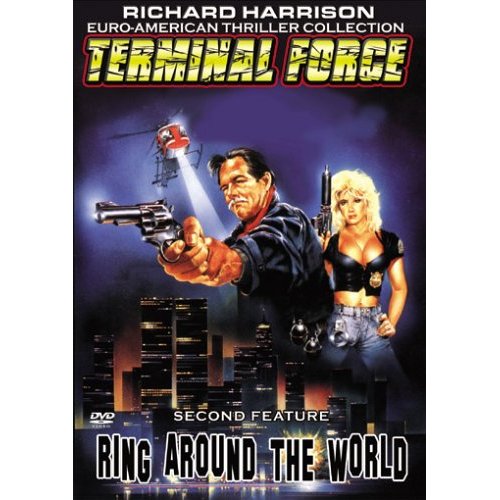
Richard Harrison starred in quite a few Eurospy movies, but this is the first one I’ve seen. My girlfriend and I spent most of the movie trying to figure out whether he was a doofus or a lug, and I think, in truth, he’s a bit of both here. As Fred Lester (is that a hero’s name or what?), he dons a pair of glasses that may be intended to make us think of Harry Palmer, but end up looking more Clark Kent instead. See what I mean? Lug. (Kind of a Matt Damon-y lug.) Whichever term applies, I mean it in the best possible way. A likeable, somewhat slow-witted, everyman sort of hero who’s never ahead of the audience when it comes to figuring out the plot. He has a great moment near the end when he does actually discover the identity of the villainous ringleader (long after the audience has guessed it) and he pauses to allow himself a congratulatory smile. He’s truly pleased with himself! You can’t help but root for that kind of doofus.

Ring Around the World belongs to that very strange subgenre of Sixties spy flicks, the "insurance investigator movie." Yes, Fred Lester is not a secret agent, but an insurance investigator, just like Bulldog Drummond (Richard Johnson) in Deadlier Than the Male and Some Girls Do. I’m not sure who decided that insurance investigators led the same glamorous, violent lives as spies, and I don’t know if there are actually any other examples of this subgenre (though it wouldn’t surprise me), but three movies is already enough to provoke discussion. (Maybe you can take a class at some film school in the country on "Masculinity in the Heroic Insurance Investigator Film of the 1960s." That would be the greatest film school in the world!) So, anyway, the bespectacled Fred Lester works for an insurance company, which makes him even more of a doofus than previously imagined. (No offense to any insurance investigators reading this blog!)

Lester is assigned to investigate a series of murders around the world in which wealthy victims’ huge life insurance policies benefit the same bank. His investigation takes him from London to Rio to Brasilia to Hong Kong, and the movie actually appears to be shot on location in all of those places, which elevates it at least a notch above certain rival Eurospy flicks that clearly never left Spain, no matter where they were supposed to be taking place. In the course of his journey, Lester gets in several fights, a couple of car chases, and, most impressively, a midair fight over a single parachute while plummeting towards earth. This stunt preceded the similar (though decidedly more impressive) James Bond sequence from Moonraker by more than a decade, and makes for a nice set piece. The movie’s other major set piece comes in the finale, an extended machine gun shootout in a beautiful Hong Kong sculpture garden. It’s a great, exotic location and the film makes ample use of it. (The incredibly informative poster "davidfoster" at the Eurospy Forum says it's called Tiger Balm Gardens, or Aw Boon Haw Gardens.)

Jack Stuart (aka Giacomo Rossi-Stuart) is suitably suave and slimy as Lester’s primary adversary, whom he encounters several times throughout his mission, not just at the end. He’s smarter than Lester, and always one step ahead of him, which leads to several genuinely clever plot twists which I won’t reveal.

Unfortunately, Ring Around the World is a letdown in the one category that you can usually count on from even the worst Eurospy movies: sexy spy babes. While Lester does encounter a few attractive distractions along the way, he doesn’t have time to pay them any attention until he meets Mary Brightford, played by Sheryll Morgan (aka Helene Chanel). Not only does Miss Morgan lack significant acting skill (not a requirement for Eurospy stardom), but she’s unfortunately not very sexy either. While Harrison exudes a certain luggish charm in most of his scenes, it sadly evaporates when confronted with Morgan, and their scenes together come off as kind of creepy.

Still, the stunts and the fights are enough to recommend this movie, which is a fun, fast watch. It’s got a good bad guy, great locations, a great Bondian score (by Piero Umiliani), and remains thoroughly entertaining throughout. Furthermore, I like the doofus. I’m keen to see more Richard Harrison spy movies, and I hope he maintains his doltish charm even without the nerd glasses.

The quality of the DVD itself leaves a lot to be desired. It looks like a bootleg-quality print, though I hear it’s actually a better print than the available bootlegs. It’s the kind of movie that might prove a revelation if one were able to see it on the big screen, on a pristine, 35mm film print. Until one of those turns up, though, this DVD is what we’ve got, and, as with whatever Eurospy titles are actually available, we have to be thankful for what we’ve got. Retromedia deserves credit for releasing this, in what is no doubt the best quality possible given their resources.