Today, Universal afforded spy fans our first glimpse at Jeremy Renner in action as Matt Damon's Bourne replacement (though not playing the same character). And, not surprisingly, really... it looks good! Even without Rachel Weisz or any of the Phillipines footage we know they shot. So it's a very solid teaser... building slowly, revealing the new actor (you were expecting someone else?) and finally giving us a taste of some awesome spy action in a wintry setting without giving away much at all about the plot itself or spoiling too many of the film's highlights. One thing it does reveal, however, is David Straithairn. I don't recall previously reading that he would be reprising his Bourne Ultimatum role in this. Tony Gilroy's The Bourne Legacy (which is not based on any Robert Ludlum novel or Eric Van Lustbader's continuation novel of that name) opens on August 3, and I can't wait!
Watch the trailer in HD on the Apple site.
Feb 8, 2012
Feb 7, 2012
Tradecraft: Brett Ratner to Direct Fox's Teen Spy Pilot
According to Deadline, Brett Ratner (Tower Heist, After the Sunset) has signed on to direct the pilot for Karyn Usher's untitled teen spy drama at Fox. The project, centering on the orphaned teenage daughter of a CIA officer recruited to spy herself and mentored by a deadly and mysterious rogue agent, sounds sort of like a mash-up between Luc Besson's La Femme Nikita and The Professional. Last year, Ratner directed the slick but empty pilot for CBS's failed spy dramady CHAOS. Let's hope this one, assuming it gets picked up (and gets a title!), fares better.
Tradecraft: Philip Seymour Hoffman Tackles le Carré
Deadline reports that Mission: Impossible III villain Philip Seymour Hoffman is close to signing on to star in Anton Corbijn's previously announced John le Carré adaptation A Most Wanted Man. I haven't read the 2008 novel, but Hoffman and le Carré seem like a good match no matter what. (The author's high-brow spy fare is probably especially appealing to top caliber actors right now following Gary Oldman's well-deserved Oscar nomination for Tinker Tailor Soldier Spy.) According to the trade blog, Hoffman will play a rogue German spy chief who tries to piece together the complicated mystery surrounding a Chechen Muslim who illegally immigrates to Hamburg and may be at the center of an elaborate terror plot. I'm very excited to see how Corbijn, who directed the visually striking George Clooney assassin thriller The American, handles le Carré material. I guess I need to move that book to the top of my reading list. In the meantime, though, I need to post something really silly to get away from this non-stop stream of le Carré of late! Stay tuned for the silliness tonight or tomorrow.
Feb 6, 2012
I Spy Comics Collected
Spy Vibe points the way to some very exciting news for fans of Sixties spy television and comics: the long-awaited collection of Gold Key I Spy comics from Hermes Press is now officially on the publisher's schedule! Amazon lists the release date as June 19. The 256-page hardcover compendium I Spy: The Complete Series reprints all six issues of Gold Key's comic books based on the globetrotting Robert Culp/Bill Cosby TV series, as well as (per the publisher) "informative essays about the creative team behind the comic book and loads of never-before seen publicity photographs featuring stars Culp and Cosby." Paul S. Newman scripted the stories, and Al McWilliams and Mike Roy provided the art. SRP is $49.99, but you can pre-order this baby from Amazon for just $31.49 right now! Best of all, this book is hopefully just the tip of the iceberg for fans of Gold Key's TV-based Sixties spy comics. A Hermes representative told me at last year's Comic Con that the publisher hopes to follow their I Spy volume with subsequent collections featuring all the other Gold Key spy properties, including The Man From U.N.C.L.E. and The Girl From U.N.C.L.E., and I think the Dell ones as well, like Mission: Impossible. I can't wait!
DVD Review: A Murder of Quality (1991)
Note: This article contains minor spoilers about the book A Murder of Quality (but not the movie).
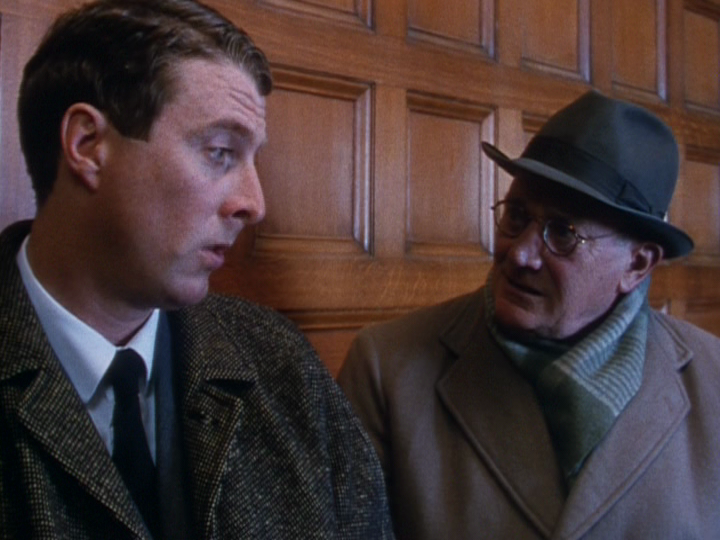
John le Carré’s second Smiley novel, 1962’s A Murder of Quality (review here), wasn’t adapted for the screen until nearly thirty years after its publication. It must have come as a surprise to readers and viewers when the feature-length television adaptation popped up so long after the fact. It’s possible that the BBC had been brainstorming how best to bring Smiley back to the screen ever since Smiley’s People scored so well with audiences and critics alike in 1982. Was an adaptation of 1989’s The Secret Pilgrim considered as a vehicle for Alec Guinness to return to the role? It would be a problematic novel to adapt, but I can’t imagine the prospect wasn't at least bandied about. Perhaps it was and Guinness turned it down. Whatever the case, that wasn’t made and TV producers were probably wondering how they could possibly top the big budget international production of Smiley’s People… and realized that they couldn’t. But if they went back to that second novel, a rich little period mystery set at a prep school, then they wouldn’t have to compete with past Smiley TV adaptations. It was small enough—and different enough—that direct comparisons would be unlikely. Of course that’s all pure speculation. Perhaps the impetus came from le Carré himself. As it happened, A Murder of Quality didn't come from the BBC, but from Thames Television, and it's a far different animal from the sprawling miniseries Tinker, Tailor, Soldier, Spy and Smiley’s People.
Since A Murder of Quality isn’t a spy story and isn’t set at the Circus, the only series character involved is George Smiley himself. Denholm Elliott (Codename: Kyril, Indiana Jones and the Last Crusade) is quite good in the role (and certainly looks the part), playing a more seemingly befuddled Smiley than Guinness. It’s almost as if every actor who’s ever tackled the role has chosen to focus on a different aspect of the literary Smiley’s personality. If you could assemble them all together into some avant garde production along the lines of Todd Haynes’ Bob Dylan biopic, I'm Not There (which featured multiple actors portraying separate aspects of the musician’s persona), you would have a complete representation of the character from the books. If James Mason is the Smiley the Lovelorn Cuckold and Alec Guinness is Smiley the Introvert and Gary Oldman is Smiley the Ruthless, then Elliott is Smiley the Fool. Of course, the fool is just a disguise for Smiley—a Lord Peter Wimseyish defense mechanism—and Elliott conveys that well. But it’s certainly a legitimate aspect of the literary Smiley. Elliott’s Smiley is Smiley as he’s perceived by people who don’t know better.
Le Carré himself penned the screenplay for A Murder of Quality… and, surprisingly, he wasn’t the most faithful of adaptors. It’s a weird experience watching this TV version right after reading the book, because the differences stand out more than the similarities. A lot of the same material is still there, but it’s been shuffled around, and good lines have been redistributed to different characters. It’s not that it’s been shortened (which wouldn’t be necessary for such a slim volume), but rewritten. This is the rare opportunity to witness an author with a chance to rewrite his second novel thirty years later, and observe exactly what he would have done differently. Personally, I preferred the original.
In his introduction to later editions of the novel, le Carré said, “Rereading the book now, I find a flawed thriller redeemed by ferocious and quite funny social comment.” For the screenplay he clearly accentuated the social comment, but it loses some of its bite in being moved to the fore. If he attempted to “fix” the thriller elements, he didn’t do a very good job. The mystery becomes more obvious in the film, and the cleverest part (involving a letter case behind) is streamlined so as to remove all the fun of the clue. Even the primary suspect in the murder mystery is changed. In the book, we’re led to always suspect the victim’s husband, Stanley Rhode (David Threlfall), because he’s mentioned in his late wife’s letter—the letter that gets Smiley involved in the case to begin with. And for all the reader knows, he could have done it. But in the movie, we see him, through a subjective camera, come home alone and discover his wife’s body and react, so we’re reasonably certain all along that he did not commit the crime! And, unfortunately, that doesn’t leave too many viable red herrings.
We also learn about Stella’s true nature much sooner in the movie than in the book—pretty much right away, in fact, which seriously dulls one of the novel’s biggest surprises and leaves us with a much more conventional Agatha Christie-type mystery. But because of the lack of red herrings and misdirection, it’s a lot more predictable than your typical Christie mystery. While the omission does streamline the plot, the book’s ingenious misdirection doesn’t seem to have been cut for the sake of time; what fit in a 150-page novel should fairly easily translate to a 90-minute drama. Instead, I suspect that le Carré purposely pared away a lot of the story’s “thriller” aspects in order to allow the social satire to better shine.
Indeed, he keeps much of his best (which is to say, nastiest—and funniest) dialogue verbatim, though while the lines were mostly Shane Hecht’s in the book, many have now been awarded to other characters, as Shane is a fairly minor role in the film. In fact, le Carré now gives the murderer some of Shane’s best lines, in order to accentuate his or her own class consciousness and drive home the already biting critique of the British class system. The move rather backfires, though, I’m afraid. In moving the social satire to the foreground, the author’s motives become too transparent. Such commentary works best when it’s surreptitiously inserted into other genres (like mystery) and takes the reader or viewer by surprise. When it’s the whole point of the piece, it loses a good deal of impact.
While I understand why Shane Hecht’s dialogue was redistributed, I don't understand why in the movie le Carré takes away some of Smiley’s actions and gives them to other characters, actually making his hero less proactive! That seems like an odd choice, and somewhat diminishes Smiley’s character.
All of my complaints, however, derive from direct comparisons to the book. Judged on its own merits, A Murder of Quality makes a handsome one-off in the PBS Mystery! mold (on which it originally aired in America), likely to satisfy most fans of British period detective shows. Director Gavin Miller (Foyle's War) creates a pleasing atmosphere and takes full advantage of his locations; whatever actual school stood in for Carne does a good job. There’s a first rate cast, too, including Joss Ackland as house Master Terrance Fielding (brother of one of Smiley’s wartime compatriots), Glenda Jackson as the former colleague who involves Smiley in the mystery, Ailsa Brimley, and a young Christian Bale (The Dark Knight) as one of the boys who unwittingly holds a vital piece of the puzzle. Diane Fletcher does a fine job as a slightly defanged Shane Hecht, but I can’t help imagining how wonderfully Maggie Smith might have channeled the character from the novel (with all her lines intact, hopefully). Ah well. What might have been. Matthew Scurfield is also good as Smiley’s police contact, Inspector Rigby.
Solid cast and high production values aside, though, the finished product is undeniably lightweight. As a television drama, A Murder of Quality is even less essential Smiley than the book. It’s still worth watching for serious Smiley fans, however, just to see Denholm Elliott’s take on the character. I quite like it, but wish we could have seen him in something a bit more substantial—like, maybe, another crack at Call for the Dead. As a spy story, that one might have drawn more inevitable comparisons to the Guinness miniseries, but I have to wonder if there might have been plans to film it with Elliott after A Murder of Quality had the actor's health held up? (He died a year later.) As things stand, his sole contribution to the Smiley Files is limited to this rather insubstantial television movie.
The Region 1 A&E DVD offers an adequate, if grainy (as expected for UK TV productions of that era) presentation, and is thankfully uncut. (There’s some surprising female nudity, which I can’t imagine made it into the original PBS broadcast.) Other than some text features on the author and the actors, there are no special features to speak of.
The Smiley Files
Part 1: George Smiley: An Introduction
Part 2: Movie Review: Tinker Tailor Soldier Spy (2011)
Part 3: Book Review: Call for the Dead (1961)
Part 4: Movie Review: The Deadly Affair (1966)
Part 5: Book Review: A Murder of Quality (1962)
Note: This article contains minor spoilers about the book A Murder of Quality (but not the movie).
John le Carré’s second Smiley novel, 1962’s A Murder of Quality (review here), wasn’t adapted for the screen until nearly thirty years after its publication. It must have come as a surprise to readers and viewers when the feature-length television adaptation popped up so long after the fact. It’s possible that the BBC had been brainstorming how best to bring Smiley back to the screen ever since Smiley’s People scored so well with audiences and critics alike in 1982. Was an adaptation of 1989’s The Secret Pilgrim considered as a vehicle for Alec Guinness to return to the role? It would be a problematic novel to adapt, but I can’t imagine the prospect wasn't at least bandied about. Perhaps it was and Guinness turned it down. Whatever the case, that wasn’t made and TV producers were probably wondering how they could possibly top the big budget international production of Smiley’s People… and realized that they couldn’t. But if they went back to that second novel, a rich little period mystery set at a prep school, then they wouldn’t have to compete with past Smiley TV adaptations. It was small enough—and different enough—that direct comparisons would be unlikely. Of course that’s all pure speculation. Perhaps the impetus came from le Carré himself. As it happened, A Murder of Quality didn't come from the BBC, but from Thames Television, and it's a far different animal from the sprawling miniseries Tinker, Tailor, Soldier, Spy and Smiley’s People.
Since A Murder of Quality isn’t a spy story and isn’t set at the Circus, the only series character involved is George Smiley himself. Denholm Elliott (Codename: Kyril, Indiana Jones and the Last Crusade) is quite good in the role (and certainly looks the part), playing a more seemingly befuddled Smiley than Guinness. It’s almost as if every actor who’s ever tackled the role has chosen to focus on a different aspect of the literary Smiley’s personality. If you could assemble them all together into some avant garde production along the lines of Todd Haynes’ Bob Dylan biopic, I'm Not There (which featured multiple actors portraying separate aspects of the musician’s persona), you would have a complete representation of the character from the books. If James Mason is the Smiley the Lovelorn Cuckold and Alec Guinness is Smiley the Introvert and Gary Oldman is Smiley the Ruthless, then Elliott is Smiley the Fool. Of course, the fool is just a disguise for Smiley—a Lord Peter Wimseyish defense mechanism—and Elliott conveys that well. But it’s certainly a legitimate aspect of the literary Smiley. Elliott’s Smiley is Smiley as he’s perceived by people who don’t know better.
Le Carré himself penned the screenplay for A Murder of Quality… and, surprisingly, he wasn’t the most faithful of adaptors. It’s a weird experience watching this TV version right after reading the book, because the differences stand out more than the similarities. A lot of the same material is still there, but it’s been shuffled around, and good lines have been redistributed to different characters. It’s not that it’s been shortened (which wouldn’t be necessary for such a slim volume), but rewritten. This is the rare opportunity to witness an author with a chance to rewrite his second novel thirty years later, and observe exactly what he would have done differently. Personally, I preferred the original.
In his introduction to later editions of the novel, le Carré said, “Rereading the book now, I find a flawed thriller redeemed by ferocious and quite funny social comment.” For the screenplay he clearly accentuated the social comment, but it loses some of its bite in being moved to the fore. If he attempted to “fix” the thriller elements, he didn’t do a very good job. The mystery becomes more obvious in the film, and the cleverest part (involving a letter case behind) is streamlined so as to remove all the fun of the clue. Even the primary suspect in the murder mystery is changed. In the book, we’re led to always suspect the victim’s husband, Stanley Rhode (David Threlfall), because he’s mentioned in his late wife’s letter—the letter that gets Smiley involved in the case to begin with. And for all the reader knows, he could have done it. But in the movie, we see him, through a subjective camera, come home alone and discover his wife’s body and react, so we’re reasonably certain all along that he did not commit the crime! And, unfortunately, that doesn’t leave too many viable red herrings.
We also learn about Stella’s true nature much sooner in the movie than in the book—pretty much right away, in fact, which seriously dulls one of the novel’s biggest surprises and leaves us with a much more conventional Agatha Christie-type mystery. But because of the lack of red herrings and misdirection, it’s a lot more predictable than your typical Christie mystery. While the omission does streamline the plot, the book’s ingenious misdirection doesn’t seem to have been cut for the sake of time; what fit in a 150-page novel should fairly easily translate to a 90-minute drama. Instead, I suspect that le Carré purposely pared away a lot of the story’s “thriller” aspects in order to allow the social satire to better shine.
Indeed, he keeps much of his best (which is to say, nastiest—and funniest) dialogue verbatim, though while the lines were mostly Shane Hecht’s in the book, many have now been awarded to other characters, as Shane is a fairly minor role in the film. In fact, le Carré now gives the murderer some of Shane’s best lines, in order to accentuate his or her own class consciousness and drive home the already biting critique of the British class system. The move rather backfires, though, I’m afraid. In moving the social satire to the foreground, the author’s motives become too transparent. Such commentary works best when it’s surreptitiously inserted into other genres (like mystery) and takes the reader or viewer by surprise. When it’s the whole point of the piece, it loses a good deal of impact.
While I understand why Shane Hecht’s dialogue was redistributed, I don't understand why in the movie le Carré takes away some of Smiley’s actions and gives them to other characters, actually making his hero less proactive! That seems like an odd choice, and somewhat diminishes Smiley’s character.
All of my complaints, however, derive from direct comparisons to the book. Judged on its own merits, A Murder of Quality makes a handsome one-off in the PBS Mystery! mold (on which it originally aired in America), likely to satisfy most fans of British period detective shows. Director Gavin Miller (Foyle's War) creates a pleasing atmosphere and takes full advantage of his locations; whatever actual school stood in for Carne does a good job. There’s a first rate cast, too, including Joss Ackland as house Master Terrance Fielding (brother of one of Smiley’s wartime compatriots), Glenda Jackson as the former colleague who involves Smiley in the mystery, Ailsa Brimley, and a young Christian Bale (The Dark Knight) as one of the boys who unwittingly holds a vital piece of the puzzle. Diane Fletcher does a fine job as a slightly defanged Shane Hecht, but I can’t help imagining how wonderfully Maggie Smith might have channeled the character from the novel (with all her lines intact, hopefully). Ah well. What might have been. Matthew Scurfield is also good as Smiley’s police contact, Inspector Rigby.
Solid cast and high production values aside, though, the finished product is undeniably lightweight. As a television drama, A Murder of Quality is even less essential Smiley than the book. It’s still worth watching for serious Smiley fans, however, just to see Denholm Elliott’s take on the character. I quite like it, but wish we could have seen him in something a bit more substantial—like, maybe, another crack at Call for the Dead. As a spy story, that one might have drawn more inevitable comparisons to the Guinness miniseries, but I have to wonder if there might have been plans to film it with Elliott after A Murder of Quality had the actor's health held up? (He died a year later.) As things stand, his sole contribution to the Smiley Files is limited to this rather insubstantial television movie.
The Region 1 A&E DVD offers an adequate, if grainy (as expected for UK TV productions of that era) presentation, and is thankfully uncut. (There’s some surprising female nudity, which I can’t imagine made it into the original PBS broadcast.) Other than some text features on the author and the actors, there are no special features to speak of.
The Smiley Files
Part 1: George Smiley: An Introduction
Part 2: Movie Review: Tinker Tailor Soldier Spy (2011)
Part 3: Book Review: Call for the Dead (1961)
Part 4: Movie Review: The Deadly Affair (1966)
Part 5: Book Review: A Murder of Quality (1962)
Labels:
Books,
Detectives,
DVDs,
John Le Carre,
Movies,
Nineties,
Reviews,
Smiley,
TV
Feb 2, 2012
First Pictures Emerge From Ben Affleck's Spy Movie Argo
A little over a month ago, The Hollywood Reporter unveiled the first photograph of Ben Affleck playing self-described CIA "Master of Disguise" Antonion Mendez in his fact-based tale of a daring hostage rescue in Iran, Argo. If his book
is to be believed, Mendez was something of a real-life equivalent of Mission: Impossible's Jim Phelps. Indeed, the rescue plot he came up with, which involved agents posing as a film crew shooting a fake sci-fi movie, sounds right out of that TV show. Further solidifying the connection, today the Huffington Post revealed another still from the movie... and this shot of Affleck briefing his team in a living room instantly makes me think of the obligatory team briefing in Jim's apartment that begins every episode of Mission: Impossible. Perhaps the connections are entirely unintentional, but this is shaping to look up like a really fun spy movie either way.
Feb 1, 2012
Book Review: A Murder of Quality (1962)
Part 5 of an ongoing series, "The Smiley Files," examining the career of George Smiley in literature and film. Read my introduction to Smiley here.
John le Carré’s second novel, A Murder of Quality, features George Smiley, but it doesn’t feature any spying. While Smiley finds himself either pushed out of the Circus (le Carré’s sobriquet for British Intelligence) or resigning from it in disgust in nearly every novel he appears in, A Murder of Quality is his only adventure that occurs entirely outside of the Circus, and doesn’t feature any of its staff—not even stalwart Peter Guillam. Instead, Smiley is called upon by an old friend and wartime intelligence colleague, Aisla Brimley, to investigate the murder of one Stella Rode, a junior teacher’s wife at an exalted English public school, the fictional Carne. While Smiley may be somewhat out of his element here, the author is decidedly not out of his. Because while a detective story isn’t necessarily a spy story, nearly all of le Carré’s spy stories are detective stories.
In Call for the Dead (review here), Smiley is an investigator attempting to solve a murder. The circumstances in which it happened and the people involved put that particular murder in the realm of Smiley’s department (though he resigns from it early on and acts as a private citizen for most of the novel) rather than the police, but his methodical investigation is very much in the tradition of Sherlock Holmes’ or Hercule Poirot’s investigations. And le Carré’s careful plotting very much follows the classical mystery structure, revealing one clue at a time, along with plenty of red herrings and misdirection. Later Smiley novels follow the same formula. Smiley’s People is another out-and-out murder investigation. In that one, Smiley’s called out of retirement (yet again) to probe the murder of an agent he used to run, a trail which will eventually lead him to his old nemesis, Karla. Tinker, Tailor, Soldier, Spy is a similarly structured detective story (again beginning with Smiley being summoned out of retirement), only the mystery is uncovering the identity of a mole rather than a killer. Still, the process is the same: a meticulous search for clues and a methodical study of the facts at hand. Even The Honourable Schoolboy has a mystery at its core—the mystery of Karla’s Hong Kong Gold Seam. (I'm glad le Carré didn't call it that, thought!) A Murder of Quality, therefore, is hardly treading unique narrative territory for the author, although the public school setting is unique for the character.
As Otto Penzler points out in his introduction to the Walker edition, Smiley is a natural detective, in the same league as Holmes and Poirot and all of their ilk. It somehow makes sense to see him tackle the same sort of case those titans would attack.
Smiley approaches detecting the same as he does spying. “It had been one of Smiley’s cardinal principles in research,” le Carré writes, “whether among the incunabula of an obscure poet or the laboriously gathered fragments of intelligence, not to proceed beyond the evidence. A fact, once logically arrived at, should not be extended beyond its natural significance. Accordingly he did not speculate with the remarkable discovery he had made, but turned his mind to the most obscure problem of all: motive for murder.” Smiley’s investigation is a textbook approach that would do his literary forebears proud, and once again le Carré proves a master of the form, doling out clues with enough regularity to make the problem solvable for the reader, but at the same time obscuring them with enough misdirection to make arriving at a conclusion difficult.
On the eve of her brutal murder, Mrs. Stella Rode wrote to Brimley’s agony column in a small nonconformist newspaper and expressed that she suspected her husband was trying to kill her. Thus her husband, Stanley Rode, seems the prime suspect when Smiley arrives on the scene, letter in hand for the local police. (As in Call for the Dead, he works hand-in-hand with an official detective.) However, despite the letter, Smiley quickly discovers a heap of evidence suggesting that Rode couldn't have done it. A whole assortment of suspects present themselves as the spy-cum-detective moves about in the halls of academia and the odd, fiercely class-conscious social circles of Carne.
Despite crafting a perfect mystery story, however (complete with a final false solution every bit as surprising and satisfying as the one in Tinker, Tailor), le Carré is less concerned about his genre than he is about his characters and themes. As with many of his spy novels, the thriller conventions here are merely a clotheshorse on which to hang a hilariously vicious condemnation of the British class system as cultivated in Etonian institutions—and with which to explore a handful of memorable, deeply flawed and deeply human characters.
The best dialogue comes from the characters for whom the author clearly feels the most contempt. Witness, for example, the venomous, socially-obsessed don’s wife Shane Hecht’s remembrances of the deceased: “Stella Rode was such a nice person, I always thought . . . and so unusual. She did such clever things with the same dress. . . .” Later, “I went to tea with Stella once. Milk in first and Indian. So different.” It’s clear that for someone like Shane Hecht, “different” could never be a compliment.
Or, on the subject of funerals: “I hate funerals, don’t you? Black is so insanitary. I always remember King George V’s funeral. Lord Sawley was at Court in those days, and gave Charles two tickets. So kind. I always think it spoilt us for ordinary funerals in a way. Although I’m never quite sure about funerals, are you? I have a suspicion that they are largely a lowerclass recreation; cherry brandy and seed cake in the parlour. I think the tendency of people like ourselves is for a quiet funeral these days; no flowers, just a short obituary and a memorial service later.”
For Shane Hecht, the author tells us, people exist “to be found wanting in the minute tests of social behavior, to be ridiculed, cut off, and destroyed.” A woman who collects the shame of others, she’s got Smiley’s number, too. She corners him at a dinner party and makes it clear what she thinks of this outsider in her hallowed circle:
One character succinctly sums up the discrepancy between Smiley’s looks and his intellect: “Looks like a frog, dresses like a bookie, and has a brain I’d give my eyes for.” It’s certainly possible that the author feels the same way about his character. He may ridicule him in his descriptions, but at the same time I suspect le Carré may want to be Smiley as much as Ian Fleming wanted to be James Bond. Fleming’s alter ego was a man of action who lived the adventures the author dreamt of during his deskbound war—a classic schoolboy fantasy; le Carré’s alter ego is a man of intellect, but perhaps more crucially, a man of staunch convictions that the author, belonging to another generation who never fought a noble war, simply cannot subscribe to. If Smiley is a clergyman, le Carré is the lapsed parishioner who envies his faith, but is himself incapable of such devotion. But the later books better illustrate Smiley’s convictions.
At a scant 152 pages, A Murder of Quality is a breezy read. It’s light-weight entertainment with a fun mystery and some biting social satire sure to have readers laughing aloud, but it’s certainly not essential le Carré. Die-hard fans of Smiley will enjoy seeing the familiar character in an unfamiliar setting and recognize recurring themes in the author’s work, but newcomers to the le Carré canon are encouraged to seek out his more substantial, far more essential work first—like Tinker, Tailor, Soldier, Spy, The Spy Who Came in from the Cold, or even Call for the Dead.
The Smiley Files
Part 1: George Smiley: An Introduction
Part 2: Movie Review: Tinker Tailor Soldier Spy (2011)
Part 3: Book Review: Call for the Dead (1961)
Part 4: Movie Review: The Deadly Affair (1966)
Part 5 of an ongoing series, "The Smiley Files," examining the career of George Smiley in literature and film. Read my introduction to Smiley here.
John le Carré’s second novel, A Murder of Quality, features George Smiley, but it doesn’t feature any spying. While Smiley finds himself either pushed out of the Circus (le Carré’s sobriquet for British Intelligence) or resigning from it in disgust in nearly every novel he appears in, A Murder of Quality is his only adventure that occurs entirely outside of the Circus, and doesn’t feature any of its staff—not even stalwart Peter Guillam. Instead, Smiley is called upon by an old friend and wartime intelligence colleague, Aisla Brimley, to investigate the murder of one Stella Rode, a junior teacher’s wife at an exalted English public school, the fictional Carne. While Smiley may be somewhat out of his element here, the author is decidedly not out of his. Because while a detective story isn’t necessarily a spy story, nearly all of le Carré’s spy stories are detective stories.
In Call for the Dead (review here), Smiley is an investigator attempting to solve a murder. The circumstances in which it happened and the people involved put that particular murder in the realm of Smiley’s department (though he resigns from it early on and acts as a private citizen for most of the novel) rather than the police, but his methodical investigation is very much in the tradition of Sherlock Holmes’ or Hercule Poirot’s investigations. And le Carré’s careful plotting very much follows the classical mystery structure, revealing one clue at a time, along with plenty of red herrings and misdirection. Later Smiley novels follow the same formula. Smiley’s People is another out-and-out murder investigation. In that one, Smiley’s called out of retirement (yet again) to probe the murder of an agent he used to run, a trail which will eventually lead him to his old nemesis, Karla. Tinker, Tailor, Soldier, Spy is a similarly structured detective story (again beginning with Smiley being summoned out of retirement), only the mystery is uncovering the identity of a mole rather than a killer. Still, the process is the same: a meticulous search for clues and a methodical study of the facts at hand. Even The Honourable Schoolboy has a mystery at its core—the mystery of Karla’s Hong Kong Gold Seam. (I'm glad le Carré didn't call it that, thought!) A Murder of Quality, therefore, is hardly treading unique narrative territory for the author, although the public school setting is unique for the character.
As Otto Penzler points out in his introduction to the Walker edition, Smiley is a natural detective, in the same league as Holmes and Poirot and all of their ilk. It somehow makes sense to see him tackle the same sort of case those titans would attack.
Smiley approaches detecting the same as he does spying. “It had been one of Smiley’s cardinal principles in research,” le Carré writes, “whether among the incunabula of an obscure poet or the laboriously gathered fragments of intelligence, not to proceed beyond the evidence. A fact, once logically arrived at, should not be extended beyond its natural significance. Accordingly he did not speculate with the remarkable discovery he had made, but turned his mind to the most obscure problem of all: motive for murder.” Smiley’s investigation is a textbook approach that would do his literary forebears proud, and once again le Carré proves a master of the form, doling out clues with enough regularity to make the problem solvable for the reader, but at the same time obscuring them with enough misdirection to make arriving at a conclusion difficult.
On the eve of her brutal murder, Mrs. Stella Rode wrote to Brimley’s agony column in a small nonconformist newspaper and expressed that she suspected her husband was trying to kill her. Thus her husband, Stanley Rode, seems the prime suspect when Smiley arrives on the scene, letter in hand for the local police. (As in Call for the Dead, he works hand-in-hand with an official detective.) However, despite the letter, Smiley quickly discovers a heap of evidence suggesting that Rode couldn't have done it. A whole assortment of suspects present themselves as the spy-cum-detective moves about in the halls of academia and the odd, fiercely class-conscious social circles of Carne.
Despite crafting a perfect mystery story, however (complete with a final false solution every bit as surprising and satisfying as the one in Tinker, Tailor), le Carré is less concerned about his genre than he is about his characters and themes. As with many of his spy novels, the thriller conventions here are merely a clotheshorse on which to hang a hilariously vicious condemnation of the British class system as cultivated in Etonian institutions—and with which to explore a handful of memorable, deeply flawed and deeply human characters.
The best dialogue comes from the characters for whom the author clearly feels the most contempt. Witness, for example, the venomous, socially-obsessed don’s wife Shane Hecht’s remembrances of the deceased: “Stella Rode was such a nice person, I always thought . . . and so unusual. She did such clever things with the same dress. . . .” Later, “I went to tea with Stella once. Milk in first and Indian. So different.” It’s clear that for someone like Shane Hecht, “different” could never be a compliment.
Or, on the subject of funerals: “I hate funerals, don’t you? Black is so insanitary. I always remember King George V’s funeral. Lord Sawley was at Court in those days, and gave Charles two tickets. So kind. I always think it spoilt us for ordinary funerals in a way. Although I’m never quite sure about funerals, are you? I have a suspicion that they are largely a lowerclass recreation; cherry brandy and seed cake in the parlour. I think the tendency of people like ourselves is for a quiet funeral these days; no flowers, just a short obituary and a memorial service later.”
For Shane Hecht, the author tells us, people exist “to be found wanting in the minute tests of social behavior, to be ridiculed, cut off, and destroyed.” A woman who collects the shame of others, she’s got Smiley’s number, too. She corners him at a dinner party and makes it clear what she thinks of this outsider in her hallowed circle:
“The only Smiley I ever heard of married Lady Ann Sercombe at the end of the war. She left him soon afterwards, of course. A very curious match. I understand he was quite unsuitable. She was Lord Sawley’s cousin, you know. The Sawleys have been connected with Carne for four hundred years. The present heir is a pupil of Charles; we often dine at the Castle.” For a moment the noise in the room stopped. For a moment, no more, he could discern nothing but the steady gaze of Shane Hecht upon him, and knew she was waiting for an answer. And then she released him as if to say: “I could crush you, you see. But I won’t, I’ll let you live,” and she turned and walked away.Yes, this is very much the same Smiley we know and love from the other books. In addition to being hopelessly devoted to an absent wife, he’s “toad-like,” and “short and plump, with heavy spectacles and thinning hair,” and “the very prototype of an unsuccessful middle-aged bachelor in a sedentary occupation” whose “natural diffidence in most practical matters was reflected in his clothes, which were costly and unsuitable, for he was clay in the hands of his tailor, who robbed him.” Yet he’s also capable, when he finally corners the killer, of the same sudden ruthlessness we later witness on occasion in the Karla Trilogy. That doesn’t mean, however, that he has a taste for such things. “He had come to the end of the chase, and was already sickened by the kill.”
![]() |
| Image from swallace99's flickr photostream |
At a scant 152 pages, A Murder of Quality is a breezy read. It’s light-weight entertainment with a fun mystery and some biting social satire sure to have readers laughing aloud, but it’s certainly not essential le Carré. Die-hard fans of Smiley will enjoy seeing the familiar character in an unfamiliar setting and recognize recurring themes in the author’s work, but newcomers to the le Carré canon are encouraged to seek out his more substantial, far more essential work first—like Tinker, Tailor, Soldier, Spy, The Spy Who Came in from the Cold, or even Call for the Dead.
The Smiley Files
Part 1: George Smiley: An Introduction
Part 2: Movie Review: Tinker Tailor Soldier Spy (2011)
Part 3: Book Review: Call for the Dead (1961)
Part 4: Movie Review: The Deadly Affair (1966)
Labels:
Books,
Detectives,
John Le Carre,
Reviews,
Sixties,
Smiley
Network DVD Sale: Last Day!
Cold Light of Day Poster
We saw the intriguing trailer yesterday; today, thanks to the Imp Awards, we have a glimpse at the 1-sheet for the Henry Cavill/Bruce Willis (yes, in that order) spy movie The Cold Light of Day.
First Official Still From SkyFall
Though Empire previously touted an image of Daniel Craig from behind in another tiny blue swimsuit sitting at the edge of a blue-lit pool as the first official still from the 23rd James Bond film, SkyFall, the producers apparently didn't consider that to be the case. Officially, this image revealed today on 007.com is the first still from SkyFall. It's certainly more traditionally Bondian: we have an exotic location (Shanghai), a classic pose and a classic gun. A purist at heart, I'm glad to see Bond packing the Walther PPK again, even if it is an impractical antique, as some firearms enthusiasts claim. The return to the PPK was one of the few good things Mark Forster brought to Bond on Quantum of Solace. But this image isn't all traditional! Glaringly non-traditional for James Bond is the beard Craig sports. It's not a surprise, since we've already seen paparazzi shots of a bearded Craig filming in London, but it's still sort of jarring to see it in an official, purposefully composed photo. Previously, Bond has only ever sported a beard (of the Robinson Crusoe variety) after a period of long captivity in North Korea at the beginning of Die Another Day. Unlike that one, this neatly-trimmed facial hair appears to be a purposeful choice on Bond's part, and not the result of lengthy torture. As non-traditional as it is, I'm not against the beard... just commenting on its irregularity. Craig pulls it off... and manages to still look very Bondian. We know, of course, from other set photos, that the actor does not have a beard in every scene in SkyFall. I'm curious to learn its purpose and its placement in the film. All told, this is a pretty cool picture. And I like that that logo at the bottom kind of makes it look like a trading card. You can see it in super-high resolution on the official website.
Jan 31, 2012
Movie Review: The Deadly Affair (1966)
Part 4 of an ongoing series, "The Smiley Files," examining the career of George Smiley in literature and film. Read my introduction to Smiley here.
Sidney Lumet's The Deadly Affair is based on John le Carré's first George Smiley novel, Call for the Dead (review here). Though it introduced the author's famous hero, Call for the Dead is generally considered one of le Carré's less significant works. The movie, with its more generic title, is even more obscure, though it's overall quite a good adaptation in that it actually improves on the book in some respects. Both are well deserving of rediscovery in the wake of the Tomas Alfredson's fantastic, high-profile new film version of Tinker Tailor Soldier Spy (review here). However, fans coming to this movie from that one might be slightly confused at first by the lead character's name. Because Paramount owned the rights to the name "George Smiley" for their film of The Spy Who Came in from the Cold (in which Smiley plays a relatively small part), Columbia had to change the name of the protagonist to Charles Dobbs. That’s too bad, because James Mason gives a really great interpretation of Smiley in Dobbs. (Even if, like most screen Smileys up until Gary Oldman, he's prone to wearing hats, something the Smiley of the books steadfastly refuses to do.)
Note: This review incorporates and updates an earlier review of this film that I wrote in 2008.
Sidney Lumet's The Deadly Affair is based on John le Carré's first George Smiley novel, Call for the Dead (review here). Though it introduced the author's famous hero, Call for the Dead is generally considered one of le Carré's less significant works. The movie, with its more generic title, is even more obscure, though it's overall quite a good adaptation in that it actually improves on the book in some respects. Both are well deserving of rediscovery in the wake of the Tomas Alfredson's fantastic, high-profile new film version of Tinker Tailor Soldier Spy (review here). However, fans coming to this movie from that one might be slightly confused at first by the lead character's name. Because Paramount owned the rights to the name "George Smiley" for their film of The Spy Who Came in from the Cold (in which Smiley plays a relatively small part), Columbia had to change the name of the protagonist to Charles Dobbs. That’s too bad, because James Mason gives a really great interpretation of Smiley in Dobbs. (Even if, like most screen Smileys up until Gary Oldman, he's prone to wearing hats, something the Smiley of the books steadfastly refuses to do.)

Like the book, the movie begins with Smiley–er, Dobbs–interviewing a senior civil servant named Samuel Fennan in the park. An anonymous letter came in revealing Fennan’s involvement in communist circles back in his prewar college days and questioning his present-day loyalty, so as a formality the Security Services are obliged to check him out. Dobbs suggested the park instead of his office to spare the man any undue embarrassment. Indeed, Fennan seems very pragmatic about his idealistic college days (everyone wants a cause at that age, he argues, and for those who hated fascism, it was communism), and appears to be a loyal British subject. Smiley/Dobbs gives him his stamp of approval and routes it to his boss.
That night he’s awakened at an ungodly hour with a phone call: Fennan has killed himself. Going out, he passes his unfaithful, nymphomaniac wife, Ann (Harriet Andersson) coming in, and they have an argument they’ve clearly had a hundred times before. Mason excels as the conflicted cuckold, playing up a rather pathetic side of Smiley's personality that fades to the background in other performances. He clearly loves his wife very much and wants to forgive her condition, but the jealousy is tearing him up inside. Pushed near breaking point in his personal life, he dives whole-heartedly into his professional life, determined to solve the mystery of Fennan’s death. If the man was really loyal, why would he kill himself?
While there are infrequent bursts of violence, le Carré relishes instead the inherent drama and humor of bureaucracy, and the mechanics of a thorough investigation. Though his stories are set in the murky world of international espionage, le Carré is a mystery writer at heart, and he’s constructed a good one here. Screenwriter Paul Dehn (who also co-wrote Goldfinger and The Spy Who Came in from the Cold in the two consecutive years preceding this movie, and went on to such varied fare as Murder On the Orient Express and Beneath the Planet of the Apes) does a good job with the difficult task of making Le Carré’s complex mystery and bureaucracy cinematic. While hardly action-packed, The Deadly Affair is never dull.
In one respect, Dehn even improves upon the novel, by integrating Ann fully into the story. In the book, Ann has already left Smiley, though she remains constantly on his mind. It would be difficult to depict the constant presence of an absent character on screen, so it makes sense for Dehn to write her back into the plot. He also works her directly into the central mystery in the very manner that le Carré himself will later use in Tinker, Tailor, Soldier, Spy, so I'm guessing the author was to some degree influenced by this adaptation. Andersson (more than twenty years Mason's junior, unlike in the novel) is definitely not le Carré's well-bred English aristocrat Lady Ann Smiley (née Sercombe) but she still manages very ably to convey the essence of the author's enigmatic character who looms so large in Smiley's life. In fact, she somehow manages to embody exactly the Ann I picture reading the books, despite being too young and a Swede! Andersson and Mason build an entirely credible, if utterly dysfunctional, relationship between these unlikely partners.
There are actually two mysteries unfolding in the movie: whether the traitor was actually Fennan or his wife (and who wrote the letter condemning Fennan to begin with), and the identity of their contact. The latter is rather obvious, but the former keeps the audience guessing right up to the final revelation. At the same time (and as much as he’d rather lose himself in his work–or drink–and forget it), Dobbs’ personal life remains hell, and his investigative talents come to hurt him in that arena when he can’t help but deduce that his wife’s latest lover is one of his oldest friends, an agent he ran during the war (Maximillian Schell). Mason does a first rate job as a man grasping desperately at a professional conundrum in order to ignore a personal one–only to discover it’s impossible.
The Deadly Affair is a highly enjoyable spy film, and a thoroughly gripping and generally faithful le Carré adaptation. James Mason makes a great Smiley (I know, I know... Dobbs), and it's too bad that his contribution to the filmic history of the character is often overlooked thanks to the long shadows of Alec Guinness’s later, definitive portrayal in two British miniseries, and Gary Oldman's Oscar-nominated turn in the new movie. Mason is even believable when provoked to uncharacteristic violence at the finale. A rarity when I first reviewd it several years ago, The Deadly Affair is now available on Region 2 DVD and as an MOD title in Region 1 as part of the Colombia Classics On Demand program. It's also available streaming through Amazon Instant Video. For le Carré fans or fans of Sixties spy cinema, it's well worth seeking out.Part 1: George Smiley: An Introduction
Part 2: Movie Review: Tinker Tailor Soldier Spy (2011)
Part 3: Book Review: Call for the Dead (1961)
Trailer: The Cold Light of Day
Hm, this one seems to have slipped by me completely throughout the production process. Weird! Or maybe I did post a Tradecraft item about it at some point; the title sounds kind of familiar. And bad. Boy, is that a bad title: The Cold Light of Day? That said, the movie looks potentially cool, and I did like the director's previous film, JCVD. But the trailer's also frustrating. Can you really put Bruce Willis in a cool, actiony spy trailer and then pull the rug out from under us and tell us he's not the hero? And that, adding insult to injury, Henry Cavill is? I don't think Willis is so old yet that he has to assume the father role in action movies! Maybe Cavill won't be so bad; right now my assessment of him is based solely on the mostly awful Immortals. Hopefully he takes this opportunity to show that that one was a fluke. But those gripes aside (along with the minor gripe that Sigourney Weaver seems to be playing the exact same role that she played in Abduction and speaking the same lines, too), this looks to be a Takenesque spy movie set in Europe, and European locations always win me over. It does look pretty cool...
Jan 30, 2012
Bourne Legacy Filming
Kees Stam of the Harry Palmer Movie Site pointed the way to this video of a Filipino news broadcast covering the first day of shooting on The Bourne Legacy in Manila. Stick with the broadcast for a few minutes, because you'll be rewarded with some brief glimpses of an action sequence with Rachel Weisz running from police. Even seen from news cameras, the sequence looks very Bourney indeed! (No sign of star Jeremy Renner, though.)
Jan 27, 2012
Chuck Ends Tonight
It's the end of an era when NBC's comedic geek spy show Chuck airs its series finale tonight. That makes me realize how long I've been doing this blog... long enough that a new spy series has premiered, enjoyed a respectable five-season runs, and ended all in the time I've been blogging. I mean, it's one thing for flash-in-the-pan series like UnderCovers or CHAOS to come and go, but Chuck was for real. When I first reviewed the pilot after seeing it early at Comic-Con in 2007, I wasn't terribly impressed. I revised my opinion, however, after watching it again (in a slightly different cut) when it aired, and by the second episode I was a fan. Over its course Chuck has had a lot of ups and downs. By Season 3 I thought it was severely sagging, but former 007 Timothy Dalton proved to be exactly what the series needed to rebound in Season 4. Without Dalton, however, and owing to a fairly lame plot point involving Chuck's best friend Morgan gaining the superspy skills of the "Intersect," the fifth season has had its share of disappointments. It's probably time for Chuck to end, and I'm eager to see how the writers do that.
Throughout its five seasons (and despite surviving a long, momentum-sapping hiatus due to the writers' strike during its first season), Chuck has been a fixture of NBC's "bubble" each year, a show constantly in danger of cancellation. This danger proved to be a blessing in disguise, however, as it united the cult show's fans, who showed their support each year through various wacky means sometimes involving Subway sandwiches. Ultimately, the perpetually endangered Chuck even proved to be a reliable rock in NBC's increasingly troubled line-up. Reliable enough, in fact, that its final renewal was its most painless pick-up, and the producers had plenty of time to plan an actual ending rather than delivering an unsatisfying one due to cancellation.
The final 2-part episode airs tonight beginning at 8pm Eastern on NBC.
Throughout its five seasons (and despite surviving a long, momentum-sapping hiatus due to the writers' strike during its first season), Chuck has been a fixture of NBC's "bubble" each year, a show constantly in danger of cancellation. This danger proved to be a blessing in disguise, however, as it united the cult show's fans, who showed their support each year through various wacky means sometimes involving Subway sandwiches. Ultimately, the perpetually endangered Chuck even proved to be a reliable rock in NBC's increasingly troubled line-up. Reliable enough, in fact, that its final renewal was its most painless pick-up, and the producers had plenty of time to plan an actual ending rather than delivering an unsatisfying one due to cancellation.
The final 2-part episode airs tonight beginning at 8pm Eastern on NBC.
Jan 26, 2012
Lockout U.S. Trailer
Luc Besson and his partners take their neo-Eurospy nonsense to outer space in Lockout. Yeah, I know; this is pretty much straight sci-fi, so what's it doing on a spy blog?
1. Because despite the outer space setting, the hero (played by Guy Pearce) is still a secret agent. And, better still, "He's the best there is... but he's a loose cannon."
2. Because it clearly embodies the same anything-goes gonzo enthusiasm as Besson's more down-to-earth neo-Eurospy movies, like From Paris With Love and the Transporter movies.
3. Because it looks utterly awesome.
We saw an extended trailerish featurette a few weeks ago here, and there's also this international trailer which contains some different one-liners from the American one:
Lockout opens April 20 in the United States.
Tradecraft: RKO Attempts New Saint Movies
Following the frustrating collapse (yet again) of the latest attempt to bring Simon Templar back to the small screen, Variety reports that RKO will attempt a big screen revival for Leslie Charteris' famous modern-day Robin Hood. According to the trade, the studio has signed Eagle Eye co-writer Travis Wright to pen a remake of one of the 1930s or 40s RKO Saint films (exactly which one is unclear) for producer Rick Porras (The Lord of the Rings) with an eye toward a trilogy of Templar tentpoles. But according to all-around Saint expert Ian Dickerson (author of The Saint on TV and erstwhile co-producer of the stalled television revival), Wright will have his work cut out for him. "RKO have the rights to remake their old B&W films but they cannot change the dialogue and they cannot change the length of the picture," Dickerson posted on the CommanderBond.net forums, where he has been updating fans for some time on his own Saintly efforts. He adds that RKO's rights apply to movies only, not to television. Does this really mean that an RKO remake would have to be 69 minutes long with all the same lines spoken by Louis Hayward or George Sanders? Maybe... but maybe not. Remember, Kevin McClory was actually able to get pretty creative in Never Say Never Again, even though his rights were strictly limited to an exact remake of Thunderball. Granted, the individual cases could be quite different, and I'm certainly no expert on copyright law, but I'm betting RKO have some experts on their legal team working hard to find loopholes. But the prospect of a fairly faithful, period-set remake of The Saint in New York actually quite appeals to me! While I'm very eager for Dickerson and his colleagues to get a new TV Saint up and running, I'd be curious to see what RKO can come up with as well. The more Saintly irons in the fire the better, as far as I'm concerned. It just increases the odds of one of them actually coming to fruition, right? Fingers crossed, but (to paraphrase a CBn poster) breath not held.
Hayward, Sanders and Hugh Sinclair all played Simon Templar for RKO; in later movies he was played by Felix Marten, Jean Marais (who gets a bad rap, but I quite liked in the role) and Val Kilmer (who deserves his bad rap). Vincent Price was among the actors to voice the Saint on the radio, and on TV he's been played by Ian Ogilvy, Simon Dutton, Andrew Clarke and, most famously, of course, Roger Moore.
Jan 24, 2012
Tinker Tailor Nets Three Oscar Nominations
Tomas Alfredson's Tinker Tailor Soldier Spy (review here) netted three well-earned Academy Award nominations this morning, including Best Actor for Gary Oldman (portraying John Le Carré’s spymaster George Smiley), Best Original Score for Alberto Iglesias and Best Adapted Screenplay for the husband-and-wife team of Bridget O'Connor and Peter Straughan. Sadly, the recognition is a posthumous one for O'Connor, who succumbed to cancer before the film was released. But what better tribute for such a talented screenwriter? I'm glad that the film garnered these nominations, since it's been shockingly omitted from most of the year-end guild awards, but I'm still sorry that it didn't earn more. For my money, it should have also been up for Director, Supporting Actor (for John Hurt as Control), Art Direction, Costumes, Editing and Best Picture. The last one is particularly insulting, considering that only nine out of a possible ten films were chosen this year. Shockingly, this nomination is a long-overdue career first for the great Gary Oldman!
Tinker Tailor Soldier Spy was better recognized in its native land, where it earned 11 BAFTA nominations including Best Film and Outstanding British Film, Best Actor, Director, Adapted Screenplay, Cinematography, Original Score, Editing, Production Design, Costume Design and Sound.
Spy fans may also be pleased that four veterans of the fantastic OSS 117 parodies (reviews here and here) received Oscar nominations for their work on the wonderful awards front runner The Artist: Jean Dujardin and Bernice Bejo were both nominated for their acting, Ludovic Bource for his score and Michel Hazanavicius for directing and writing. It's great to see spy movie veterans go on to such acclaim, but I hope amidst all the Oscar buzz they don't forget their Eurospy spoof roots... because I still desperately want to see a third OSS 117 adventure! (It would likely see a much wider U.S. release following the visibility of The Artist.)
Congratulations to all the nominees from Tinker Tailor Soldier Spy and The Artist!
Tinker Tailor Soldier Spy was better recognized in its native land, where it earned 11 BAFTA nominations including Best Film and Outstanding British Film, Best Actor, Director, Adapted Screenplay, Cinematography, Original Score, Editing, Production Design, Costume Design and Sound.
Spy fans may also be pleased that four veterans of the fantastic OSS 117 parodies (reviews here and here) received Oscar nominations for their work on the wonderful awards front runner The Artist: Jean Dujardin and Bernice Bejo were both nominated for their acting, Ludovic Bource for his score and Michel Hazanavicius for directing and writing. It's great to see spy movie veterans go on to such acclaim, but I hope amidst all the Oscar buzz they don't forget their Eurospy spoof roots... because I still desperately want to see a third OSS 117 adventure! (It would likely see a much wider U.S. release following the visibility of The Artist.)
Congratulations to all the nominees from Tinker Tailor Soldier Spy and The Artist!
Labels:
Awards,
Jean Dujardin,
John Le Carre,
Movies,
OSS 117,
Smiley
Jan 21, 2012
Haywire Movie Review
Steven Soderbergh's action-packed, all-star spy movie Haywire opens this weekend, with a stellar cast featuring Gina Carano, Michael Fassbender, Ewan McGregor, Antonio Bandaras, Michael Douglas, Channing Tatum and Bill Paxton. And it's pretty awesome. There are plenty of incredible action sequences sure to please Bourne fans, and Carano is a truly empowered female action star you can really believe could kick the asses of everyone whose ass she kicks in the movie in real life! (I thoroughly enjoyed Colombiana, but did you really believe that the rail-thin Zoe Saldana could win that final fight?) Read my full review of Haywire here. See the movie in theaters this weekend and chime in here with your thoughts.
Movie Review: Haywire (2012)
Jan 19, 2012
Archer Returns in a Big Way
The jerkiest spy since The Adventurer returns tonight, when Archer begins its third season on FX. The network has released a number of cool stills and hilarious clips from the new season, and it looks just as promising as those that came before. (Both prior seasons have made my Best of the Year lists in television, here and here.) And the advertising, like the look off the show itself, is once again heavily Bond-inspired. Existing in a sort of never-never nebula where the Cold War never ended and classic From Russia With Love menswear never went out of style, Archer always provides as many nods to past pop culture as it does references to present pop culture. This year's poster art adds Cheryl's ocelot into the mix, which is itself a Honey West reference, and the TV spots all play Nancy Sinatra's theme song from The Last of the Secret Agents. The season premiere manages to name-check a pretty obscure Sixties spy movie, too... and in the process makes what I am certain is the best Operation C.I.A. joke ever made on a TV show!
Archer isn't just back on TV though. In addition to the Complete Season Two DVDs and Blu-rays that came out a few weeks ago, this week saw the release of a brand new book by Sterling Archer himself, How to Archer: The Ultimate Guide to Espionage and Style and Women and Also Cocktails Ever Written. The contents are very similar to Kingsley Amis's classic James Bond lifestyle bible The Book of Bond or Every Man His Own 007, providing all sorts of details on how to live the Archer lifestyle written in classic Archer deadpan, but the cover is something else. The cover itself is one of those great, obscure pop culture references that Archer excels at, perfectly recreating the look of a Sixties Annual. It's got hints of the James Bond annuals and a Danger Man one. I love it! You can sample the contents for yourself courtesy of publisher Harper Collins here.
Archer returns tonight, January 19, at 10pm Eastern on FX. The season premiere, guest starring Burt Reynolds, should continue to air throughout the weekend. Check your local listings, as they used to say.
Archer isn't just back on TV though. In addition to the Complete Season Two DVDs and Blu-rays that came out a few weeks ago, this week saw the release of a brand new book by Sterling Archer himself, How to Archer: The Ultimate Guide to Espionage and Style and Women and Also Cocktails Ever Written. The contents are very similar to Kingsley Amis's classic James Bond lifestyle bible The Book of Bond or Every Man His Own 007, providing all sorts of details on how to live the Archer lifestyle written in classic Archer deadpan, but the cover is something else. The cover itself is one of those great, obscure pop culture references that Archer excels at, perfectly recreating the look of a Sixties Annual. It's got hints of the James Bond annuals and a Danger Man one. I love it! You can sample the contents for yourself courtesy of publisher Harper Collins here.
Archer returns tonight, January 19, at 10pm Eastern on FX. The season premiere, guest starring Burt Reynolds, should continue to air throughout the weekend. Check your local listings, as they used to say.
New Spy DVDs Out Since Christmas
I've gotten several weeks behind now on new spy DVDs, but there's been some great stuff coming out! So here's a massive post-Christmas catch-up.
Remember Age of Heroes, the movie we first heard about in 2010 about "Ian Fleming's Red Indians," the 30 Assault Unit commando team created by the future Bond author while he served in Naval Intelligence during WWII? It came out on Region 2 PAL DVD last June from Metrodome Distribution, and I had little hope of it ever showing up stateside. But this week, thanks to eOne Entertainment, it has, on both DVD and Blu-ray! The film stars former Bond baddie Sean Bean, and James D'Arcy plays Commander Fleming. A good old-fashioned war adventure, Age of Heroes depicts the incredible true story of how James Bond creator Ian Fleming oversaw the activities of an elite and supremely well-trained commando unit during World War II, following the members of the 30AU from defeat at Dunkirk to a chance to change the course of the war on a top secret mission in Norway. For more on Fleming's involvement with 30AU, check out Craig Cabell's books Ian Fleming's Secret War and The History of 30 Assault Unit: Ian Fleming's Red Indians.
Also out this week on DVD and Blu-ray, from Lions Gate, is Abduction, the teen spy movie starring simian Twilight heartthrob Taylor Lautner. This movie got terrible, terrible reviews when it came out theatrically last fall. And I won't say they're not deserved; it is, after all, a pretty terrible movie. But so are a lot of movies, and Abduction isn't any worse than most other bad movies, and is a whole lot more fun than most bad movies. So... okay, I will say that it didn't deserve quite the drubbing it took. Because if you have some friends over, pour some drinks, and put this on, you're all going to have a pretty good time. And while you're cracking jokes about Lautner's unbelievably terrible performance and wondering aloud what the likes of Sigourney Weaver, Jason Isaacs, Maria Bello, Alfred Molina and Michael Nyqvist are doing in this movie, you're also going to find yourself sucked in a bit by John Singleton's ridiculous action sequences and the overall absurdity of the script. It's bad, yes... but it's enjoyably bad! (And I have a sneaking suspicion that some people probably thought the teen spy movies of my youth were bad, like my own personal favorite If Looks Could Kill.) Extras on both versions include the featurettes "Abduction Chronicle: On-Camera Production Journal," "Initiation of an Action Hero: Taylor's Amazing Stunts" and "The Fight for The Truth: Making Abduction" as well as a gag reel. On top of that, the BD offers "an exclusive In-Film Experience with in-picture documentaries and exclusive behind the scenes interviews with cast and crew." If you care. Retail is $39.99 for the Blu-ray (which also comes with a digital copy) and $29.95 for the DVD, but of course they're both half those prices on Amazon.
Earlier this month, Acorn released the second volume of the Sixties ITC spy series Man in a Suitcase, starring Richard Bradford as sacked CIA agent turned private operator McGill. These episodes from the second half of the show's single, super-sized season made their Region 1 DVD debut. (The entire series was released in single volumes in Britain and Australia.) Many of McGill's best adventures come in the second half, so this would be a welcome release and a must-buy for American ITC aficionados on that basis alone... but as it happens, there's even more reason. Man in a Suitcase: Set 2 also includes a very big bonus feature: the 69-minute interview with star Richard Bradford that first appeared on Network's Region 2 DVD release (but was not found on the Region 4 Umbrella set). Bradford was a perfectionist and a Method actor, which brought him into conflict with some members of the cast and crew and earned him a reputation for being "difficult." In this surprisingly candid interview from 2004, he speaks frankly and openly about those on-set clashes, as well as discussing his early days studying at Lee Strasberg's famous Actors Studio, working with his friend and fellow Method actor Marlon Brando, and more. If for some reason you needed further encouragement to buy the second and final collection of this top-notch Sixties spy show, this is it! Man in a Suitcase: Set 2 retails for $59.99, though it's considerably cheaper from the usual online vendors.
Read my review of Acorn's Man in a Suitcase: Set 1 here.
In the last week of 2011 (on my birthday, in fact), Fox snuck out one of the very best spy releases of the year, Archer: The Complete Season Two, on DVD and Blu-ray. The wildly irreverent, always inappropriate Archer remains one of my favorite spy shows on TV, and as I said in my post about the Best Spy Television of 2011, I find it very impressive that the writers managed to maintain the high level of quality in its second season. That's particularly tough for a parody series. The secret, of course, is that Archer is much more than a mere spy parody. It's a dysfunctional family comedy that happens to be set in a spy agency. As I said before, the extremely raunchy humor is definitely not for all tastes, but if it is to your liking, you'll no doubt appreciate the excellent animation and cool spy style on top of the gags. And even if I didn't love it already, a very obscure Magnum, P.I. reference in Season Two assured the show my allegiance forever! The Season Two discs contain some very good extras, including excerpts from last year's Comic-Con panel, which are hilarious (though I wish they'd included the 2010 panel, too, which featured less cutting up from the cast, but more legitimate answers about how the show is made and what influenced its creators), and several animated shorts. In one, Archer himself answers viewers' questions (and the writers get a whole lot of mileage out of a single set-up!), and in another he messes up the opportunity to give a shout-out to troops stationed overseas who love the show in a uniquely Archer way. These extras certainly make up for Season One's fake "unaired pilot" (which annoyed some fans), but they don't let that concept go, either. In fact, another funny short expands upon the main gag in that feature. The same day Season Two came out, Fox also made Archer: The Complete Season One
widely available on Blu-ray for the first time. The high-def version was previously a Best Buy exclusive, and Archer's top-notch design and crisp animation make it one show that truly benefits from high-def presentation.
Finally, Universal released the Jason Statham/Clive Owen period assassin thriller Killer Elite on dual formats, DVD and DVD/Blu-ray combo. The only real bonus material on both versions is deleted scenes, which is too bad, because I would have liked some featurettes exploring the supposedly factual book on which the movie was based, The Feather Men, and how and why the film deviates from its source. Oh well. The combo version also includes a digital copy and an Ultraviolet copy (oooh!), which is something the studio wants you to be way more excited about than you no doubt are. Retail is $29.98 for the DVD and $34.98 for the combo, though of course both are considerably cheaper than that on Amazon right now. I really enjoyed Killer Elite. You can read my full review of the film here.
Remember Age of Heroes, the movie we first heard about in 2010 about "Ian Fleming's Red Indians," the 30 Assault Unit commando team created by the future Bond author while he served in Naval Intelligence during WWII? It came out on Region 2 PAL DVD last June from Metrodome Distribution, and I had little hope of it ever showing up stateside. But this week, thanks to eOne Entertainment, it has, on both DVD and Blu-ray! The film stars former Bond baddie Sean Bean, and James D'Arcy plays Commander Fleming. A good old-fashioned war adventure, Age of Heroes depicts the incredible true story of how James Bond creator Ian Fleming oversaw the activities of an elite and supremely well-trained commando unit during World War II, following the members of the 30AU from defeat at Dunkirk to a chance to change the course of the war on a top secret mission in Norway. For more on Fleming's involvement with 30AU, check out Craig Cabell's books Ian Fleming's Secret War and The History of 30 Assault Unit: Ian Fleming's Red Indians.
Also out this week on DVD and Blu-ray, from Lions Gate, is Abduction, the teen spy movie starring simian Twilight heartthrob Taylor Lautner. This movie got terrible, terrible reviews when it came out theatrically last fall. And I won't say they're not deserved; it is, after all, a pretty terrible movie. But so are a lot of movies, and Abduction isn't any worse than most other bad movies, and is a whole lot more fun than most bad movies. So... okay, I will say that it didn't deserve quite the drubbing it took. Because if you have some friends over, pour some drinks, and put this on, you're all going to have a pretty good time. And while you're cracking jokes about Lautner's unbelievably terrible performance and wondering aloud what the likes of Sigourney Weaver, Jason Isaacs, Maria Bello, Alfred Molina and Michael Nyqvist are doing in this movie, you're also going to find yourself sucked in a bit by John Singleton's ridiculous action sequences and the overall absurdity of the script. It's bad, yes... but it's enjoyably bad! (And I have a sneaking suspicion that some people probably thought the teen spy movies of my youth were bad, like my own personal favorite If Looks Could Kill.) Extras on both versions include the featurettes "Abduction Chronicle: On-Camera Production Journal," "Initiation of an Action Hero: Taylor's Amazing Stunts" and "The Fight for The Truth: Making Abduction" as well as a gag reel. On top of that, the BD offers "an exclusive In-Film Experience with in-picture documentaries and exclusive behind the scenes interviews with cast and crew." If you care. Retail is $39.99 for the Blu-ray (which also comes with a digital copy) and $29.95 for the DVD, but of course they're both half those prices on Amazon.
Earlier this month, Acorn released the second volume of the Sixties ITC spy series Man in a Suitcase, starring Richard Bradford as sacked CIA agent turned private operator McGill. These episodes from the second half of the show's single, super-sized season made their Region 1 DVD debut. (The entire series was released in single volumes in Britain and Australia.) Many of McGill's best adventures come in the second half, so this would be a welcome release and a must-buy for American ITC aficionados on that basis alone... but as it happens, there's even more reason. Man in a Suitcase: Set 2 also includes a very big bonus feature: the 69-minute interview with star Richard Bradford that first appeared on Network's Region 2 DVD release (but was not found on the Region 4 Umbrella set). Bradford was a perfectionist and a Method actor, which brought him into conflict with some members of the cast and crew and earned him a reputation for being "difficult." In this surprisingly candid interview from 2004, he speaks frankly and openly about those on-set clashes, as well as discussing his early days studying at Lee Strasberg's famous Actors Studio, working with his friend and fellow Method actor Marlon Brando, and more. If for some reason you needed further encouragement to buy the second and final collection of this top-notch Sixties spy show, this is it! Man in a Suitcase: Set 2 retails for $59.99, though it's considerably cheaper from the usual online vendors.
Read my review of Acorn's Man in a Suitcase: Set 1 here.
Finally, Universal released the Jason Statham/Clive Owen period assassin thriller Killer Elite on dual formats, DVD and DVD/Blu-ray combo. The only real bonus material on both versions is deleted scenes, which is too bad, because I would have liked some featurettes exploring the supposedly factual book on which the movie was based, The Feather Men, and how and why the film deviates from its source. Oh well. The combo version also includes a digital copy and an Ultraviolet copy (oooh!), which is something the studio wants you to be way more excited about than you no doubt are. Retail is $29.98 for the DVD and $34.98 for the combo, though of course both are considerably cheaper than that on Amazon right now. I really enjoyed Killer Elite. You can read my full review of the film here.
Labels:
Animation,
Archer,
Clive Owen,
DVDs,
Ian Fleming,
ITC,
Jason Statham,
Movies,
Parody,
Sixties,
Teen Spies,
TV
Subscribe to:
Posts (Atom)