Showing posts with label Reviews. Show all posts

Sep 19, 2022

Movie Review: DR. GOLDFOOT AND THE BIKINI MACHINE (1965)

AIP’s Vincent Price vehicle Dr. Goldfoot and the Bikini Machine was one of the first Sixties Bond parodies I ever heard of, long before I actually saw it. In a way, that was a good thing, because it afforded the movie years to percolate in my imagination, growing far beyond a potential it could possibly live up to when I finally saw it. Ultimately I was bound for disappointment, because, let’s face it, Dr. Goldfoot and the Bikini Machine is a far better title than it is a movie. But because of all those years that it lived in my mind as pure potential, I went into it for the first time after college (during college I had tried in vain to track down a 35mm print to program on campus) with a pre-built nostalgia, and nostalgia is a wonderful—and possibly essential—cushion for a movie like this. If you remember it from your childhood, you’ll probably enjoy it more than it deserves to be enjoyed. And the same can be said if you’ve somehow approximated such a nostalgia like I did. But even after that lengthy apologia for liking the movie, I have to admit that I only really like certain parts of it. Most of it is pretty bad.

Made at the height of the Sixties (and here I’m grudgingly conceding that that phrase, which I usually use very positively, can also have negative connotations), Dr. Goldfoot and the Bikini Machine is a as much a blend of what was popular then as those Seltzer and Friedberg “parody” movies (usually with “movie” in the title) were in the early 2000s. (Though to be fair it’s a lot better than those!) And since it was made by American International Pictures, it’s a blend of its time that particularly reflects that studio’s output. Therefore it’s as much a parody of their two bread-and-butter genres—Frankie and Annette beach movies and Poe-inspired Vincent Price horror movies—as it is of James Bond. While I’m indifferent to beach movies, I do love those Poe movies… so I’m not being an espionage chauvinist when I say that the only bits that really work are those inspired by the spy craze. And even then the hit-to-miss ratio is probably 50/50... at best.

Appropriately, Dr. Goldfoot and the Bikini Machine opens with one of the strangest title sequences of any Sixties spy movie. Under a rather great and undeniably infectious theme song performed by the Supremes (available on the stellar Ace Records Sixties spy theme compilation Come Spy With Us), instead of the Bond-style credits most spy spoofs opted for, Bikini Machine treats us to Claymation, courtesy of Gumby creator Art Clokey. And the entire Claymation sequence is built around the stupidest thing in the whole movie: a pair of stupid gold elf shoes with little bells on their pointed toes that Price’s character wears to justify his name, Dr. Goldfoot. I’m aware that I just used the word “stupid” twice in that sentence, but that’s because these shoes are seriously stupid. I don’t know whose idea they were, but I sure am glad that Ken Adam wasn’t struck by a similar necessity to equip Gert Frobe with jingling golden thimbles.

After the titles, we meet an attractive robot woman (Susan Hart) in a trenchcoat and fedora walking through the streets of San Francisco. We learn that she’s a robot woman through a series of stupid gags (there’s that word again… are you detecting a pattern?), like a car crashing into her and getting wrecked (because she’s metal, get it??), or two bank robbers escaping and crashing into her and getting knocked down (because she’s metal!), then shooting her full of holes with no discernable result (because… you’ve figured it out by now, haven’t you?). Then we meet Frankie Avalon being annoying in a restaurant and sporting a really annoying helmet of hair. (Uh-oh. There’s another word that bore repeating twice in one sentence!) The robot woman comes in and drinks a sip of his milk and then spouts out gallons of the white stuff (all from that one sip, apparently) through the “bullet holes” in her body. (John Cleese would recycle the same questionable gag years later in that Schweppes commercial on the original Licence to Kill VHS.) Despite her leakage, the holes (which aren’t visible) don’t seem to have damaged her mechanics one bit, and in minutes she’s successfully picked up Avalon and is heading back to his apartment with him.

Avalon is Craig Gamble, a bumbling agent of Secret Intelligence Command (or SIC, which I think is supposed to pass for a joke) who decorates his walls with a picture of Sherlock Holmes, apparently for inspiration. The robot woman is named Diane, and she talks with an annoying put-on Southern accent and, we and Gamble soon come to learn, wears only a gold lamé bikini underneath her fashionable spy trenchcoat! (The latter makes up for the former.) But what made her pick him?

The answer comes back at Dr. Goldfoot’s lair, where we meet the diabolical mastermind and his sidekick, Igor (occasional Elvis cohort Jack Mullaney). While Vincent Price deserves an iconic entrance in any movie he makes, it’s kind of undercut here by those stupid gold shoes, which really are quite stupid. (Have I mentioned that?) I am not a production designer, nor a fashion maven, but I am confident I could have designed much better gold shoes for the same purpose. And regular readers will know that I am not given to making such claims. Anyway, it transpires at Goldfoot HQ that the idiotic Igor programmed poor Diane to go after the wrong man. While Gamble hasn’t got two pennies to rub together, she was supposed to be seducing Avalon’s beach buddy Dwayne Hickman, as millionaire playboy Todd Armstrong. (As either an inside joke or laziness, Hickman’s character is named after Avalon’s character in Ski Party, and Avalon’s Craig Gamble is named after Hickman’s character from that movie.) To Igor’s credit, the two actors do look a lot alike (in a very generic Sixties heartthrob way), and that fact actually makes the movie a little bit confusing. The fact that Gamble turned out to be a secret agent was just bad luck—or bad scriptwriting. Luckily Dr. Goldfoot can operate Diane by remote control, and he’s able to reprogram her to suddenly walk out on Craig and set off to lay a trap for Todd.

Diane’s trap for Todd involves bending over and pulling her trenchcoat far enough aside to expose a glimpse of that golden behind as she pretends to inspect a flat tire. It also involves Dr. Goldfoot somehow taking remote control of Todd’s car, and driving him backwards until he sees Diane. (Dr. Goldfoot possesses a magical universal remote long before its time, and uses it primarily for making cars drive the wrong direction and various things blow up. He also threatens people with it a lot, though I’m not sure if he’s threatening to blow them up or to reverse them.) One glimpse of Diane, however, is enough to make Todd forget that it might be a little suspicious and just a tad weird to find yourself suddenly pulled backwards by an unseen force while driving. Their meeting also offers the movie’s choicest bit of dialogue—and, yes, it’s every bit as sexist as you would expect/hope for from a movie called Dr. Goldfoot and the Bikini Machine.

“Thank heavens you came along, darling, I’m completely flat!” declares Diane as she opens the front of her trenchcoat.

“Well, I wouldn’t say that,” replies Todd, ogling her gold bikini-clad breasts jutting out of the London Fog.

So what’s all this about? Well, sadly all of Dr. Goldfoot’s ingenuity is expended on a simple gold digging scheme. Diane is supposed to get millionaire Todd to marry her and then make him sign over power of attorney to her (which is of course the same as signing it to Dr. Goldfoot). Honestly, I find it a little disappointing that Dr. Goldfoot has the ingenuity and the wherewithal to build perfectly human-looking robots and universal remotes that control anything, and yet the best scheme he can come up with is gold digging. Why not aim higher, Dr. G? Why not strive for world domination? (Well... that's what sequels are for!)

Anyway, Igor’s error with the target has accidentally tipped off an agent of SIC to the mad doctor’s big gold digging plot. Fortunately for Dr. Goldfoot, though, he’s not a very good agent.

Gamble’s code number is only Double O and a half. “Why they won’t even let you carry a gun until you get a digit instead of a fraction!” yells his boss and uncle, Uncle Donald (genuine comic genius Fred Clark, of Zotz! and Hammer's Curse of the Mummy's Tomb). Donald’s not really in any position to berate his nephew, though, because he’s not the sharpest knife in the drawer himself. When Igor shows up in his office dressed in what looks like a Sherlock Holmes Halloween costume (deerstalker and Inverness cape) claiming to be SIC director Inspector Abernathy, Donald believes him despite Gamble’s protestations.

The gags in this movie are mostly lame (as opposed to lamé), and recycled for the hundredth time. When an upper file cabinet drawer is closed, a lower one pops out knocking someone on the head. A beautiful girl robot is mis-programmed (Igor!) and starts talking like a Brooklyn gorilla. When Igor tries to spy on his boss using a periscope, Dr. Goldfoot splashes some ink on the top end giving Igor a black ring around his eye from the viewer. (Actually, that one's still kind of funny.) Even the spy-specific jokes tend to fall flat a lot of the time. Igor shows Dr. G a new attaché case (pronounced the American way, not the British “attachee”) with its own From Russia With Love-style gadgetry. What surprises does it have in store?  Would you believe a fist with a boxing glove that pops out and punches someone when they open it? (Neatly and obviously accomplished by situating a stuntman underneath the table the case is set on, easily able to reach through a hole in the table and the case.)

While the jokes often fall flat, highlights come in the form of random outbursts of go-go dancing, whether from Dr. Goldfoot’s bikini girls (whose default mode seems to be set as “go-go,” befitting their gold bikini costumes) or in nightclubs. (There’s a odd number from a band all dressed up as Fred Flintstone credited as Sam and the Apemen and accompanied by—you guessed it—go-go girls. But for some reason the go-go girls aren’t dressed in fur bikinis, just regular bikinis.)

Price himself camps it up to the extreme (surprise, surprise), parodying his own other AIP performances and even donning costumes from a few of them at times. To that end, the movie becomes more and more of an AIP in-joke as it proceeds (complete with an Annette Funicello cameo), and eventually Gamble and Todd end up in Dr. Goldfoot’s torture chamber, getting a tour that includes portraits of all his illustrious forebears (again bearing certain resemblances to famous Price roles past) and lots of familiar torture implements. It’s poor Todd who ends up strapped down beneath the swinging pendulum from The Pit and the Pendulum.

But then, in its final act, something unexpected happens. The movie becomes… really fun! The undisputable high point of the film is the fifteen-minute-long final chase through the streets of San Francisco in which the heroes and villains keep changing vehicles. It’s accomplished mostly through obvious rear projection, but the San Francisco scenery is quite real. The heroes (Gamble and Todd) start out in a gadget-laden Cadillac spy car whose gags include inflatable seats that inflate when you don’t want them to and a steering wheel that switches sides between the driver and the passenger at inopportune moments. The villains start out in a motorcycle and sidecar that become detached in the course of the chase and eventually manage to re-attach themselves. When Dr. Goldfoot uses his magic remote control device to blow up their spy car, the heroes swipe a red convertible (a Sunbeam Alpine, like Bond drove in Dr. No), and when the motorcycle and sidecar end up smashed on the front of a train, the villains (their faces coated in black soot, just like a cartoon character’s after surviving such a collision) appropriate an E-Type Jag. Eventually the heroes are on a bicycle while the baddies commandeer a San Francisco cable car—and manage to drive it right off its tracks and all over town! By the end the good guys are in a boat on a boat trailer careening wildly down San Francisco’s steep hills. It’s all pretty fun, really, in a typically zany way.

The end titles feature those stupid gold shoes again (though not Claymation this time), performing a disembodied dance (accomplished simply—and effectively—enough with a dancer dressed all in black dancing in front of a pitch black background) alongside gold bikini-clad go-go dancers—and similarly disembodied writhing gold bikini tops and bottoms. (That’s actually a really cool effect!) All of which handily beats (and makes up for) the Claymation opening in my book.

Even though Doctor Goldfoot and the Bikini Machine leaves things open for a sequel with Dr. Goldfoot and Igor surviving their cable car crash (and subsequent bombardment by gunboats) and turning up on the plane winging our victorious heroes off to Europe, the end credits instead tout the next beach movie, The Girl in the Glass Bikini. Which kind of brings us back to this movie’s title. Say it out loud to yourself. Think about it. Based on that title more than my (or any) review, I suspect you already know if this movie is for you or not.

Sep 16, 2019

Movie Review: SAIGON: YEAR OF THE CAT (1983)

UK TV movie Saigon: Year of the Cat might be most notable today for what many of its key personnel went on to do, but it’s worth a watch as a sad historical spy movie, and does a good job conveying a strong sense of its titular time and place on a low budget. Frederick Forrest (The Conversation) plays CIA officer Bob Chesneau, stationed at the U.S. embassy in Saigon during the final weeks before the city fell to the North Vietnamese. Judi Dench (a decade before GoldenEye) plays the English bank employee, Barbara Dean, who falls in love with him at this inopportune time. The versatile Stephen Frears (who has a strange Bond connection, in that he was attached to direct the Die Another Day spinoff movie, Jinx, that ultimately fell apart) directs, from a script by playwright David Hare (who went on to write the excellent Page Eight spy thrillers). Frears frames the film as a star-crossed love story, opening with a retro-style title card and dramatic music that seem intended to evoke Casablanca, but the spy plot is far more interesting.

Chesneau receives intelligence from a good local asset, whose past record is unblemished, that the North will invade the city within three weeks. He tries desperately to convince his boss of the intel’s validity, but the station chief toes the line of official U.S. policy, insisting that an invasion is not imminent and refusing to make obvious evacuation preparations for fear of setting off a panic in the city. When the invasion does, inevitably, come, the evacuation is rushed and haphazard. Chesneau tries desperately to arrange to get all of his assets out of the country, which he had promised in good faith to do. Since the evacuation is a matter of historical record, it doesn’t seem too much of a spoiler to say that that doesn’t happen, and scenes of file cards with agents’ photos on them left in the embassy for North Vietnamese soldiers to discover, or bands of loyal South Vietnamese assets waiting nervously at their pre-appointed rendezvous points for American helicopters that will never come carry a heartbreaking, le Carré-esque sense of doom. 

The love story, of course, is similarly doomed, as Barbara does what she can to get her own local bank employees out before the Communist influx, even attempting to offer up her own spot on a helicopter. While the movie is mainly talky and stagey (not totally surprising, coming from a playwright and made for Thames Television), it becomes surprisingly exciting in its final act. Hundreds of extras swarm the streets as Vietnamese refugees try in vain to gain access to the U.S. embassy, escaping personnel pack themselves onto helicopters, and embassy staff furiously push as many documents as they can into industrial shredders and furnaces. There is nothing groundbreaking in Saigon: Year of the Cat, but it’s still a fairly compelling drama set against a fairly unique historical backdrop. Roger Rees (If Looks Could Kill), Wallace Shawn (The Princess Bride), and E.G. Marshall (The Poppy is Also a Flower) round out the impressive cast.

Saigon: Year of the Cat is available on a quality DVD from Network in the UK, and in America, where it seems to be in the public domain, on various budget DVDs and compilations, as well as streaming on Amazon (free for Prime members).

Jun 22, 2019

Movie Review: ANNA (2019)

French director Luc Besson single-handedly revived the latent Eurospy genre, so prominent in the 1960s, for this century with popular series he produced like the Taken and Transporter movies. Now he finally turns his hand to directing a neo-Eurospy movie himself (his first outright spy movie since the one that put him on the map, 1990’s seminal La Femme Nikita—one of the very best action movies of its decade)… and the results are spectacular. Anna is a slick, sexy, action movie, as the trailers lead you to believe (a twist, in fact, on La Femme Nikita—though more of a “remix” than a remake), but it’s also so much more than that. And it’s a movie very specifically targeted at spy fans. The more you know about the genre, the more you’re likely to appreciate its surprising number of layers.

Like the matryoshka dolls the title character starts out selling in a Moscow market, Anna is a spy movie inside a spy movie inside a spy movie. We tend to divide the genre into the action-packed fantasy school of James Bond and Mission: Impossible and the gritty, more realistic tales of double- and triple-crosses like Tinker Tailor Soldier Spy and Homeland. Anna is both at once. Like you might see a novel that amounts to a le Carré-esque spy tail set in a sci-fi setting (like an intergalactic war), or in a historical setting (on the high seas or what have you), Anna is such a twisty spy tail set in the heightened world of fantasy spy movies. It’s Tinker Tailor set inside of Mission: Impossible, or, more appropriately, John Wick. Anna’s reality is a heightened one. This is a world where a skinny model can take on hordes of armed KGB troops in hand to hand combat… and firmly within that world, this is a gritty, twisty, “realistic” tale of double- and triple-crosses. “Realistic,” obviously, being a relative term.

Anna does not exist in a recognizable real world. It ostensibly occupies a historical setting—the late Cold War, specifically 1985-1990. But this isn’t a late Eighties or early Nineties that anyone who lived through those decades would recognize. Rather, it’s a deliberately inaccurate simulacrum. We might recognize fashions and music of the era, but in this alternate 1980s, we also see technology that did not exist then. Characters constantly use cell phones and pagers that behave like modern smart phones. They are not the obscenely chunky cell phones of the era, but the Nokias of the early 2000s—only chunky in comparison to today’s phones. There are laptops, too, and they, also, are chunkier than those we are used to… but again, the chunkiness of the early 2000s, not the early 1990s. Yet, while this technology didn’t exist in the real period, it might have existed in spy movies of that period, had they been thinking ahead along realistic lines. Other forms of tech—ones that never actually came to be—certainly litter Cold War spy movies. It’s artifice, and intentional artifice. But that’s only one layer—only the outermost matryoshka doll.

In that outer layer dwell recognizable characters from the fantasy spy genre. Foremost among them is Anna herself (Sasha Luss), the “female James Bond”/Modesty Blaise/Nikita archetype—the sexy, asskicking female superspy. (But she proves to have layers of her own.) In the movie’s middle layer lies a more complex, twistier narrative derived from the le Carré school. Here dwells a different kind of spy archetype—one based very obviously on George Smiley. But this archetype, too, has undergone a sex change. Helen Mirren plays the KGB spymaster Olga, and seems to be basing her performance on Alec Guinness’ BBC Smiley portrayal, right down to the distinctive, thick-framed glasses she wears.

All of the characters have inner lives—or inner layers. Most attention is paid to Anna’s—revealing, finally, the film’s innermost matryoshka doll—a cat-and-mouse character study hidden beneath the shoot ‘em up action. Because even within this heightened world of spy fantasy, people are complicated. No one is the simple “cardboard booby” Ian Fleming reductively described James Bond as being. But all three of Anna’s love interests over the course of the movie—Maude (Lera Abova), Alex (Luke Evans), and Lenny (Cillian Murphy)—also have inner lives. Maude’s is dealt with the least, but when a late scene between her and Lenny could cut away as he walks out, instead we dwell on her for several long moments as she cries. This is the classic innocent whose life is inevitably torn apart upon contact with the secret world, and it’s somewhat unusual for a neo-Eurospy-type movie to dwell on such a character at all. Lenny and Alex, both macho genre archetypes on the surface, are also allowed more introspective moments than we might expect. But they are very clearly supporting players in Anna’s story. “Never put your faith in men, Anna. Put faith in yourself,” Alex tells Anna early on. And from there, hers is a journey of female empowerment, with a very rewarding payoff.

In her most revealing speech (which Luss, until recently a model and not an actress, handles impressively), Anna admits, “When I was a kid I used to play with matryoshka dolls, way before I pretended to sell them on the street corner. I loved putting them up and looking at their beautiful faces. It’s a woman inside of a woman inside of a woman. If there would be a doll made of me, what would she be? A daughter? A girlfriend? Russian spy? Model? An American spy? If you go to the very smallest doll buried deep inside and say, ‘what is she?’… I never knew, and I would like to find out.”

But the matryoshka concept is not merely thematic. It’s also structural. Besson’s remarkable script is carefully constructed of different layers. It’s nearly (but not quite) palindromic, treating us to scenes that we think are complete the first time we see them, but later revisiting them and showing another half that reveals far more information, significantly altering the plot. If I’m being cryptic, it’s only because I don’t wish to spoil the actual plot elements revealed as Besson peels away layers; there’s a lot of satisfaction in watching that play out.

Lest I spend too much time on the fascinating inner dolls, however (which become clearer and clearer on multiple viewings), I should make it clear that that flashy outer layer is also terrific. And that may be the only layer some audience members choose to see… and that would be fine. They will still be satisfied. The action is spectacular.

For its first act, Anna plays like a fairly straight remake of La Femme Nikita, relocated from France to Soviet Russia (one setting not yet explored by previous remakes of the original concept, including American, Canadian, and Hong Kong versions of the story). On my first viewing, I thought that was what I was watching, and I was surprised it hadn’t been sold up front as a remake of that endlessly fruitful tale. It’s an interesting idea for a director to take another pass thirty years later at the film that put him on the map. What would he do differently? As it happens, Besson is telling a whole different story. But he makes the most of the Nikita foundation from which to do so. The basic concept is replicated intact: a woman involved with crime and drugs leading a seemingly dead-end life is taken off the streets by a secret government agency and given a new lease on life as a spy... but not given a choice. There are familiar characters (Alex is a version of Tcheky Karyo’s Pygmalion-like spy mentor figure Bob; Maude a gender-flipped variation on the innocent boyfriend Marco), and familiar situations, including the restaurant at which first Nikita and now Anna is given her first assignment—with a duplicitous catch. The catch in Anna is even more devious than the one in Nikita (where the exit she’d been briefed on turns out to be bricked up), and appropriate for the more heightened world in which this movie is set. The scenario escalates into a bloodbath, and it’s the most deliriously cinematic bloodbath I’ve seen in Western cinema in years. (And that includes the expertly choreographed action scenes of the John Wick franchise!) It's hyper violent, yet balletic in its execution.

It won’t be a spoiler to anyone familiar with La Femme Nikita that Anna does, indeed, survive her trial by violence, and impresses the not easily impressed doyenne of Moscow Centre, Olga (a frumped down Mirren channeling Guinness). Because of her beauty, she is assigned the cover of a model and sent to Paris. From there, Anna embarks on a dual career as rising supermodel and secret KGB assassin… and parts ways with Nikita’s path as the film’s further layers start to reveal themselves.

One interesting byproduct of making the movie a period piece is that, with the U.S.S.R. securely relegated to Trotsky’s “dustbin of history,” Western audiences can actually root for a character working for the KGB. Because the Cold War is an old enough conflict now that the specific ideologies no longer matter, we can accept a heroine with shifting loyalties without identifying too strongly with any single one. Call it The Americans Effect.

Of course, Anna has enemies within her own organization as well (including the fearsome director, Vassiliev (Eric Godon), who informs her at the wrong end of a pistol that there is only one way to leave the KGB), and that final layer of the film—the character layer—turns out to typify another favorite spy subgenre of mine, the internecine office politics thriller. Until the last frame of film, you’re never sure who Anna can trust and who she is betraying to achieve her ultimate desire (in fact, there may be just one twist too many)—to break free of the various intelligence services that have control of her, and take the time to get to that very smallest doll buried within herself. This is the story of an asset breaking free and becoming master of her own destiny—learning to put her faith in herself.

Anna is a gritty spy movie within a fantasy one, and a character-focused thriller within a flashy, surface, action picture. It’s a more mature work than many audiences will realize upon first viewing, and rewards repeat watching. It’s the crowning achievement of Luc Besson’s career, and one of the best spy films of this century.

Sep 5, 2018

Podcast: Reviews of RED SPARROW and THE KREMLIN'S CANDIDATE

I've participated in another episode of Shane Whaley's excellent spy-themed podcast Spybrary, one that went live last week. (We recorded it in the spring, shortly after the release of the Red Sparrow film.) In it, Spy Write blogger Jeff Quest and I discuss Jason Matthews' Red Sparrow trilogy, and the Jennifer Lawrence film adaptation. Matthews' Red Sparrow is one of my favorite spy novels of this century, but my feelings about the sequels are more complex, as are Jeff's. Listen to the podcast to hear them!

Also be sure to check out all the previous episodes of Spybrary that I've been on:

Episode 6: John le Carré's Call for the Dead
Episode 18: John le Carré's A Legacy of Spies
Episode 19: Desmond Bagley's Running Blind
Episode 49: Donald Hamilton's The Interlopers

From those links, you'll find all episodes available on iTunes, Google Play, and all your favorite Podcast listening apps. You can also download them. And if you really like Spybrary, consider backing it on Patreon!

Aug 7, 2018

Review: MISSION: IMPOSSIBLE - FALLOUT (2018)


Warning: This review does contain some minor spoilers... though not really anything not already spoiled by the trailers. The really fun reveals I try to keep mum on, though I assume most spy fans have had the chance to see the movie by now. 

Christopher McQuarrie’s second Mission movie, Fallout, is the third stellar entry in a row in the Mission: Impossible series... but not quite as stellar as the previous two. Fallout feels a tad overlong, and the score isn't up to par with the best Missions, but it offers more of the excellent action we've come to expect from this series, more of the banter from supporting characters we've come to love, and some unexpected resolution to dangling plot threads from previous entries.

John Woo’s mandate on M:I-2 may have been that he didn’t have to reference events of the first picture, but McQuarrie seems determined to do just the opposite. While Fallout definitely feels most of a piece with its two immediate predecessors, it references events from all of the previous films (well, except M:I-2, whose only legacy on display here is the continued use of the voice strips it introduced as mask accessories), neatly tying together a series that started out deliberately haphazard. In fact, Mission: Impossible – Fallout nicely concludes one particular arc that began over a decade ago in J.J. Abrams’ Mission: Impossible III, while leaving the door open on another thread that began in McQuarrie’s own Mission: Impossible – Rogue Nation


Sam Mendes attempted a similar feat in the last Bond movie, SPECTRE (2015), trying to sew together events from the previous Daniel Craig films after the fact, but McQuarrie succeeds much more deftly on that front. Still, this franchise wouldn’t even be here without James Bond. While it’s inevitable that every screen spy since Sean Connery lit that first cigarette at the gaming table in Dr. No (1962) has owed something to 007, Mission: Impossible – Fallout is particularly full of bits borrowed from the longer running franchise. (Indeed, it reminds me of the classic South Park episode “Simpsons Already Did It,” in which the South Park writers vent their frustration at following a longer running series that has literally done everything... in a very meta way.) From an early throwaway bit with a BMW controlled remotely by a phone right out of Tomorrow Never Dies (down to the same brand of car!) to a HALO jump into Paris (Tomorrow Never Dies again, mixed with A View to a Kill) to a prisoner escape from a submerged armored truck from Licence to Kill, a variation on a classic villain line from GoldenEye (“Why can’t you just die?!”), a helicopter dogfight filled with improbable aerobatics (SPECTRE), and even a famously deleted scene from On Her Majesty’s Secret Service (a chase across London rooftops near St. Paul’s Cathedral), Tom Cruise’s Ethan Hunt relives a lot of classic Bond moments in Fallout… and frequently manages to improve on them. 

Even the best stuntmen and greenscreens can’t compete with an actor who’s willing to actually perform the HALO jump himself… including midair stuntwork on the way down. In other cases, simply the benefit of modern filmmaking techniques gives McQuarrie’s film an edge on the classics. When his transport van plunged off a bridge in Licence to Kill, Sanchez didn’t face the jaw-dropping onslaught of a massive wave flooding the cabin and pouring over him like Sean Harris’s villainous Solomon Lane does in this movie. And even if George Lazenby did insist on performing a lot of his own stunts in OHMSS, he wasn’t insane enough to attempt the sort of leap in which Cruise famously broke his ankle as he fell just short of a rooftop and smashed into the side of a building instead. 

But the Bond movies that McQuarrie clearly has in his head more than any others are Skyfall and SPECTRE. And not their stunts, but the emotional wringer they put James Bond through. Fallout is the Daniel Craig Bond movie of the Mission: Impossible series. This is an emotional journey for Ethan Hunt—more so, even, than when Philip Seymour Hoffman’s Owen Davian kidnapped his wife, Julia (Michelle Monaghan), in Mission: Impossible III. On this front, McQuarrie’s film doesn’t manage to outdo 007, but the effort is appreciated. (I also liked McQuarrie's use of dream sequences to grant us access to Ethan's thoughts and fears. I think that's a first for the series.) While James Bond is a rich character with literary origins dating back more than six decades, Ethan Hunt is more of a deliberate cipher. We’re just not as invested in his psyche; instead of dwelling there, we want to him push the limits of human endurance in his next feat of incredible daring. Still, it’s rewarding to see McQuarrie and Cruise push in this direction, attempting to inject more humanity into a character after five outings. And Cruise deserves credit for his acting as well as his astonishing physical stamina (at 56, no less—the same age Roger Moore was in A View to a Kill, if you can believe it!). He is really excellent in Fallout, from his reaction to seeing Rogue Nation’s Ilsa Faust (Rebecca Ferguson) again in… surprising circumstances, to his delivery of the line, "Power!" as he formulates a plan on the move, quickly figuring out how to fly a helicopter in order to save the world.


At the beginning of Mission: Impossible – Fallout, IMF team leader Ethan makes a call opting to save the one (longtime friend and teammate Luther Stickell, played once again by the ever reliable Ving Rhames) at the expense of the many (saving Luther requires letting three nuclear devices fall into the hands of terrorists). Not only does this decision set into motion the operational plot of the movie (recovering those nukes and preventing disaster), but it also sets up the character journey. Was that the right call? Would Ethan make it again in similar circumstances? As usual, there’s a bellicose superior who questions his call in the form of Angela Basset’s CIA Director Erica Sloan. Basset is essentially reprising her Alias role of CIA Director Hayden Chase, who had roughly the same relationship to Sidney Bristow that Sloan does to Ethan Hunt. (Interestingly, Basset’s most famous screen husband, Laurence Fishburne, played a variation on this role in Mission: Impossible III.) Former CIA Director, now IMF Secretary (“it was a lateral move”) Alan Hunley (Alec Baldwin) took a similar view of Ethan’s tactics in Rogue Nation, but has now come fully around to Team Ethan. It’s refreshing to see an IMF Secretary really have his back (like Tom Wilkinson in Ghost Protocol) instead of yelling at him over things beyond his control (like Fishburne), but that point of view is balanced out by Sloan’s blustery disapproval.


Sloan pulls rank on Hunley, and insists that her Special Activities Division blunt instrument (or “plumber,” to use Hunley’s Watergate vernacular) August Walker (Henry Cavill, who took the part of Napoleon Solo in The Man From U.N.C.L.E. after Cruise dropped out) accompany Ethan on his mission looking out for CIA interests—meaning, making sure that the job gets done, no matter who has to die. "You go rogue, he's authorized to hunt you down and kill you," Hunley points out to Ethan. 

Walker shrugs. "It's the job. No hard feelings."


Sloan is no fan of Ethan Hunt, but then she’s not totally without her reasons. Among other things, she cites his “long and incriminating history of rogue behavior.” You know, that’s fair. Seldom a company man, Ethan has gone rogue in all but one of the movies in this series—that outlier M:I-2. That history gives another character a good framework from which to try to set up Ethan as a traitor in Sloan’s eyes, asking her, “How many times has Hunt’s government betrayed him, disavowed him, cast him aside? And how long before a man like that has had enough?” Erica’s opinion of the IMF at large (later echoed by Walker) is equally withering. “The IMF is Halloween. Nothing but grown men wearing masks.”

And so the IMF have no choice but to reluctantly agree to let Walker tag along on their mission as a new member of the team, but one whom the others mistrust. It’s a good setup, because while there have been team members before who turn out to be surprise traitors, we haven’t previously seen a team member actively pursuing his own agenda not necessarily in keeping with that of the IMF—and the rest of the team knowing that. 


The mission on which Walker accompanies Ethan ties in directly with the previous film, Rogue Nation… and has roots going back even further to the end of the third film, in which the recorded voice warns Ethan of a new terrorist group calling itself “The Syndicate…” and even to the original 1966-73 TV series, in which The Syndicate (albeit one of organized crime rather than terrorism) served as a primary antagonist during the later seasons. At the end of Rogue Nation, Ethan and his team crippled The Syndicate by cutting off its head—capturing founder and former British agent Solomon Lane (Harris). Without Lane to direct them, the former members of The Syndicate (created, per Lane, “to tear [governments] down, brick by brick”), now calling themselves “The Apostles” (perhaps an oblique reference to the Cambridge Spies? Probably not…) have continued to wreak havoc around the world, and are now in possession of the nuclear devices Ethan let slip from his hands. Ethan’s mission (which, obviously, he has no choice but to accept) is to recover those devices, and keep them from getting into the hands of a dangerous anarchist known as John Lark. 


The mission, as always, is a somewhat tedious framework on which to hang lots of exhilarating action setpieces. To that end, Ethan and Walker first need to make a dangerous high altitude, low opening (HALO) parachute jump into Paris to infiltrate an elite gathering hosted by an arms dealer and information broker known as The White Widow. If that sentence rushed by you a bit, it does in the movie too. No, there’s no particularly good reason that the agents need to enter Paris by such a dangerous method, but McQuarrie expertly brushes past that with a single line of exposition you won’t stop to question until well after leaving the theater. And that’s a key function of a good Mission: Impossible director—making the audience overlook the ridiculous. Necessary or not, the HALO jump is a spectacular sequence, following Ethan in more or less real time as he free falls. Adding to that spectacle is the aforementioned fact that it’s very clearly Cruise himself performing the freefall. As spectacular as the freefall fight is at the beginning of Moonraker, it’s clear that the close-ups of Roger Moore are inserts. (Though, for me personally, that Moonraker scene will always be the benchmark for midair action.) It’s not just a fall either. After a lightning strike, Ethan needs to perform a sort of midair CPR on Walker as he plummets, meaning Cruise had to act and fall at the same time, and wasn’t merely pursuing an adrenaline-fueled hobby.


Hot on the heels of the jump, we get another terrific action scene, and once again it’s a variation on a tried and true trope of the spy genre—the bathroom fight. (It’s Cavill’s second, in fact, following The Man From U.N.C.L.E.) But McQuarrie manages to make his own mark on that old familiar standard. As so often happens, Ethan’s plans of drugging their mark with a syringe go quickly out the door, and Walker improvises by whacking the man in the face with the laptop they need to generate a mask for Ethan to impersonate him. They haul him into a stall to attempt that nonetheless (leading to some comedic tension when a group of French ravers notice the multiple sets of feet under the door of the stall and jump to their own conclusions), but he revives and proves quite a formidable opponent. Liang Yang (Skyfall) is a standout, in fact, in this scene. He’s more than a match for both agents, let alone either one, and they take turns fighting him individually and together. They’re only able to win, however, with the unexpected intervention of Ilsa Faust. Rebecca Ferguson proved a terrific addition to the team in Rogue Nation, and it’s wonderful to see her back—the first female team member (well, in an unofficial capacity, anyway) to return. (Which kind of echoes the show, where after Barbara Bain departed, female leads didn’t tend to last more than a season—if that.) Ferguson is a great beauty and a great actress, and Ilsa remains the series’ best female character to date. But she’s hardly alone. 


Mission: Impossible – Fallout is packed with good roles for women, all populated by impressive actresses. During production, McQuarrie posted a photograph of them all together looking so formidable, in fact, that I mused this might be a spy movie that actually passes the Bechdel Test. Alas, it isn’t, even despite all these great female roles. But I still think the number of strong, interesting female characters with agency (or running agencies!) in this movie is perhaps a high water mark for female representation in any theatrical spy series. Amid all of these enormously talented actresses, though (including two veterans of the series), newcomer Vanessa Kirby (The Crown) manages to steal the show in a relatively small role. She is terrific as the enigmatic White Widow in her own right, but even more terrific when (or if) you realize that she’s playing the daughter of a fan-favorite character from an earlier film in the series. That revelation is subtle, and easy to miss if you haven’t re-watched the other movies recently or don’t know them by heart. But it’s a rewarding one if you have, or if you do. And Kirby does such a great job channeling the inflections and mannerisms of the renowned thespian who played her parent that she’s entirely convincing as their daughter! (Her eyes are also a perfect genetic match for that star's.) Furthermore, if that Black & Dekker reboot of The Avengers ends up happening, Kirby has secured my vote for the new Emma Peel!

Ethan's meeting with the White Widow starts out with that great sort of probing banter you get in good spy movies as they size each other up, then turns into one of the film's lower key action sequences that still manages to be a highlight. Ethan needs to get her safely out of a black tie party filled with assassins, and he starts off taking them out surreptitiously, then loses the option of discretion. Eventually Walker and Ilsa are both aiding him with impressive moves of their own, and even the Widow herself joins in, producing a stiletto from her garter. There are no freefalls or crashing aircraft in this encounter, but it remains one of the film's most memorable scenes—and wonderfully emblematic of everything I love about the spy genre at large.


The next big setpiece is the movie's major setpiece. It's a 17-minute long chase across Paris comprised of several interlocking action scenes involving all sorts of different vehicles (boats to bikes to trucks to drones) and four (or possibly five) competing parties: Ethan's team (which includes Walker, who obviously has his own agenda to consider as well), the White Widow's team, Ilsa (it's unclear who she's working for at this point), and the Parisian police. The entire sequence, beginning with the armored car breakout, is a masterpiece of a action filmmaking, and accomplished largely without dialogue. It's also composer Lorne Balfe's finest (if most bombastic) moment amidst an otherwise disappointingly generic score. McQuarrie knows not only how to keep the action moving (including the aforementioned, Licence to Kill-inspired underwater springing of Solomon Lane from the transport van, a truck chase, two separate motorcycle chases, a brief, Sergio Leone-style standoff and gundown, and a car chase), but also when to pause a moment and let the film breathe. There are several breathing moments amidst the otherwise relentless action during this 17-minute stretch. In one such moment, a little dramatic scenario plays out involving a brave French policewoman (Alix Bénézech, an actress to keep an eye on) caught in the crossfire. In another, McQuarrie just slows things down for one of those whole-team-on-a-motorboat moments like in Mission: Impossible 3, while Lalo Schifrin’s iconic “The Plot” plays, and the camera lingers on the (relatively) slow Zodiac moving through the Paris sewers. And when the whole epic setpiece is over, he lets the movie breathe for even longer as Ilsa follows Ethan (both exercising good tradecraft) through some columns (maybe the same ones from Charade) and then has a lengthy conversation with him as notable for the feelings not spoken as the exposition that is.

Unlike a lot of modern filmmakers (including the whole Imitation Greengrass contingent), McQuarrie isn’t afraid to let his camera linger. He puts you in the middle of the action, as does Bourne director Paul Greengrass, but in a totally different way. Instead of quick cuts and a camera spinning chaotically out of control, McQuarrie’s action shots are very controlled. He uses plenty of long takes, like when the camera stays on Cruise as he powers his motorcycle through (and against) block after block of Paris traffic. (Again, it helps that it’s clearly really Cruise, even if some of the traffic is probably CGI.) You’re never unsure of the space in any of McQuarrie’s action scenes, which is refreshing in an age when other directors seem to revel in depriving the viewer of spatial relationships (often in an attempt to mask illogical physics).

Speaking of motorcycle chases, yes, there’s another one in this movie. Even though we just had one in the last movie. And that famous (if laughable) one in the second film. But… so what? How many variations have we seen on the car chase? Motorcycles are clearly Ethan Hunt’s favorite mode of transportation, so it seems fitting that he ride them whenever possible. And the bike  chases in Rogue Nation and Fallout are distinct from one another. So are the car chases (even if the BMW brand is feeling a tad over familiar thanks to product placement). There was a BMW chase in the last movie, and there’s a BMW chase in this one, and in both of them the Beamer goes down some stairs… but they’re still each unique! The BMW chase in Fallout is improved by what appears to be a late 1980s 5 Series rather than the latest model. (“Was the little car your idea?” Benji asks Walker as they all pile into it.) Not only does this model just feel appropriate for a Parisian street chase; it also feeds my nostalgia by triggering instant flashbacks to Eighties spy movies like Octopussy or The Holcroft Covenant… even if McQuarrie was obviously going for the more highly regarded touchstone of The French Connection with Ilsa piloting her motorcycle beneath an elevated track.


But this movie doesn't peak in the middle like Ghost Protocol. Even after the masterful Paris sequence, McQuarrie still delivers some more thrills along with cons and double-crosses. This movie's version of series staple The Long Run is a spectacular 7-minute foot chase across the streets, roofs, and interiors of London that once again has Benji in Ethan's ear, directing him as he sprints flat-out. Though Ethan doesn't stay on the ground this time. His dash takes him into a service at St. Paul's Cathedral, up a spiral staircase (prompting Benji, following Ethan's tracker on a 2D display, to ask "Why is he running in circles?"), and onto (and off of!) a progression of rooftops of varying heights. This, of course, is the sequence in which Cruise famously broke his ankle, causing production to shut down for six months while the star recovered. The side-on shot from the trailers where you can clearly see his foot impacting the wall of the building isn't actually in the movie, but the stunt is certainly there (from an overhead angle), as is the shot where Cruise completed it, clearly running on a broken ankle. You've got to give the guy credit for his utter dedication to his craft.

The third act, inevitably, finds the team going rogue, once again, without support. When Luther asks,"Shall we inform the CIA?" (I don't know why he bothers!), Ethan replies, "The CIA's been infiltrated. I don't trust anybody outside this room. We'll have to go it alone." Going it alone takes them to Kashmir, where Ethan will have to play "demolition derby" in helicopters, and the rest of the team will have to defuse two strategically placed nuclear bombs. It also takes them, per Solomon Lane's plan, to Ethan's ex-wife, Julia, whom he still loves. But now she's married to someone else—happily, and making a difference in the world as a doctor without borders. It's a reverse Casablanca situation, where we're emotionally connected to her freedom fighter husband (Ethan as Paul Henreid), rather than her Bogie (Wes Bentley). But making matters murkier, there's another woman in Ethan's life now—Ilsa! (Uh-oh! Better forget the Casablanca analogies, because that name really confuses things.) In a stroke of brilliance, McQuarrie has Julia be the one to spot Ethan when they come together this time, not the other way around. Going in from her perspective gives a different slant on ensuing events than a meeting from his perspective would have.

Luther once again gets to play his role as Ethan's romantic conscience, like he did in Mission: Impossible 3 when he warned Ethan not to get married. He fills in Ilsa (and the audience, who may not recall the relevant tag scene at the end of Ghost Protocol) on Ethan's status with Julia, saying that in all the years he's known Ethan, he's only been serious about two women. (Sorry, Nyah!) One was his wife. (The other, implicitly, is her... which is kind of a new development.) "They were happy for a while, but every time something bad would happen in the world, Ethan would think, 'I should have been there.'" He explains that Julia's a ghost now ("Good at it, too."), occasionally sending up a signal to let Ethan know she's alright... "and that keeps him going." This is a bit of a retcon, but it clarifies the somewhat confusing ending to Brad Bird's movie, in which it appeared that Ethan was creepily stalking his ghost ex. Personally, I appreciate the clarification!

There's a really great dynamic between Ethan and all of the women in this movie. It isn't a Bond thing, where they all fall at his feet, but unique connections with each one. With Julia, the shared connections between two exes who still care about one another is clear. With Ilsa, as he explains it to the inquisitive White Widow, "We have a past. Let's just say it's complicated." To which Kirby's character replies, "Well, I'm going to make it more complicated. The price just went up. Bring her to me... I'd hate for her to come between us." She punctuates this demand with an impulsive, unsolicited kiss. Not because she can't resist him, but because Kirby pulses with the Widow's curiosity and thirst for knowledge. She's testing.

But if these relationships aren't enough of a powderkeg, McQuarrie has concocted an excellent impossible puzzle bomb for the characters to unlock. It consists of two plutonium cores connected to two bombs, in separate locations. "Any attempt to defuse one bomb automatically triggers the other," Luther explains.

Benji even admits at one point, "If there's a way to defuse these bombs, I can't find it." Of course he does find it, but it involves another great little MacGuffin. Not only do he, Luther, Ilsa, and Julia have to locate and defuse both bombs after the countdown has started (a complicated task that involves cutting wires in a certain order and unscrewing things at the same time)... but Ethan needs to deactivate a trigger mechanism before they can do so. This gimmick sets a great clock for the final act, where the characters are out of communication but must rely on one another to do their respective jobs, or else any action they take will result in catastrophe. Of course it's a 15-minute ticking clock that plays out over 23 minutes... but that's easily chalked up to us seeing action that's unfolding simultaneously separately. 

Ethan's part requires him to shimmy up a rope and board a helicopter midair, and then figure out a way to get the trigger from the bad guy in another helicopter. This leads to the movie's final major stunt sequence, in which actor Cruise (of course!) pilots the chopper himself for real. The aerial battle runs a bit long, honestly, but it does showcase the extreme (even preposterous) lengths to which Ethan will go to accomplish the impossible. The villain in the other helicopter can't even believe it when he exclaims, "This crazy son of a bitch is trying to ram us!" Who would ever attempt to ram a helicopter from another helicopter—an action bound to result in both craft plummeting to the earth?? Ethan Hunt, that's who. 

As much as I liked how this stunt defines and serves the character (and vice-versa), it's sort of shame that McQuarrie couldn't leave it as the film's final stunt. Instead, we have to go through an even more preposterous sequence where the two wrecks fall off of cliff after cliff (three times!) with hero and villain trapped inside, and then an anticlimactic fist fight reminiscent of the one on the beach at the end of M:I-2. I wish they'd stop ending Mission: Impossible movies with fist fights. It's never satisfactory. I much preferred the sleight of hand trickery that unexpectedly concluded Rogue Nation, subverting expectations. Fallout, ultimately, plays into them instead.

It's also marred by a serious villain problem. The two best villains were Philip Seymour Hoffman in Mission: Impossible III, and Sean Harris, in Rogue Nation. (Hoffman featured in the one final fist fight that actually worked.) Harris, of course, is back for more in this movie, but he is seriously underserved. McQuarrie makes the same mistake that Mendes & Co. made in SPECTRE when they decided that Blofeld's motivations should be all about personal revenge rather than financial gain. So Solomon Lane is now so hung up on revenge against Ethan Hunt that he's incapable of the utterly emotionless, cold logic that drove him to frequently out-think Ethan in Rogue Nation. The other main villain, the inevitable turncoat who turns out to be John Lark, fails to convince in the latter role. I had trouble believing that that character had written the anarchic Lark manifesto so frequently quoted in the film. He comes off as a Jaws, not a Drax.

While the villains were ultimately unsatisfying, I did find the resolution of Ethan's marriage storyline fully satisfying. I hadn't really realized before what a burden J.J. Abrams had created for the series in saddling Ethan with a wife, but I appreciate how McQuarrie ultimately concludes it. (Though it does involve some more convenient retconning. I can't imagine the Julia of Mission: Impossible III, so happy among her large family and friend group, really being as happy as this one claims to be to live off the grid, presumably without access to her nieces and nephews. But that's all wisely ignored.) There is a scene between Julia and Ilsa where they share a whisper we're not privy to. But it's Ilsa who does the whispering, when it seems to me that it would have made more sense the other way around, as it's basically a "He likes his tea stirred anti-clockwise" moment, to use an Avengers reference.


For the most part, Mission: Impossible - Fallout is pretty great. But it's got some faults. Balfe's unimaginative score is a real liability, especially compared to Joe Kraemer's wonderfully inventive take on Mission music in the last film. (I sure hope Kraemer gets another shot at this series in the future!) The film, like this review, goes on a bit too long. And the script, in some ways, is actually too twisty—even for a franchise known for twists! This is the opposite script problem of M:I-2. Instead of not trying to con the audience, the filmmakers try to con the audience in essentially every scene. Which plays fine in the course of watching the film once. But as soon as you start to think about it, some things don't stand up to scrutiny. Like, for example, the supposed meeting the White Widow brokered in London where Ethan (believed to be Lark) and Walker were supposed to trade Lane to the Apostles for the nuclear devices. No party (not the IMF, the CIA, the Apostles, or the Widow) was going into that meeting in good faith. In fact, from the point of view of some of the groups, the very existence of the meeting was counterproductive. So why would they have even shown up? Well, that doesn't need to be addressed, because things don't go according to plan and the meeting doesn't happen. But what if it had? Nobody's plot would have worked out. It's a Schrödinger's Cat-like scenario. (And it would fascinate two characters in this series who are fascinated by paradoxes!) Yet it's crucial that all the parties do get themselves to London, behaving as if a meeting was going to occur. Why? The whole house of cards falls apart given too much thought, and hurts the brain. And that's only one example. This is one of those spy movies that tries to get too clever for its own good. But... thankfully, as with the unnecessary HALO jump, McQuarrie keeps the plot moving fast enough that we don't question anything in the course of the movie! Because despite being long, it's so fast-paced, and it's so damn fun. And the action is so damn good. The paradigm of this series may have shifted with a returning director, but Christopher McQuarrie has proven himself the ideal director to return.

Mission Report
TV Moments: A favorite TV con is used pretty much right off the bat.
Dangling: While Ethan does indeed dangle from a helicopter, it's all upright dangling, and there is no instance of his patented horizontal dangling. I think the series has realized it's moved beyond that, and that's a good thing.
Rogue Agents: Yep, there's definitely a rogue amidst the Good Guy intelligence apparatus.
Rogue Ethan: You bet! As usual, he's rogue through most of the second half of the film.
The Long Run: Through London, once again with Benji talking him through it, though McQuarrie adds some humorous twists to this scenario established in Mission: Impossible III.

Read my review of Mission: Impossible III (2006) here.
Read my review of M:I-2 (2000) here.
Read my review of Mission: Impossible (1996) here.
Read my review of Mission: Impossible: The Seventh TV Season here.
Read my review of Mission: Impossible: The Sixth TV Season here.
Read my review of Mission: Impossible: The Fifth TV Season here.
Read my review of Mission: Impossible: The Fourth TV Season here.
Read my review of Mission: Impossible: The Third TV Season here.
Read my review of Mission: Impossible: The Second TV Season here.
Read my review of Mission: Impossible: The First TV Season here.

Jul 27, 2018

Movie Review: MISSION: IMPOSSIBLE III (2006)

NOTE: Like a Bruce Geller third act twist, I'm having a lot of technical trouble on this series. I don't know why my screen grabs are appearing squished. I'm trying to fix that, but wanted to go ahead and get this post up anyway for now.

After the first two films helmed by Brian De Palma and John Woo, respectively, the Mission: Impossible film franchise had established itself as a director’s series, attracting well-established auteurs and leaving them free to imprint their own style on the series rather than vice versa. (In fact, for better or worse, I can think of no example of another pre-existing franchise bending to the style of a single director than M:I-2.) In keeping with that tradition, major auteur David Fincher was approached to direct the third film. I’m curious what that would have looked like (especially after his bad experience working on another established franchise), but it wasn’t to be. After Fincher left, Tom Cruise (wearing his producer hat) and then-partner Paula Wagner decided to take a different approach. Instead of going with a well-established director, they’d take a chance on a bold new voice. That voice was Joe Carnahan, who had made a dramatic debut with Narc (2002), a movie Cruise came on board to executive produce. Carnahan’s Mission: Impossible III was all set to go with Kenneth Brannagh and Carrie-Ann Moss… but then it didn’t. The director famously quit the project. Still, Cruise seemed to like the idea of a fresh voice, at least theatrically. One weekend he binge-watched J.J. Abrams’ inventive ABC spy series Alias (of which Abrams had directed several episodes, including the spectacular pilot), and decided that despite having no experience directing feature films, Abrams was the man for the job. Thus the franchise shifted gears, and went from being a playground for veteran auteurs to a showcase for fresh voices, relatively new to live-action features. And in doing so, Mission: Impossible III established J.J. Abrams’ reputation as a director who could reinvigorate stagnant franchises… though always dividing fans. 


After Woo’s all flash, no character (or all style, no substance) approach to M:I-2, Abrams’ third entry begins with a pure character beat, signifying yet another change of direction for the series. Abrams had brought on two of his Alias writers with experience running their own spy series before that (Jack of All Trades), Alex Kurtzman and Roberto Orci, and together they set out to do with Mission: Impossible what they did weekly on Alias, and ground spy action in personal family drama. This approach makes a welcome change from the characterless action histrionics of M:I-2, but also presents its own set of problems. Namely, when it comes to TV origins, Mission: Impossible III feels more like Alias than it does like Mission: Impossible—which has never been a character-driven franchise. But the experiment works, to some degree, like those occasional special, personal episodes of the TV series that I enjoy so much.


That opening character beat comes when the movie begins in media res (a favorite technique of Abrams), and thrusts us into the middle of the drama without knowing how we got there. The scene finds our hero, Ethan Hunt (Cruise), going through all the stages of grief as the clear villain, Owen Davian (Philip Seymour Hoffman, looking far more fit than he did in A Most Wanted Man), threatens the woman Ethan loves, Julia (Michelle Monaghan, fresh off of her career-launching turn in the brilliant Kiss Kiss Bang Bang). Davian wants to know the location of a MacGuffin called “the Rabbit’s Foot,” and Ethan denies, rages, and bargains for Julia’s life as the villain calmly counts to ten with a gun to her head. Then there’s a shocking gunshot, and we flash back to learn how everyone got to that point. It’s a very formalist script from there on in, and true to Joseph Campbell the hero rejects the call at first. (Which is kind of hard to do in the M:I format wherein he’s asked point blank to accept it!)


The IMF’s top superspy doesn’t want to go back into the field because he’s been domesticated. He’s living a peaceful life as an instructor for new trainees, complete with a beautiful fiancé, Julia (who believes he works for the Department of Transportation), and, when we meet them, a house full of friends and family. (Hers, not his. Apparently the mother and uncle Kittridge used as bait in the first film are no longer with us.) For Alias fans, it’s nice to see series regular Greg Grunberg among those friends. Even at home, Ethan’s superspy skills are still attuned, as demonstrated when he tunes into Julia’s conversation all the way across the room and surprises her friends by chiming in. But a whole movie of this would be pretty boring, so it’s no surprise when Ethan answers the phone and hears a recorded voice using a code phrase and instructing him to go to a nearby convenience store.


It is, of course, a personal thing that lures Ethan back into the field: an agent he trained, the first agent he deemed ready for fieldwork, Lindsey Ferris (a pre-Americans Keri Russell) has been captured by the man her team was investigating—Davian. An old IMF colleague and friend, now superior, John Musgrave (Billy Crudup) wants Ethan to lead the rescue operation. He leaves him a familiar briefing recording in a disposable camera to consider. It’s wheels up in the morning. Will Ethan be there? Of course—and in a nice homage to the Cruise classic Top Gun, he arrives on a motorcycle against the haze of dawn.


The IMF of Mission: Impossible III (whose headquarters is indeed hidden within the façade of the Department of Transportation) is a huge, sprawling bureaucracy where even the disembodied voices who record mission briefings have bosses. And even they report to some sort of upper management  (or board, or whatever) that seems to consist of at least ten people whose job it is to scowl and grumble at lowly field agents. This makes a stark contrast with what was presented as a fairly small division of the CIA in the first movie, and seemed to be fairly small in the second, too, seeing as the boss (Anthony Hopkins) could turn up in the field to provide his own personal briefing in lieu of a tape recorder. The agency may be unlike the IMF of previous films, but it’s very much like SD-6 (or the CIA’s L.A. field office) of Alias. Its head, Theodore Brassel (Laurence Fishburne) presides over it like Ron Rifkin’s Arvin Sloan or Angela Bassett’s Hayden Chase, or Terry O’Quinn’s Assistant Director Kendall—whoever happens to be the yelly boss of a given season. Like his name implies, Brassel is the yelliest of IMF bosses, and this is not a man who would turn up in Seville for an in-person briefing, and unlike Hopkins’ character, seems to have no special regard for Ethan’s talents. There’s a whole tech division, of which resident nerd Benji Dunn (Simon Pegg) is the star—basically filling the Marshall role from Alias. The office could even be one of the Alias office sets. All of this is illustrative of the larger picture in Mission: Impossible III: it’s basically a mega-budget episode of Alias, with Ethan as Sidney. It explores the same themes of a spy having to choose between work and personal life, except instead of Francie and Will, Ethan has Julia and her huge family and circle of friends.


Even the first mission of the movie, though undeniably spectacular, feels like an Alias mission rather than a Mission: Impossible mission. (Though Alias in turn, of course, owed a huge debt to the original Mission TV show.) Instead of masks and cons, it’s all miniguns (operated by familiar face Luther Strickel, played for the third time straight by the movies’ longest running co-star, Ving Rhames) and martial arts and shooting and exploding, and running around an abandoned warehouse—which, Abrams’ commentary track reveals, actually is actually a reused Alias location, from the pilot! 


But at least there’s a team involved, in true M:I style, and not just Ethan going it solo. Besides Rhames, the team includes Maggie Q (Nikita) as Zhen Lei and Jonathan Rhys-Meyers (Damascus Cover) as Irish agent Declan Gormley. Both are likable and manage a good repartee, even if their characters are underdeveloped. Like Billy Baird from M:I-2, I’d love to see either or both reappear in a future series installment. 

It’s also great to hear this mission accompanied by strains of not only Lalo Schifrin’s Mission: Impossible Theme, but also his distinctive TV track “The Plot,” after a frustrating dearth of both in the previous film! Of course it’s no surprise that composer Michael Giacchino (another Alias alum brought on board by Abrams) is clearly a fan of Schifrin’s music, as he’d already demonstrated his deep affection for Sixties spy sounds with his brilliant John Barry pastiche score for Brad Bird’s The Incredibles (2004).


In stark contrast to Woo’s movie, this first action setpiece is distinctly character-driven (Abrams’ specialty). As the team flees the warehouse, having rescued Lindsey, in a Huey helicopter piloted by Declan, Ethan has to perform a medical operation on her. While he’s trying to charge his defibrillators, a pursuing Cobra attack helicopter gets missile lock on the team. The combination of extreme physical peril with human drama results in excellent, nail-biting tension more effective than any slow-motion, dove-filled explosion. And we feel Ethan’s torment when, in the midst of the chaos, he loses her. This failure deeply undercuts the team’s momentary elation at evading the Cobra through a field of windmills (which might, in keeping with series tradition, be a Hitchcock reference—to Foreign Correspondent).


Back at IMF Headquarters, Brassel yells at Hunt for things no reasonable boss would yell about, blaming him for Lindsey’s ostensible mission failure since it was Ethan who had deemed her field-ready, and demanding to know why on earth he let her on the helicopter while under fire in a breakneck chase on the mission whose sole objective was to rescue her… without first scanning her head for bombs. As if Ethan was supposed to predict that the villain would have a thing for implanting bombs in people’s heads via their noses just because it had happened on an episode of Alias!

The next setpiece in this mission will be a very traditional Mission: Impossible sequence, but before we get there, Ethan has some more domestic business to take care of. His moodiness after losing Lindsey and his sudden need to travel a lot for work has Julia concerned. He can't tell her what's up, but he asks for her trust. Then, to demonstrate he really means it, he proposes that they just get married on the spot, at the hospital where she works. And right there in the middle of a Mission: Impossible movie, Ethan Hunt gets married. He is now truly invested in these personal stakes. But as Luther tries to tell him, settling down isn't for spies. Somehow, it always falls to Luther to make sense of Ethan's romantic life. After he gives his friend a long lecture on all the reasons a spy should never get married and warns him that Julia will somehow be used against him, Ethan tells him they already got married. After a beat, Luther says, "Congratulations." Of course, he's perfectly right, and Julia will be used against Ethan—sooner rather than later.


Ethan, now firmly back on board thanks to feeling personally responsible for losing Lindsey, leads the team on their next attempt to find Davian and stop him from getting a doomsday device—that "Rabbit's Foot" we heard about in the cold open (it's impossible not to think of this entry like a TV episode), and amusingly never learn the true nature of. This attempt, in great spy fashion, will take place at a black tie benefit gala. And that gala happens to be at the Vatican... because why not? It's a great Mission location!


The Vatican operation really does play out like a traditional Mission: Impossible TV setpiece, and it's highly rewarding for fans of the show. It's a great setpiece with loads of classic spy trappings, accompanied by a great score. Declan creates a diversion by causing a traffic jam outside, enabling Ethan to scurry up the wall. Cruise then does his patented horizontal dangle coming down from the wall inside Vatican City. There's really no reason for belly-flopping into the courtyard like this, other than that the character has a history of it. While in M:I-2 another horizontal, Topkapi-style dangle felt like a tired and inferior rehash of the iconic moment from the first film, this time it feels like a winking, playful reference... and it's fun. After changing disguises, Ethan, in the perfect image of a priest, enters the Vatican itself.


Zhen, meanwhile, makes her splashy entrance in a gaudy (if awesome) orange Lamborghini and a spectacular red dress with flesh-revealing cutouts just perfectly appropriate for a day at the, um, Vatican. As in all the best Mission capers, every team member has a role to play. Zhen covertly photographs Davian's face with her compact camera, beaming the results to Luther and Ethan, lurking in the bowels of the Vatican, so they can 3D print the mask of his face. (And this was still a few years before 3D printing was a widely available technology!)


This is cool new mask technology on display (retaining the voice chipped Band-Aid from M:I-2, but further explaining how it works), but also very classic. Rollin Hand sometimes had to create on-the-go disguises like this on the TV show. Abrams builds suspense with the ticking clock of needing to make the mask before the real Davian enters the bathroom (driven there by Zhen spilling red wine on his shirt), and then throws in that classic Bruce Geller monkey wrench by having a bodyguard check on his boss before Ethan (wearing his Philip Seymour Hoffman mask) has managed to fully synthesize Davian's voice. The team eventually makes a rather spectacular escape, with the real Davian unconscious in their custody, involving the destruction of that Lamborghini, sewers, and a shot that's become sort of a staple of the series—the whole team, looking cool and collected, riding away in a motorboat.


Upon returning to the United States with Davian, Ethan and an IMF convoy are ambushed on the Chesapeake Bay Bridge causeway while transporting the prisoner. (Prisoner transports rarely go well in Mission: Impossible movies.) This was marketed as the film's signature action setpiece, but doesn't rank as highly for me as the Vatican sequence or a car chase to come in Shanghai. The causeway scene is too derivative. It plays like a cross between Clear and Present Danger and True Lies... with a dash of Licence to Kill thrown in. (It also prefigures a better, similar sequence in Fallout.) But it does bring us a few more impressive Cruise stunts, including a leap across a huge gap in the partially decimated bridge, and a leap from an explosion that's more impressive than it sounds owing to the obvious proximity of Cruise to the blast.


Ethan, of course, is blamed for this fiasco, because that's the way things work in Brasell's Alias-style bureaucracy. This time it goes beyond undeserved chewing out, and Ethan is instead trussed up like a cannibal complete with a Hannibal Lechter face mask. This raises a few questions, like why the IMF deems Ethan's mouth a bigger threat than his fingers (which naturally manage to pick the locks binding his hands with some help from his pal Musgrave), and how exactly the HR department manages to be so much more effective than any other in this enormous bureaucracy. Because my experience with large corporations is that it's very hard for anyone to even get fired with all the red tape and worries about discrimination suits. And I would think a government department would be even worse! One would imagine that a lot of paperwork needs to be filed in order to prove an employee was in need of a cannibal mask; otherwise the IMF would be looking at some potentially whopper lawsuits for wrongful restraint. Whether Ethan brings any action against his employers we never learn in the course of this movie, because Abrams wisely decides a more exciting course of action is for him to escape, go rogue (of course), and run off to Shanghai to find the Rabbit's Foot. Because now that Davian knows who he is, Davian (who is just plain evil) has naturally kidnapped Julia and used her for leverage, just as Luther correctly predicted would happen. But sometime during his flight, it must occur to Ethan that one of his bosses has to be a traitor for Davian's group to have found out where to intercept them. Is Brassel's incompetence actually a mask for treachery? Or is the mole Ethan's friend, Musgrave? It's an Ipcress File scenario, where one of the bosses must be bad.


In Hong Kong, the team helps Ethan break into yet another tall building. For a while you couldn't call a Mission: Impossible movie "the one with the skyscraper," because like saying "the Robert Ludlum book with the twins," that wasn't specific enough. Ethan broke into a skyscraper in M:I-2 by jumping from a helicopter. And, of course, the fourth movie easily made itself the definitive Mission: Impossible with the skyscraper when Ethan rappelled outside the world's tallest structure, the Burj Khalifa. So Mission: Impossible III is stuck in the middle, but for my money it's a more creative and thus more enjoyable sequence than the one in M:I-2. Instead of getting in by dangling (since he's already done that for this movie), Ethan gets in by using a fulcrum... or swinging from one tower to another. Sure, it's basically a variation on a dangle, but with more forward momentum, but it's fun to watch. (I also like that his team distracts the guards in advance by launching tennis balls at the building's glass roof.) There's then a pretty exciting bit where Ethan slides headfirst down the sloping glass side of the skyscraper, and even has to shoot some guards while he's sliding towards the perilous precipice, but what I really like about this particular break-in is that we don't follow Ethan inside. Instead Abrams keeps us with Declan and Zhen in a van outside, waiting to aid him in his escape when he base jumps out. They have a genuine tender moment in the midst of this ostensible action scene... only to be interrupted when Ethan, inevitably, comes bursting out of the building in the wrong place and several floors too low, his parachute blowing haphazardly and threatening to fold up on itself. 

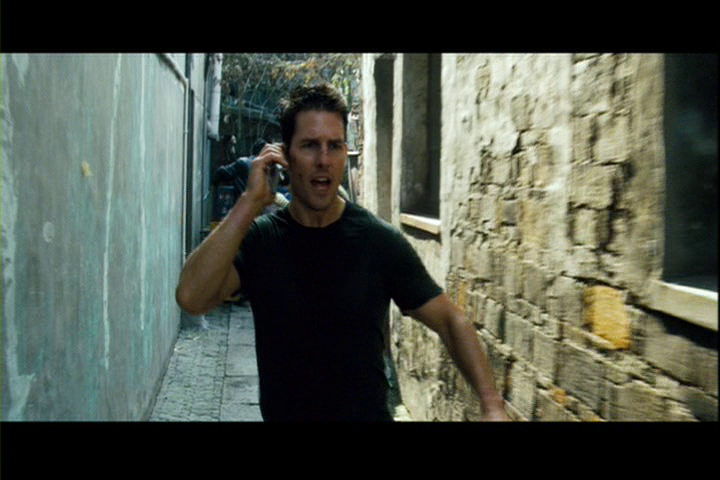
There follows a great chase through the streets of Shanghai, first with Declan and Zhen in pursuit of the parachuting Ethan, and then, when the collect him, with Ethan (and obviously Cruise, for real) hanging out of the vehicle shooting backwards at a pursuing car. That's impressive, as is another bit where a giant tanker truck skids sideways over Ethan. It's pretty great action against a pretty great backdrop, and that combination makes it the best sequence in the movie for me. Of course, all this action has only gotten our man the Rabbit's Foot; it hasn't saved Julia. For that, Abrams introduces a scene that will become a new staple of the series: the Long Run.

It could be argued, I suppose, that Ethan's doom-fraught dash through the streets of Prague in the first movie, trying and failing to get to each team member before they're killed, is a Long Run. But it's in too many different directions, with too many different stops along the way. So I'd call it a precursor at best to what Abrams sets up: a sequence in which Cruise needs to run at full bore for a great distance, always moving forward, inevitably against a ticking clock of some sort and ideally with Benji in his ear telling him where to go. This one ticks all those boxes, as Benji, back at headquarters because he is not yet a field operative, directs Ethan as he runs through residential Shanghai neighborhoods to the location where Julia is being held.

While this exciting run is followed by another fist fight (a fairly dull yet all too common ending to M:I movies), this one at least isn't bogged down by the unnecessary flipping and senseless slow motion that hampered Ethan's fight with Ambrose at the end of M:I-2. Instead this is a gritty, nasty throw-down with Davian. Philip Seymour Hoffman may have never actually been a physical match for the always athletic Tom Cruise, but he's a good enough actor that he certainly manages to convince us he is! His performance (reminiscent of his turn in Punch Drunk Love) is just so full of palpable menace that I damn well believe it each time he knocks Ethan down. (The odds are also evened a bit by the fact that Ethan has just run who knows how many blocks and—oh yeah—had one of those nose bombs implanted in his head!) Davian isn't a particularly well-developed character (he remains a cipher, albeit a brutal one), and doesn't even have a lot of scenes in the movie, but Hoffman so thoroughly occupies the ones that he is in that he easily becomes the series' best villain to date. (A record I'd say he probably still holds, though Rogue Nation's Sean Harris at least comes close.)

Despite being a civilian, Julia proves herself a remarkably competent and capable heroine when she basically saves the day after being saved by Ethan. Ethan actually dies for a little while in this movie, and Julia not only manages to (eventually) revive him, but also to slay quite a few more villains (including the turncoat IMF superior) in the time while he's dead! There's a brief moment in Mission: Impossible III where we get to glimpse her hanging out with the whole team (including Benji), and at the time it seemed to portend more... but sadly that wasn't to be, and her character was obviously taken in a different direction.


If M:I-2 suffered from an overabundance of style from a director who was ridiculously self-assured, Mission: Impossible III suffers from a relative lack of style from a director who's just discovering his. Abrams can tell a story like nobody's business (on its own enough to elevate the third film well above the second one), and he's good with character and hence good with actors (much better than Woo on this front), eliciting fine performances from all involved. But he's not (or at least wasn't at this point in his career) a master of building elaborate action scenes. Mind you, he's not bad at it, either, but most of the action direction feels a tad perfunctory. Used to television and having to stretch a small budget, he tends to rely heavily on close-ups during chase scenes and fights that require the camera to occasionally stand back and let the audiences get their bearings. Even simple conversations over-rely on close-ups, cutting from one face to another as dialogue is spoken (again, standard for TV), and rarely giving us a two-shot with both characters in focus at the same time. That said, the editing is good, and the shots are at least reliably steady and never so jerky (like all the imitation Greengrass stuff we see in this genre) that we can't tell what's going on. And I definitely prefer this sort of action to overwrought slow motion. But it would take another movie for us to get back to truly spectacular action where you can always tell who's where. And Abrams' palette is as cool as Woo's was warm, but just as monotonous. I did get a bit sick of blues and greens. 


Overall, Mission: Impossible III is a major step in the right direction. It's more of a team movie, with a few more nods to the TV show than the second movie had. It's got a great score that once again makes ample use of Schifrin, as any M:I score should. And it's got legitimate character development. But it also gets a bit bogged down in that character development. Ethan isn't Sidney Bristow. Audiences don't want to see him torn between action and home life; they just want to see him performing ever more impossible stunts! Abrams did exactly what he knew how to do expertly at that time. He delivered a terrific big-screen Alias movie, with the cast of Mission: Impossible. But even if that formula doesn't make for a perfect Mission, it proved the perfect stepping stone from which both the franchise and Abrams were able to reach stunning new heights.


The DVD and Blu-ray feature a surprisingly in-depth half-hour making-of. Sure, it’s largely EPK footage of people congratulating each other, but it’s also a fly-on-the-wall look at J.J. Abrams’ first feature directing experience. It shows how a lot of the stunts were done, what things were miniatures, and reveals that that Berlin factory where they rescue Lindsey is actually the same building where the pilot of Alias was shot! It's also worth noting that the documentary ends with a  piece of music not found in the movie that uses the Mission: Impossible theme. That's a rap with M:I-related lyrics called “Self Destruct” by Kid Beyond. I can’t find any information about this bizarre track online! With lyrics mentioning, “Retinal scanning procedure” and a chorus that goes, “Get ready for the self-destruct," it has more to do with the series than a lot of the pop songs on the second film's soundtrack.

There are also five short deleted scenes. Most are from the Berlin factory sequence, and it's easy to see why Abrams decided to cut that down and keep things moving quickly through the movie's first action scene. But one scene between Cruise and Crudup proves to be a pretty substantial omission, whose inclusion would have improved the movie's plot. Another shows a lot more of Maggie Q and her Lamborghini (never a bad thing!), which not only provides more eye candy, but also explains how her character gets into the Vatican, something resolved (somewhat confusingly) off-screen in the film.

The commentary with Abrams and Cruise contains many surprising revelations, like the fact that the famous Philip Seymour Hoffman dialogue in the opening scene (that was featured heavily in the film's marketing campaign) was originally shot as Eddie Marsan’s dialogue. Then they realized that it had to be Hoffman speaking and reshot it. Marsan's part became tiny, but it was definitely the right decision because it helps make Hoffman such a great villain. 


Mission Report
TV Moments: Loads—mostly from Alias, though, instead of Mission: Impossible! (Ethan's disguise as a priest does seem vaguely reminiscent of Martin Landau in the episode "The Cardinal," however.)
Dangling: There’s a classic horizontal dangle as Ethan descends the Vatican wall (winkingly acknowledging its own superfluousness, as opposed to M:I-2’s blatant and inferior copying)
Rogue Agents: Yes, it’s pretty clear that one of Ethan’s IMF bosses—Musgrave or Brasell—is a turncoat... sort of an Ipcress File situation.
Rogue Ethan: For sure. Locked up like Hannibal Lechter on nonsense charges by Brasell, he escapes to save his wife and somehow convinces his whole team to go along with him on this unsanctioned, personal mission.
Fashion Alert: Either the 2000s wasn’t a decade of particularly egregious trends, or we’re still too close to realize what was wrong. Happily, Ethan never sports an Ed Hardy T-shirt and neck tattoo, anyway!
The Long Run: Ethan has to run across most of Shanghai as the clock ticks down on Julia, and Benji directs him via cell phone.


Buy Mission: Impossible III on Blu-ray on Amazon.

Read my review of M:I-2 (2000) here.
Read my review of Mission: Impossible (1996) here.
Read my review of Mission: Impossible: The Seventh TV Season here.
Read my review of Mission: Impossible: The Sixth TV Season here.
Read my review of Mission: Impossible: The Fifth TV Season here.
Read my review of Mission: Impossible: The Fourth TV Season here.
Read my review of Mission: Impossible: The Third TV Season here.
Read my review of Mission: Impossible: The Second TV Season here.
Read my review of Mission: Impossible: The First TV Season here.