I never expected to see a Region 1 release of the 1989-90 ITV series Frederick Forsyth Presents, but thanks to Timeless Media Group, here it is! That awkwardly Photoshopped cover isn't representative of the six classy TV movies contained on 3 discs within. These movies are mostly based on novellas contained in Forsyth's book The Deceiver. Alan Howard (best known as the voice of the Ring in the Lord of the Rings movies) plays unorthodox spymaster Sam McCready, Forsyth's answer to George Smiley. McCready generally takes a backseat, however, to the people he's manipulating in each story. This formula enabled the producers to bring in big guest stars for each film, including Elizabeth Hurley, Lauren Bacall, Brian Dennehy, Beau Bridges, Chris Cooper, Phillip Michael Thomas, David Threlfall and Peter Egan. The ones I've seen are solid productions, and I'm not sure why this series isn't better known. It deserves a place beside other solid Forsyth adaptations like The Day of the Jackal (indeed, one of these stories concerns Carlos, the international terrorist the media dubbed "the Jackal" after Forsyth's book!), and especially the Pierce Brosnan and Michael Caine starrer The Fourth Protocol. (Fans of that film should definitely give this release a try.) This budget release, priced at just $14.98 (and even less on Amazon) will no doubt prove to be one of those nice little cheap gems for spy fans eager for more serious espionage dramas in the serious vein of le Carre. Since it's Valentine's Day, why not pick it up today for your spy-loving sweetheart?
You've probably seen, or at least heard of, last year's John Madden-directed, English-language version of The Debt starring Helen Mirren and Jessica Chastain. Maybe you've even picked up the recent Blu-ray. But have you seen the original Israeli film on which that one was based? If not, now's your chance. American spy fans can now see the 2007 version (originally titled Ha-Hov) of this spy thriller about Mossad agents on the trail of a Nazi war criminal in Cold War Berlin, and the present-day ramifications of their mission, on DVD thanks to MPI. This version is in German and Hebrew with English subtitles. I wasn't crazy about the remake, but I've heard good things about the original and I'm curious to see how the compare. Retail is $24.98, but it's only $14.49 on Amazon right now.
Additionally, the Warner Archive unleashed a wave of MOD spy fare this week.
British Agent is Michael Curtiz's epic 1934 spy romance set against the backdrop of the Russian Revolution. Leslie Howard is the titular British agent, and Kay Francis is a dedicated Communist who happens to love him... yet has orders to gather evidence against him that will surely lead to his death. Though this airs from time to time on TCM, I've never seen it. That cover, though, is pretty awesome, and makes me want to. British Agent is already available directly from the Warner Archive for $19.95, and available to pre-order from Amazon.
Forgotten funnymen Wheeler and Woolsey get up to 1930s-style antics in Diplomaniacs. The studio copy gives you some idea of exactly what those antics entail: "Whisked away by the oil-rich Oopadoop Indians, the pair are offered a million dollars by the chief of the tribe to represent them at the Geneva peace talks. What ensues is madcap hilarity on a steamship that goes in endless circles due to a drunken captain. The pair dodges assassination attempts and is spied on by the team of Schmerzenpuppen, Puppenschmerzen, Schmerzenschmerzen and Puppenpuppen!" If that sounds up your alley, Diplomaniacs is available today from Warner Archive and for pre-order from Amazon.
Straight-edge Efram Zimblast, Jr. leads the chase in the deadly serious 1960s Quinn Martin show The FBI, and The Second Season is available this week from the Warner Archive, split into Part One and Part Two, available this week from Warner Archive and to pre-order from Amazon. Part One features Mission: Impossible star Peter Graves as a guest star, along with Octopussy villain Louis Jourdan, On Her Majesty's Secret Service villain Telly Savalas and Archer's mom, Jessica Walter. A fact-based series, The FBI drew story ideas directly from the Bureau's actual casefiles, and J. Edgar Hoover himself served as a creative consultant up until his death in 1972. Like Dragnet, it's all a bit dry, but unlike Dragnet, the show frequently deals with espionage, since that falls within the Bureau's purview. You can actually watch one of those espionage-themed episodes, "The Courrier," guest starring a young Gene Hackman, for free right now. Warner Archive is streaming the episode here through February 17th.
Feb 16, 2012
Feb 15, 2012
Tradecraft: Ali Larter Flaunts Her Asset
Deadline reports that Heroes alum Ali Larter has scored the lead role on the Fox spy pilot The Asset. Larter will play photojournalist/spy (it's not just a cover; she's really passionate about her pictures) Anna King, billed as a "Human Intel Specialist" with behavioral insights similar to those of House or the Mentalist. But the far more interesting aspect of her character, and what separates her from similar TV spy heroines like Sydney Bristow or Annie Walker, is that she doesn't merely seduce her targets up to a point and then overpower them; she actually sleeps with them... and develops very complicated feelings about that. My pun may be lame as a headline, but I actually think the title Assets would better describe this show, since King herself (as she's always referred to) is an agent rather than an asset, and it seems like she'll recruit, run and otherwise use a number of individual assets (plural) over the course of the series. And, of course, she uses her own God-given assets to do so. And it's Fox, so puns like that should be par for the course! Limitless director Neil Burger is helming this pilot, from a script by Terminator: Sarah Connor Chronicles' Josh Friedman. Read more about The Asset here.
Tradecraft: New Universal Spy Franchise Born Out of Ludlum Collaboration
When Ludlum Entertainment changed its name to Captivate Entertainment, the intention was always to open up their production slate beyond just movies based on the novels of Robert Ludlum, but still in the same general tone and action-packed genre. At least one such project made it as far as a director attachment a few years ago, but has yet to materialize. Today, Deadline reports that another is moving forward. According to the trade blog, Universal has shelled out "high six figures" (against seven should the project come to fruition) for an untitled spy thriller pitch from writer Josh Zetumer, with Captivate's Jeffrey Weiner and Ben Smith attached to produce. The studio hopes the pitch can lead to a lucrative new spy franchise. Zetumer's collaboration with Smith and Weiner began in 2009 when the scribe was hired to pen one of two possible scripts for a fourth Matt Damon Bourne movie. (Series veteran George Nolfi was working on the other one.) Of course, when first Paul Greengrass and then Matt Damon exited the film, neither sequel script was produced, and instead the studio went a different direction, commissioning the "spin-off" movie The Bourne Legacy from Tony Gilroy (the teaser trailer for which was released last week). But Zetumer evidently impressed Captivate, leading to this new collaboration. In addition to writing a Bourne script and doing uncredited rewrites on Quantum of Solace, Zetumer also has an original spy script, The Infiltrator, set up at Warner Bros. with Leonardo DiCaprio attached.
Feb 11, 2012
Tradecraft: More Directors Board Spy Pilots
Earlier this week, Brett Ratner signed on to direct Fox's untitled teen spy pilot from Karyn Usher. Today, Deadline reports that feature directors Gavin O'Connor (Warrior, Miracle) and Neil Burger (Limitless, The Illusionist) will also helm spy pilots this season. According to the trade blog, O'Connor will direct The Americans for FX, and Burger will direct Fox's The Asset.
The Americans, first reported on back in December, is one of two spy scripts currently in pilot contention penned by Joseph Weisberg... which just happen to be the two spy shows in development that I'm most excited about and hopeful for. Weisberg himself is a former CIA officer turned writer, and author of the espionage novel An Ordinary Spy. His other show is that drama following assistants at various agencies in the Intelligence Community that Paul Greengrass is attached to produce and possibly direct. The Americans is a 1980s-set Cold War period piece that sounds positively fascinating. Newly relevant again after the 2010 bust of the Anna Chapman spy ring (so known because she was the hot redhead, not because she was the mastermind), it's about two KGB spies living as husband and wife in a Washington suburb. Here's how Deadline described it:
The arranged marriage of Phillip and Elizabeth Jennings grows more passionate and genuine by the day but is constantly tested by the escalation of the Cold War and the intimate, dangerous and darkly funny relationships they must maintain with a network of spies and informants under their control. Complicating their relationship further is Phillip’s growing sense of affinity for America’s values and way of life and the couple’s two children, who know nothing about their parents’ true identity.
That sounds positively fascinating to me. I really, really hope that O'Connor nails the pilot and FX picks it up. Incidentally, Weisberg is not the only name that might be familiar to spy geeks on this project. It's produced by Graham Yost, who today is probably most famous as the showrunner of FX's terrific neo-Western Justified. But to me, as a spy fan who came of age in the late 80s/early 90s, he'll always be the author of Spy-Tech, a kid-friendly non-fiction resource about the real-life tools of the spy trade, which I had on near-constant loan from the Waterford Library. (Eventually I got a copy of my very own, which I'm pretty sure is kicking around my LA apartment somewhere. I should dig it up.)
The Asset is more of a mystery as far as the information that's been put out there so far. According to its official, trade-quoted log line, it's "a character-driven drama set in the New York office of the CIA, which centers on a female agent." As I noted when I first reported on it last August, there's nothing in that description to differentiate the this show from countless others, most notably Alias and Covert Affairs. However, I recently read the script for the pilot by Josh Friedman (Terminator: The Sarah Connor Chronicles), and those comparisons sell it short. While the first act is shockingly similar to the Covert Affairs pilot (from the female agent's mysterious former boyfriend right down to the polygraph test), The Asset is actually a closer cousin to Homeland. Its protagonist, globetrotting photographer-cum-spy Anna King (usually known just as "King") shares a lot of issues, not to mention a 9/11 connection, with that show's Carrie Mathison (Claire Danes). But the twist I was wondering about, the thing that sets it apart from Alias and Covert Affairs, is not an easy one to express in a succinct log line, which is probably why we haven't heard it yet. Put simply, The Asset goes where those shows always stop short. While Jennifer Garner's Sydney Bristow certainly used her sexuality a lot on missions, that was usually limited to modelling bikinis and lingerie. Once the target was put off his guard by the vision of her in a teddy, she would knock him out and steal his microchip. King, however, is a slightly more realistic character who... goes that extra step. The Asset explores the psychology of a woman who sleeps with strange men for her country, her complicated emotions about that, and why she does it. We'll see if this bit makes it to the network broadcast, but in the script she's also bisexual. It's rare that we see female spies in popular culture (good ones, that is) allowed to sleep around as much as their male counterparts (Salt, for instance, was practically a neuter), let alone see that subject explored in an adult manner. I just have to wonder how this will all work for a network like Fox. It seems thematically better suited to cable. I'm certainly rooting for Burger to pull it off, though, because it's a solid spy script and I'd like to see where this series goes.
Feb 9, 2012
Video: Jean Dujardin Auditions for Various Spy Villain Roles
This Funny or Die video is pretty hilarious, and ably showcases Oscar nominee Jean Dujardin's ample comedy skills. Of course, spy fans (like French people) already knew those talents well from his two fantastic OSS 117 movies. But please bear with the rest of the world while they finally catch up, thanks to The Artist. I hope this video proves prophetic, and Dujardin enjoys thriving global stardom... but I hope it doesn't prove too prophetic, because I don't want future Bond or Die Hard roles to get in the way of another OSS 117 movie!
Read my review of OSS 117: Cairo Nest of Spies here.
Read my review of OSS 117: Lost in Rio here.
DVD Review: The Impossible Kid (1982?)
I promised something silly to break up all this serious John le Carré blogging of late, and here it is. I just couldn't resist the opportunity to jump from le Carré to Weng Weng, illustrating the unbelievably wide spectrum of the spy genre! Diminutive Filipino star Weng Weng, for those who don't know, managed to stretch the simple high-concept gag of “a midget James Bond” into possibly as many as five films in the early Eighties. (I reviewed the first one, For Your Height Only, a couple of years ago, here.) I say “possibly” because records of such things are apparently poorly kept in the Philippines, and as far as I can tell only two (maybe three) such movies actually found release in the United States. So nobody seems to be really sure—not even Andrew Leavold, the guy who’s writing his doctoral thesis on Filipino exploitation cinema and seems to be the West’s foremost authority on all things Weng Weng. He penned the actor’s mini biography on the IMDb, and if that’s to be believed, then it’s a biopic waiting to happen! (Or waiting for the right actor; the physical demands of playing a 2' 9" Filipino are fairly specific.) Apparently after the country finally tired of the one-gag film series, the movie roles dried up for Weng Weng, so the general in the Marcos regime who had made him an honorary secret agent years earlier decided to tap the former star to be a real secret agent, sent him to paratrooper school, and used him on actual infiltration missions where his tiny size was an advantage. If that story’s true, I think Weng Weng might be the only franchise spy star to later graduate to actual spying… which is pretty awesome.
![]() |
| I'll let Weng Weng's extraordinary hairdo remain the elephant in this room |
![]() |
| Two examples of Weng Weng's signature move |
![]() |
| Gadgets, Weng Weng-style: a handy pole |
![]() |
| This pole enables Weng Weng to injure two sets of testicles at once |
So what’s the plot? Well, that’s not easy to say. I don’t imagine it was ever very coherent to begin with, but the English language dubbing crew didn’t do it any favors, either, embracing (and extending) the silliness of the whole endeavor rather than trying to make sense of it. For all their effort, it might as well not even be dubbed. Watching The Impossible Kid and trying to follow its plot is just like watching an un-dubbed foreign exploitation film and trying to figure out what’s going on without the aid of subtitles. In the case of The Impossible Kid, it doesn’t really matter what language is being spoken on screen; confusing is a universal language. But here’s what I could discern: in a nutshell, there’s a bad guy in a white Klan hood (he looks sort of like the Hate Monger from Marvel’s Sixties Nick Fury comics) who delivers ultimatums like “he will die and then you all will die!” over a TV. I’m not really sure how he manages that in the pre-Skype era, but somehow he also manages to make the TV itself self-destruct afterwards to some Casio keyboard music that vaguely recalls the Mission: Impossible theme. At a certain point, the Casio player abandons attempts at flute-heavy James Bond or M:I music and instead starts ripping off the Pink Panther theme, which recurs throughout the rest of the film whether appropriate or not. (Alright, never appropriate.) Weng Weng’s boss responds to the threat by ordering his pint-size agent to “take his time,” and, as my friend pointed out, that’s exactly what he does. And it’s a strategy that's not really ideal for action movie pacing. There certainly aren’t enough turning points to satisfy Robert McKee. Rather than plot points per se, in fact, things just sort of happen. In that spirit, I’m going to get lazy with this review and just list some random observations:
• At one point, the bad guys throw a cobra at Weng Weng, and the actor, who usually remains impressively expressionless in any scenario, looks terrified. That sudden fit of acting leads me to believe that the Filipino production team really did toss an actual cobra at their tiny star.
• When a shoeless villain barks orders from the comfort of his luxurious home, it occurred to me that we don’t often see villains hanging around in their socks—much less indulging in maniacal laughter in their socks!
• At one point, Weng Weng’s interpretation of the order to take his time takes the form of kicking back and watching go-go dancers in a club, just like his regularly-sized poverty row spy brethren all over the world.
• People are always mistaking Weng Weng for a child, which is odd, because despite his height, Weng Weng does not look very youthful at all. “Oh, I’m sorry, sir,” exclaims an obsequious brothel proprietor when he realizes his mistake. “I didn’t know you were an adult!” To make up for trying to throw him out, he offers Weng Weng his pick of the girls, and they all swarm the poor munchkin, cooing excitedly. Weng Weng gets the same look on his face that the cobra induced, and then runs away like Short Round fleeing the harem in Temple of Doom.
Amusing though I found them, none of those moments really differentiate The Impossible Kid from For Your Height Only in any significant way. What that difference comes down to is this: For Your Height Only is the one with a jetpack. (Do yourself a favor and go take a look at the screengrabs of Weng Weng suspended from a cable in his little jetpack with that same look of cobra terror plastered on his tiny face. It’s easy to think of the poor guy as a human version of the Muppet Beaker, allowing himself to be subjected to stunt upon life-threatening stunt in a constant state of disquiet and agitation—all for the sake of his art.) The Impossible Kid is the one with the mini motorcycle. Yes, it’s a scooter of some sort specially built for someone of Weng Weng’s stature. Or maybe it’s a kids’ toy. Whatever its origin, it’s just fast enough to keep up with the junky trucks the bad guys drive, and those mischievous sound engineers have seen to it that the minuscule vehicle emits a hilarious buzzing noise that makes it sound like a wind-up toy. In this movie’s big stunt (one which really doesn’t compare to the great jetpack flight), Weng Weng jumps over a wide ravine on his pocket crotch rocket. That’s the stunt you’ll remember this film for—and not because it’s pulled off with any particular success.
Actually, there's another stunt that stands out too: at one point, Weng Weng makes a daring escape from one of the many bland, generic Manila tenements his missions tend to take him to by improvising a parachute out of a bed sheet. It's a good spy trick, oft-used, and perhaps a tad more believable with an agent of Weng Weng's height. While I sincerely doubt that Weng Weng jumped from the height depicted in the film, it's clear from the sheer terror etched on his minuscule visage (reminiscent once more of that "jet pack" expression) that the director made him jump from some height!
The other thing you might recall a day or two after seeing this movie is the indelible image of Weng Weng imprisoned in a bird cage on bad guy’s yacht. It’s funny, yet kind of degrading, and makes you feel a little sorry for the murderous Nick Nack (Hervé Villechaize), who suffered a similar fate at the end of The Man With the Golden Gun. But what will stick with you longer than any image is the infectious theme song, in which female vocalist Ruby Tia (the Phillipines' answer to Shirley Bassey, no doubt) croons, “Weng Weng, I love you, my Weng Weng!” over and over again. Unless my hearing was playing tricks on me, I think another lyric is, “he does some things.” And that pretty much sums up Weng Weng’s approach to spying. He does do some things. Sometimes.
Digiview Entertianment’s DVD delivers exactly what you’d expect of the slim-packed bargain titles you find in bins at drug stores (which is where I found it). The print is panned and scanned, and the picture is muddy at best, as you can see from these screencaps. Needless to say, there are no special features—though there is, surprisingly, a menu! For these reasons, I’d recommend Mondo Macabre’s DVD of For Your Height Only over The Impossible Kid to any spy fan looking to expand his or her horizons by viewing one Weng Weng movie—but not quite prepared to commit to two. That disc, while still full-screen (which may well be how these were shot), had a better picture, and the movie had a better centerpiece stunt. But for fans of midget secret agent cinema, The Impossible Kid delivers exactly what you expect from it: more of the same, and slightly cheaper.
![]() |
| One more advantage of being small: fire hydrants make great cover |
Feb 8, 2012
Bourne Legacy Trailer and Poster Unveiled!
Today, Universal afforded spy fans our first glimpse at Jeremy Renner in action as Matt Damon's Bourne replacement (though not playing the same character). And, not surprisingly, really... it looks good! Even without Rachel Weisz or any of the Phillipines footage we know they shot. So it's a very solid teaser... building slowly, revealing the new actor (you were expecting someone else?) and finally giving us a taste of some awesome spy action in a wintry setting without giving away much at all about the plot itself or spoiling too many of the film's highlights. One thing it does reveal, however, is David Straithairn. I don't recall previously reading that he would be reprising his Bourne Ultimatum role in this. Tony Gilroy's The Bourne Legacy (which is not based on any Robert Ludlum novel or Eric Van Lustbader's continuation novel of that name) opens on August 3, and I can't wait!
Watch the trailer in HD on the Apple site.
Feb 7, 2012
Tradecraft: Brett Ratner to Direct Fox's Teen Spy Pilot
According to Deadline, Brett Ratner (Tower Heist, After the Sunset) has signed on to direct the pilot for Karyn Usher's untitled teen spy drama at Fox. The project, centering on the orphaned teenage daughter of a CIA officer recruited to spy herself and mentored by a deadly and mysterious rogue agent, sounds sort of like a mash-up between Luc Besson's La Femme Nikita and The Professional. Last year, Ratner directed the slick but empty pilot for CBS's failed spy dramady CHAOS. Let's hope this one, assuming it gets picked up (and gets a title!), fares better.
Tradecraft: Philip Seymour Hoffman Tackles le Carré
Deadline reports that Mission: Impossible III villain Philip Seymour Hoffman is close to signing on to star in Anton Corbijn's previously announced John le Carré adaptation A Most Wanted Man. I haven't read the 2008 novel, but Hoffman and le Carré seem like a good match no matter what. (The author's high-brow spy fare is probably especially appealing to top caliber actors right now following Gary Oldman's well-deserved Oscar nomination for Tinker Tailor Soldier Spy.) According to the trade blog, Hoffman will play a rogue German spy chief who tries to piece together the complicated mystery surrounding a Chechen Muslim who illegally immigrates to Hamburg and may be at the center of an elaborate terror plot. I'm very excited to see how Corbijn, who directed the visually striking George Clooney assassin thriller The American, handles le Carré material. I guess I need to move that book to the top of my reading list. In the meantime, though, I need to post something really silly to get away from this non-stop stream of le Carré of late! Stay tuned for the silliness tonight or tomorrow.
Feb 6, 2012
I Spy Comics Collected
Spy Vibe points the way to some very exciting news for fans of Sixties spy television and comics: the long-awaited collection of Gold Key I Spy comics from Hermes Press is now officially on the publisher's schedule! Amazon lists the release date as June 19. The 256-page hardcover compendium I Spy: The Complete Series reprints all six issues of Gold Key's comic books based on the globetrotting Robert Culp/Bill Cosby TV series, as well as (per the publisher) "informative essays about the creative team behind the comic book and loads of never-before seen publicity photographs featuring stars Culp and Cosby." Paul S. Newman scripted the stories, and Al McWilliams and Mike Roy provided the art. SRP is $49.99, but you can pre-order this baby from Amazon for just $31.49 right now! Best of all, this book is hopefully just the tip of the iceberg for fans of Gold Key's TV-based Sixties spy comics. A Hermes representative told me at last year's Comic Con that the publisher hopes to follow their I Spy volume with subsequent collections featuring all the other Gold Key spy properties, including The Man From U.N.C.L.E. and The Girl From U.N.C.L.E., and I think the Dell ones as well, like Mission: Impossible. I can't wait!
DVD Review: A Murder of Quality (1991)
Note: This article contains minor spoilers about the book A Murder of Quality (but not the movie).
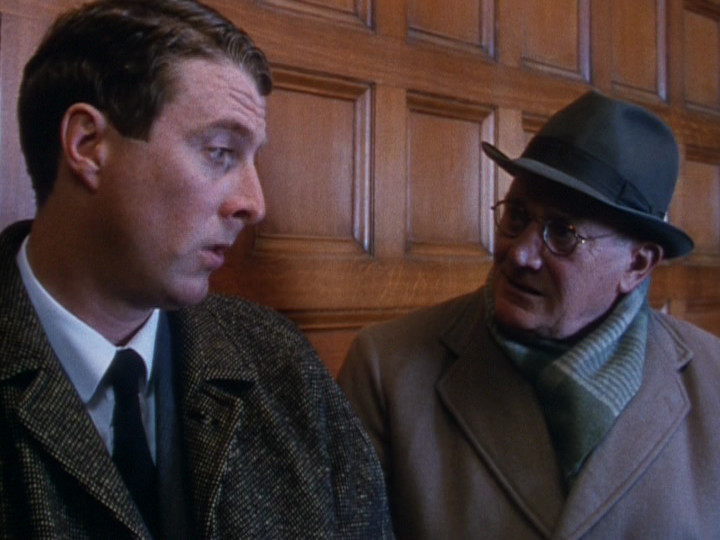
John le Carré’s second Smiley novel, 1962’s A Murder of Quality (review here), wasn’t adapted for the screen until nearly thirty years after its publication. It must have come as a surprise to readers and viewers when the feature-length television adaptation popped up so long after the fact. It’s possible that the BBC had been brainstorming how best to bring Smiley back to the screen ever since Smiley’s People scored so well with audiences and critics alike in 1982. Was an adaptation of 1989’s The Secret Pilgrim considered as a vehicle for Alec Guinness to return to the role? It would be a problematic novel to adapt, but I can’t imagine the prospect wasn't at least bandied about. Perhaps it was and Guinness turned it down. Whatever the case, that wasn’t made and TV producers were probably wondering how they could possibly top the big budget international production of Smiley’s People… and realized that they couldn’t. But if they went back to that second novel, a rich little period mystery set at a prep school, then they wouldn’t have to compete with past Smiley TV adaptations. It was small enough—and different enough—that direct comparisons would be unlikely. Of course that’s all pure speculation. Perhaps the impetus came from le Carré himself. As it happened, A Murder of Quality didn't come from the BBC, but from Thames Television, and it's a far different animal from the sprawling miniseries Tinker, Tailor, Soldier, Spy and Smiley’s People.
Since A Murder of Quality isn’t a spy story and isn’t set at the Circus, the only series character involved is George Smiley himself. Denholm Elliott (Codename: Kyril, Indiana Jones and the Last Crusade) is quite good in the role (and certainly looks the part), playing a more seemingly befuddled Smiley than Guinness. It’s almost as if every actor who’s ever tackled the role has chosen to focus on a different aspect of the literary Smiley’s personality. If you could assemble them all together into some avant garde production along the lines of Todd Haynes’ Bob Dylan biopic, I'm Not There (which featured multiple actors portraying separate aspects of the musician’s persona), you would have a complete representation of the character from the books. If James Mason is the Smiley the Lovelorn Cuckold and Alec Guinness is Smiley the Introvert and Gary Oldman is Smiley the Ruthless, then Elliott is Smiley the Fool. Of course, the fool is just a disguise for Smiley—a Lord Peter Wimseyish defense mechanism—and Elliott conveys that well. But it’s certainly a legitimate aspect of the literary Smiley. Elliott’s Smiley is Smiley as he’s perceived by people who don’t know better.
Le Carré himself penned the screenplay for A Murder of Quality… and, surprisingly, he wasn’t the most faithful of adaptors. It’s a weird experience watching this TV version right after reading the book, because the differences stand out more than the similarities. A lot of the same material is still there, but it’s been shuffled around, and good lines have been redistributed to different characters. It’s not that it’s been shortened (which wouldn’t be necessary for such a slim volume), but rewritten. This is the rare opportunity to witness an author with a chance to rewrite his second novel thirty years later, and observe exactly what he would have done differently. Personally, I preferred the original.
In his introduction to later editions of the novel, le Carré said, “Rereading the book now, I find a flawed thriller redeemed by ferocious and quite funny social comment.” For the screenplay he clearly accentuated the social comment, but it loses some of its bite in being moved to the fore. If he attempted to “fix” the thriller elements, he didn’t do a very good job. The mystery becomes more obvious in the film, and the cleverest part (involving a letter case behind) is streamlined so as to remove all the fun of the clue. Even the primary suspect in the murder mystery is changed. In the book, we’re led to always suspect the victim’s husband, Stanley Rhode (David Threlfall), because he’s mentioned in his late wife’s letter—the letter that gets Smiley involved in the case to begin with. And for all the reader knows, he could have done it. But in the movie, we see him, through a subjective camera, come home alone and discover his wife’s body and react, so we’re reasonably certain all along that he did not commit the crime! And, unfortunately, that doesn’t leave too many viable red herrings.
We also learn about Stella’s true nature much sooner in the movie than in the book—pretty much right away, in fact, which seriously dulls one of the novel’s biggest surprises and leaves us with a much more conventional Agatha Christie-type mystery. But because of the lack of red herrings and misdirection, it’s a lot more predictable than your typical Christie mystery. While the omission does streamline the plot, the book’s ingenious misdirection doesn’t seem to have been cut for the sake of time; what fit in a 150-page novel should fairly easily translate to a 90-minute drama. Instead, I suspect that le Carré purposely pared away a lot of the story’s “thriller” aspects in order to allow the social satire to better shine.
Indeed, he keeps much of his best (which is to say, nastiest—and funniest) dialogue verbatim, though while the lines were mostly Shane Hecht’s in the book, many have now been awarded to other characters, as Shane is a fairly minor role in the film. In fact, le Carré now gives the murderer some of Shane’s best lines, in order to accentuate his or her own class consciousness and drive home the already biting critique of the British class system. The move rather backfires, though, I’m afraid. In moving the social satire to the foreground, the author’s motives become too transparent. Such commentary works best when it’s surreptitiously inserted into other genres (like mystery) and takes the reader or viewer by surprise. When it’s the whole point of the piece, it loses a good deal of impact.
While I understand why Shane Hecht’s dialogue was redistributed, I don't understand why in the movie le Carré takes away some of Smiley’s actions and gives them to other characters, actually making his hero less proactive! That seems like an odd choice, and somewhat diminishes Smiley’s character.
All of my complaints, however, derive from direct comparisons to the book. Judged on its own merits, A Murder of Quality makes a handsome one-off in the PBS Mystery! mold (on which it originally aired in America), likely to satisfy most fans of British period detective shows. Director Gavin Miller (Foyle's War) creates a pleasing atmosphere and takes full advantage of his locations; whatever actual school stood in for Carne does a good job. There’s a first rate cast, too, including Joss Ackland as house Master Terrance Fielding (brother of one of Smiley’s wartime compatriots), Glenda Jackson as the former colleague who involves Smiley in the mystery, Ailsa Brimley, and a young Christian Bale (The Dark Knight) as one of the boys who unwittingly holds a vital piece of the puzzle. Diane Fletcher does a fine job as a slightly defanged Shane Hecht, but I can’t help imagining how wonderfully Maggie Smith might have channeled the character from the novel (with all her lines intact, hopefully). Ah well. What might have been. Matthew Scurfield is also good as Smiley’s police contact, Inspector Rigby.
Solid cast and high production values aside, though, the finished product is undeniably lightweight. As a television drama, A Murder of Quality is even less essential Smiley than the book. It’s still worth watching for serious Smiley fans, however, just to see Denholm Elliott’s take on the character. I quite like it, but wish we could have seen him in something a bit more substantial—like, maybe, another crack at Call for the Dead. As a spy story, that one might have drawn more inevitable comparisons to the Guinness miniseries, but I have to wonder if there might have been plans to film it with Elliott after A Murder of Quality had the actor's health held up? (He died a year later.) As things stand, his sole contribution to the Smiley Files is limited to this rather insubstantial television movie.
The Region 1 A&E DVD offers an adequate, if grainy (as expected for UK TV productions of that era) presentation, and is thankfully uncut. (There’s some surprising female nudity, which I can’t imagine made it into the original PBS broadcast.) Other than some text features on the author and the actors, there are no special features to speak of.
The Smiley Files
Part 1: George Smiley: An Introduction
Part 2: Movie Review: Tinker Tailor Soldier Spy (2011)
Part 3: Book Review: Call for the Dead (1961)
Part 4: Movie Review: The Deadly Affair (1966)
Part 5: Book Review: A Murder of Quality (1962)
Labels:
Books,
Detectives,
DVDs,
John Le Carre,
Movies,
Nineties,
Reviews,
Smiley,
TV
Feb 2, 2012
First Pictures Emerge From Ben Affleck's Spy Movie Argo
A little over a month ago, The Hollywood Reporter unveiled the first photograph of Ben Affleck playing self-described CIA "Master of Disguise" Antonion Mendez in his fact-based tale of a daring hostage rescue in Iran, Argo. If his book
is to be believed, Mendez was something of a real-life equivalent of Mission: Impossible's Jim Phelps. Indeed, the rescue plot he came up with, which involved agents posing as a film crew shooting a fake sci-fi movie, sounds right out of that TV show. Further solidifying the connection, today the Huffington Post revealed another still from the movie... and this shot of Affleck briefing his team in a living room instantly makes me think of the obligatory team briefing in Jim's apartment that begins every episode of Mission: Impossible. Perhaps the connections are entirely unintentional, but this is shaping to look up like a really fun spy movie either way.
Feb 1, 2012
Book Review: A Murder of Quality (1962)
Part 5 of an ongoing series, "The Smiley Files," examining the career of George Smiley in literature and film. Read my introduction to Smiley here.
John le Carré’s second novel, A Murder of Quality, features George Smiley, but it doesn’t feature any spying. While Smiley finds himself either pushed out of the Circus (le Carré’s sobriquet for British Intelligence) or resigning from it in disgust in nearly every novel he appears in, A Murder of Quality is his only adventure that occurs entirely outside of the Circus, and doesn’t feature any of its staff—not even stalwart Peter Guillam. Instead, Smiley is called upon by an old friend and wartime intelligence colleague, Aisla Brimley, to investigate the murder of one Stella Rode, a junior teacher’s wife at an exalted English public school, the fictional Carne. While Smiley may be somewhat out of his element here, the author is decidedly not out of his. Because while a detective story isn’t necessarily a spy story, nearly all of le Carré’s spy stories are detective stories.
In Call for the Dead (review here), Smiley is an investigator attempting to solve a murder. The circumstances in which it happened and the people involved put that particular murder in the realm of Smiley’s department (though he resigns from it early on and acts as a private citizen for most of the novel) rather than the police, but his methodical investigation is very much in the tradition of Sherlock Holmes’ or Hercule Poirot’s investigations. And le Carré’s careful plotting very much follows the classical mystery structure, revealing one clue at a time, along with plenty of red herrings and misdirection. Later Smiley novels follow the same formula. Smiley’s People is another out-and-out murder investigation. In that one, Smiley’s called out of retirement (yet again) to probe the murder of an agent he used to run, a trail which will eventually lead him to his old nemesis, Karla. Tinker, Tailor, Soldier, Spy is a similarly structured detective story (again beginning with Smiley being summoned out of retirement), only the mystery is uncovering the identity of a mole rather than a killer. Still, the process is the same: a meticulous search for clues and a methodical study of the facts at hand. Even The Honourable Schoolboy has a mystery at its core—the mystery of Karla’s Hong Kong Gold Seam. (I'm glad le Carré didn't call it that, thought!) A Murder of Quality, therefore, is hardly treading unique narrative territory for the author, although the public school setting is unique for the character.
As Otto Penzler points out in his introduction to the Walker edition, Smiley is a natural detective, in the same league as Holmes and Poirot and all of their ilk. It somehow makes sense to see him tackle the same sort of case those titans would attack.
Smiley approaches detecting the same as he does spying. “It had been one of Smiley’s cardinal principles in research,” le Carré writes, “whether among the incunabula of an obscure poet or the laboriously gathered fragments of intelligence, not to proceed beyond the evidence. A fact, once logically arrived at, should not be extended beyond its natural significance. Accordingly he did not speculate with the remarkable discovery he had made, but turned his mind to the most obscure problem of all: motive for murder.” Smiley’s investigation is a textbook approach that would do his literary forebears proud, and once again le Carré proves a master of the form, doling out clues with enough regularity to make the problem solvable for the reader, but at the same time obscuring them with enough misdirection to make arriving at a conclusion difficult.
On the eve of her brutal murder, Mrs. Stella Rode wrote to Brimley’s agony column in a small nonconformist newspaper and expressed that she suspected her husband was trying to kill her. Thus her husband, Stanley Rode, seems the prime suspect when Smiley arrives on the scene, letter in hand for the local police. (As in Call for the Dead, he works hand-in-hand with an official detective.) However, despite the letter, Smiley quickly discovers a heap of evidence suggesting that Rode couldn't have done it. A whole assortment of suspects present themselves as the spy-cum-detective moves about in the halls of academia and the odd, fiercely class-conscious social circles of Carne.
Despite crafting a perfect mystery story, however (complete with a final false solution every bit as surprising and satisfying as the one in Tinker, Tailor), le Carré is less concerned about his genre than he is about his characters and themes. As with many of his spy novels, the thriller conventions here are merely a clotheshorse on which to hang a hilariously vicious condemnation of the British class system as cultivated in Etonian institutions—and with which to explore a handful of memorable, deeply flawed and deeply human characters.
The best dialogue comes from the characters for whom the author clearly feels the most contempt. Witness, for example, the venomous, socially-obsessed don’s wife Shane Hecht’s remembrances of the deceased: “Stella Rode was such a nice person, I always thought . . . and so unusual. She did such clever things with the same dress. . . .” Later, “I went to tea with Stella once. Milk in first and Indian. So different.” It’s clear that for someone like Shane Hecht, “different” could never be a compliment.
Or, on the subject of funerals: “I hate funerals, don’t you? Black is so insanitary. I always remember King George V’s funeral. Lord Sawley was at Court in those days, and gave Charles two tickets. So kind. I always think it spoilt us for ordinary funerals in a way. Although I’m never quite sure about funerals, are you? I have a suspicion that they are largely a lowerclass recreation; cherry brandy and seed cake in the parlour. I think the tendency of people like ourselves is for a quiet funeral these days; no flowers, just a short obituary and a memorial service later.”
For Shane Hecht, the author tells us, people exist “to be found wanting in the minute tests of social behavior, to be ridiculed, cut off, and destroyed.” A woman who collects the shame of others, she’s got Smiley’s number, too. She corners him at a dinner party and makes it clear what she thinks of this outsider in her hallowed circle:
One character succinctly sums up the discrepancy between Smiley’s looks and his intellect: “Looks like a frog, dresses like a bookie, and has a brain I’d give my eyes for.” It’s certainly possible that the author feels the same way about his character. He may ridicule him in his descriptions, but at the same time I suspect le Carré may want to be Smiley as much as Ian Fleming wanted to be James Bond. Fleming’s alter ego was a man of action who lived the adventures the author dreamt of during his deskbound war—a classic schoolboy fantasy; le Carré’s alter ego is a man of intellect, but perhaps more crucially, a man of staunch convictions that the author, belonging to another generation who never fought a noble war, simply cannot subscribe to. If Smiley is a clergyman, le Carré is the lapsed parishioner who envies his faith, but is himself incapable of such devotion. But the later books better illustrate Smiley’s convictions.
At a scant 152 pages, A Murder of Quality is a breezy read. It’s light-weight entertainment with a fun mystery and some biting social satire sure to have readers laughing aloud, but it’s certainly not essential le Carré. Die-hard fans of Smiley will enjoy seeing the familiar character in an unfamiliar setting and recognize recurring themes in the author’s work, but newcomers to the le Carré canon are encouraged to seek out his more substantial, far more essential work first—like Tinker, Tailor, Soldier, Spy, The Spy Who Came in from the Cold, or even Call for the Dead.
The Smiley Files
Part 1: George Smiley: An Introduction
Part 2: Movie Review: Tinker Tailor Soldier Spy (2011)
Part 3: Book Review: Call for the Dead (1961)
Part 4: Movie Review: The Deadly Affair (1966)
Part 5 of an ongoing series, "The Smiley Files," examining the career of George Smiley in literature and film. Read my introduction to Smiley here.
John le Carré’s second novel, A Murder of Quality, features George Smiley, but it doesn’t feature any spying. While Smiley finds himself either pushed out of the Circus (le Carré’s sobriquet for British Intelligence) or resigning from it in disgust in nearly every novel he appears in, A Murder of Quality is his only adventure that occurs entirely outside of the Circus, and doesn’t feature any of its staff—not even stalwart Peter Guillam. Instead, Smiley is called upon by an old friend and wartime intelligence colleague, Aisla Brimley, to investigate the murder of one Stella Rode, a junior teacher’s wife at an exalted English public school, the fictional Carne. While Smiley may be somewhat out of his element here, the author is decidedly not out of his. Because while a detective story isn’t necessarily a spy story, nearly all of le Carré’s spy stories are detective stories.
In Call for the Dead (review here), Smiley is an investigator attempting to solve a murder. The circumstances in which it happened and the people involved put that particular murder in the realm of Smiley’s department (though he resigns from it early on and acts as a private citizen for most of the novel) rather than the police, but his methodical investigation is very much in the tradition of Sherlock Holmes’ or Hercule Poirot’s investigations. And le Carré’s careful plotting very much follows the classical mystery structure, revealing one clue at a time, along with plenty of red herrings and misdirection. Later Smiley novels follow the same formula. Smiley’s People is another out-and-out murder investigation. In that one, Smiley’s called out of retirement (yet again) to probe the murder of an agent he used to run, a trail which will eventually lead him to his old nemesis, Karla. Tinker, Tailor, Soldier, Spy is a similarly structured detective story (again beginning with Smiley being summoned out of retirement), only the mystery is uncovering the identity of a mole rather than a killer. Still, the process is the same: a meticulous search for clues and a methodical study of the facts at hand. Even The Honourable Schoolboy has a mystery at its core—the mystery of Karla’s Hong Kong Gold Seam. (I'm glad le Carré didn't call it that, thought!) A Murder of Quality, therefore, is hardly treading unique narrative territory for the author, although the public school setting is unique for the character.
As Otto Penzler points out in his introduction to the Walker edition, Smiley is a natural detective, in the same league as Holmes and Poirot and all of their ilk. It somehow makes sense to see him tackle the same sort of case those titans would attack.
Smiley approaches detecting the same as he does spying. “It had been one of Smiley’s cardinal principles in research,” le Carré writes, “whether among the incunabula of an obscure poet or the laboriously gathered fragments of intelligence, not to proceed beyond the evidence. A fact, once logically arrived at, should not be extended beyond its natural significance. Accordingly he did not speculate with the remarkable discovery he had made, but turned his mind to the most obscure problem of all: motive for murder.” Smiley’s investigation is a textbook approach that would do his literary forebears proud, and once again le Carré proves a master of the form, doling out clues with enough regularity to make the problem solvable for the reader, but at the same time obscuring them with enough misdirection to make arriving at a conclusion difficult.
On the eve of her brutal murder, Mrs. Stella Rode wrote to Brimley’s agony column in a small nonconformist newspaper and expressed that she suspected her husband was trying to kill her. Thus her husband, Stanley Rode, seems the prime suspect when Smiley arrives on the scene, letter in hand for the local police. (As in Call for the Dead, he works hand-in-hand with an official detective.) However, despite the letter, Smiley quickly discovers a heap of evidence suggesting that Rode couldn't have done it. A whole assortment of suspects present themselves as the spy-cum-detective moves about in the halls of academia and the odd, fiercely class-conscious social circles of Carne.
Despite crafting a perfect mystery story, however (complete with a final false solution every bit as surprising and satisfying as the one in Tinker, Tailor), le Carré is less concerned about his genre than he is about his characters and themes. As with many of his spy novels, the thriller conventions here are merely a clotheshorse on which to hang a hilariously vicious condemnation of the British class system as cultivated in Etonian institutions—and with which to explore a handful of memorable, deeply flawed and deeply human characters.
The best dialogue comes from the characters for whom the author clearly feels the most contempt. Witness, for example, the venomous, socially-obsessed don’s wife Shane Hecht’s remembrances of the deceased: “Stella Rode was such a nice person, I always thought . . . and so unusual. She did such clever things with the same dress. . . .” Later, “I went to tea with Stella once. Milk in first and Indian. So different.” It’s clear that for someone like Shane Hecht, “different” could never be a compliment.
Or, on the subject of funerals: “I hate funerals, don’t you? Black is so insanitary. I always remember King George V’s funeral. Lord Sawley was at Court in those days, and gave Charles two tickets. So kind. I always think it spoilt us for ordinary funerals in a way. Although I’m never quite sure about funerals, are you? I have a suspicion that they are largely a lowerclass recreation; cherry brandy and seed cake in the parlour. I think the tendency of people like ourselves is for a quiet funeral these days; no flowers, just a short obituary and a memorial service later.”
For Shane Hecht, the author tells us, people exist “to be found wanting in the minute tests of social behavior, to be ridiculed, cut off, and destroyed.” A woman who collects the shame of others, she’s got Smiley’s number, too. She corners him at a dinner party and makes it clear what she thinks of this outsider in her hallowed circle:
“The only Smiley I ever heard of married Lady Ann Sercombe at the end of the war. She left him soon afterwards, of course. A very curious match. I understand he was quite unsuitable. She was Lord Sawley’s cousin, you know. The Sawleys have been connected with Carne for four hundred years. The present heir is a pupil of Charles; we often dine at the Castle.” For a moment the noise in the room stopped. For a moment, no more, he could discern nothing but the steady gaze of Shane Hecht upon him, and knew she was waiting for an answer. And then she released him as if to say: “I could crush you, you see. But I won’t, I’ll let you live,” and she turned and walked away.Yes, this is very much the same Smiley we know and love from the other books. In addition to being hopelessly devoted to an absent wife, he’s “toad-like,” and “short and plump, with heavy spectacles and thinning hair,” and “the very prototype of an unsuccessful middle-aged bachelor in a sedentary occupation” whose “natural diffidence in most practical matters was reflected in his clothes, which were costly and unsuitable, for he was clay in the hands of his tailor, who robbed him.” Yet he’s also capable, when he finally corners the killer, of the same sudden ruthlessness we later witness on occasion in the Karla Trilogy. That doesn’t mean, however, that he has a taste for such things. “He had come to the end of the chase, and was already sickened by the kill.”
![]() |
| Image from swallace99's flickr photostream |
At a scant 152 pages, A Murder of Quality is a breezy read. It’s light-weight entertainment with a fun mystery and some biting social satire sure to have readers laughing aloud, but it’s certainly not essential le Carré. Die-hard fans of Smiley will enjoy seeing the familiar character in an unfamiliar setting and recognize recurring themes in the author’s work, but newcomers to the le Carré canon are encouraged to seek out his more substantial, far more essential work first—like Tinker, Tailor, Soldier, Spy, The Spy Who Came in from the Cold, or even Call for the Dead.
The Smiley Files
Part 1: George Smiley: An Introduction
Part 2: Movie Review: Tinker Tailor Soldier Spy (2011)
Part 3: Book Review: Call for the Dead (1961)
Part 4: Movie Review: The Deadly Affair (1966)
Labels:
Books,
Detectives,
John Le Carre,
Reviews,
Sixties,
Smiley
Network DVD Sale: Last Day!
Cold Light of Day Poster
We saw the intriguing trailer yesterday; today, thanks to the Imp Awards, we have a glimpse at the 1-sheet for the Henry Cavill/Bruce Willis (yes, in that order) spy movie The Cold Light of Day.
First Official Still From SkyFall
Though Empire previously touted an image of Daniel Craig from behind in another tiny blue swimsuit sitting at the edge of a blue-lit pool as the first official still from the 23rd James Bond film, SkyFall, the producers apparently didn't consider that to be the case. Officially, this image revealed today on 007.com is the first still from SkyFall. It's certainly more traditionally Bondian: we have an exotic location (Shanghai), a classic pose and a classic gun. A purist at heart, I'm glad to see Bond packing the Walther PPK again, even if it is an impractical antique, as some firearms enthusiasts claim. The return to the PPK was one of the few good things Mark Forster brought to Bond on Quantum of Solace. But this image isn't all traditional! Glaringly non-traditional for James Bond is the beard Craig sports. It's not a surprise, since we've already seen paparazzi shots of a bearded Craig filming in London, but it's still sort of jarring to see it in an official, purposefully composed photo. Previously, Bond has only ever sported a beard (of the Robinson Crusoe variety) after a period of long captivity in North Korea at the beginning of Die Another Day. Unlike that one, this neatly-trimmed facial hair appears to be a purposeful choice on Bond's part, and not the result of lengthy torture. As non-traditional as it is, I'm not against the beard... just commenting on its irregularity. Craig pulls it off... and manages to still look very Bondian. We know, of course, from other set photos, that the actor does not have a beard in every scene in SkyFall. I'm curious to learn its purpose and its placement in the film. All told, this is a pretty cool picture. And I like that that logo at the bottom kind of makes it look like a trading card. You can see it in super-high resolution on the official website.
Subscribe to:
Posts (Atom)