Showing posts with label Callan. Show all posts

Jan 30, 2015

Listen to Red File for Callan On BBC

BBC Radio aired the first installment of a 4-part abridged reading of James Mitchell's Red File for Callan this week, and for the next month you can listen online. Red File for Callan (originally published as A Magnum for Schneider) was the novel that introduced the world to David Callan, one of the great antiheroes of the spy genre. Mitchell adapted it twice for the screen, first as an episode of Armchair Theater (which actually predated publication of the book) that served as the pilot to the Callan TV series, and later as the feature film Callan, both starring the incomparable Edward Woodward. But the novel is fantastic in its own right, and deserving of a place alongside the better known likes of Deighton and Freemantle in the canon of working class spy fiction. While abridged versions are never the best way to read (or listen to) something, Ben Miles does quite a good job narrating, and free is infinitely preferable to the inexplicably steep price of the unabridged Story Sound audiobook (which is itself quite excellent if you can find it more cheaply).
UPDATE! And... you can get it more cheaply right now! When I composed this post last night it was its usual exorbitant $64.95, but at this moment it's available on Amazon for 88% off... just $7.86! At that price, go buy this unabridged audiobook right now! Buy it! Now! You won't regret it. Who knows how long this amazing deal will last.

Read my review of Acorn's Callan: Set 1 here.
Read my review of Acorn's Callan: Set 2 here.
Read my review of Network's Callan: The Monochrome Years here.

Nov 12, 2013

Spyship Finally Sails Onto DVD

Spyship, the critically revered 1983 BBC Cold War drama from (in part) Callan creator James Mitchell, is finally available on DVD for the first time next week in the UK courtesy of distributor Simply Media. I've never seen this series, but as a huge fan of Callan (and of 1980s UK spy dramas), I've long wanted to and happy that now I finally can. Here's how Simply Media describes the plot:
Enter a nightmarish world of political cover-ups of international consequence in the last decade of the Cold War in this six-part BBC drama. 
When an ordinary British fishing vessel and its 36-man crew mysteriously disappears off the coast of Norway, journalist Martin Taylor (Tom Wilkinson) is determined to find out why. His father was on board, and is now missing. 
His investigations soon lead him to run up against the twin barriers of Royal Navy stonewalling and an impenetrable Soviet Politburo.
The notorious finale shocked audiences when it was first aired in 1983. 
Spyship is based on the fictional novel by Brian Haynes and Tom Keene, former reporters who researched the real life sinking of the FV Gaul in 1974 which was shrouded in mystery.
The Region 2 PAL 2-disc set is available to pre-order from Amazon UK for £15.82; it comes out on November 18.

Dec 10, 2012

Upcoming Spy DVDs: Innocent Bystanders

Wow! I never really expected to see Innocent Bystanders on DVD, let alone on Blu-ray! But in early 2013, Olive Films will release the 1972 spy film starring Stanley Baker (The Man Who Finally Died), Donald Pleasence (You Only Live Twice), and Sue Lloyd (The Baron), on both DVD and Blu-ray. And that's awesome. Innocent Bystanders was directed by The Italian Job's Peter Collinson and based on a novel by Callan creator James Mitchell. (Mitchell wrote several books about secret agent John Craig, played by Baker in the film.) Bond veterans Vladek Sheybal and Cec Linder also appear. This violent tale of betrayal and espionage is one of the most sought-after titles among spy fans of this era, and I can't wait for this release on February 19, which will be in 1.77:1 widescreen. In the meantime, you can now stream the fullscreen version on Amazon. Now if only someone would give us a Region 1 release of the Callan movie!

Nov 5, 2012

Network Spy Sale

Network, the awesome UK DVD company responsible for the Region 2 releases of so many classic spy series and ITC adventure shows, is currently running an all-spy sale called their "Shadow State Sale." It's a great opportunity to pick up some fantastic serious spy shows, like Callan (review here), The Sandbaggers and Danger Man, at reasonable prices! Network's Callan releases include the reunion telefilm "Wet Job" and what survives of the original monochrome series (review here), neither of which have been released in Region 1 to date, so American spy fans with all-region players should take note. Another notable Edward Woodward title included in the sale is the 80s miniseries Codename: Kyril (review here), which had been out of print for a while and is well worth seeking out! Further great titles on sale include the excellent Mr. Palfrey of Westminster (which contains bonus material not found on the Region 1 release reviewed here), The Quiller MemorandumThe Ipcress File (also with bonus material not found in Region 1), and the Sixties anthology series Espionage, among others. I'm not sure how long The Shadow State Sale runs for.

Jul 28, 2011

More Sixties Spies in Latest League of Extraordinary Gentlemen Comic

Alan Moore's latest volume in his excellent comic book series The League of Extraordinary Gentlemen (illustrated by Kevin O'Neill), like 2007's Black Dossier, features a host of well-known (and lesser-known) Sixties spies. The conceit of the series is that it takes place in a world inhabited by fictional characters. Some play major roles (James Bond featured heavily in Black Dossier, even though Moore did the character an injustice in his portrayal) and some just pop up randomly in small roles or background cameos. (George Smiley was seen assisting a Control-like M in Black Dossier, and John Drake and Toby Meres got quick mentions in dialogue.) Most of the Sixties TV spies in the new volume, Century: 1969, fall into the latter category.

Here, I feel I should issue a SPOILER WARNING. I promise I will not reveal any plot points, but one of the enjoyments in reading these comics is spotting the cameos as you go, so if you don't want to know in advance, read no further. If you want some heads-up as to who to look out for, or if you're not planning on reading it anyway, read on for just a few of the amusing references...

MINOR SPOILERS FOLLOW:
In the latest volume, which takes place (as the title indicates) in 1969, David Callan's smelly associate Lonely turns up as an informant for the sharp-dressed gangster Carter, from the Michael Caine movie Get Carter. Carter's relationship with Lonely is a mirror of Callan's. In the background of one panel, James Bond and Simon Templar appear to have had a small fender bender at a gas station. Bond's Aston Martin has rear-ended The Saint's Volvo (with its ST1 license plate), and Bond (looking a lot more like Sean Connery than the from-the-books design artist O'Neill gave him in Black Dossier) looks ready for some road rage as he swings his golf club at the unflappable Templar (in the well-coiffed guise of Roger Moore). Adam Adamant looks on as he gasses up his Mini. Adamant turns up again, later, in a discotheque with some funny dialogue. There are numerous Avengers references, including a copy of The Winged Avenger available from a news agent and a direct reference to the villain from the Cathy Gale episode "Warlock." (Sadly neither Steed nor any of his partners make a physical appearance that I could spot, though Emma played a large part in Black Dossier.) I was shocked that, as far as I could tell, there was no appearance by Jason King. Of all the Sixties ITC characters, he probably fits into Moore's universe better than anyone else - and embodies the spirit of Swinging London better than anyone else as well!

Apr 14, 2011

New Spy DVDs Out This Week and Last

Farewell
I was very curious about this fact-based French spy film when it got limited theatrical release late last year, but I didn't have the opportunity to see it.  I look forward to rectifying that now that it's available on DVD and Blu-ray from Terra. Director Christian (Joyeux Noël) Carion's film traces the true story of a KGB defector who enlisted the unwitting aid of a French engineer working in the Soviet Union during the 1980s to smuggle secrets (including ones pertaining to American national security) out of the country to French intelligence. The DVD retails for $24.98 and the Blu-ray for $34.98, though both are significantly cheaper on Amazon, as usual.

Arabesque
Moving from harrowing true spy stories to fluffy ones of the most escapist variety, we come to the mod, ultra-Sixties confection Arabesque. Though it's been available for some time as part of the boxed set The Gregory Peck Collection, Stanley Donen's 1966 follow-up to Charade was finally issued on its own last week (along with a Peck mystery of similar vintage, Mirage). Try as it might, Arabesque doesn't quite recapture Charade's particular magic, but Gregory Peck and Sophia Loren make charming and attractive stand-ins for Cary Grant and Audrey Hepburn, and the story of a college professor caught up in psychedelic intrigue involving a beautiful spy and Middle Eastern politics is still plenty of fun. And "psychedelic" is the operative word, even if you wouldn't expect it to be used in the same sentence as "Gregory Peck." Donen gleefully taps into the zeitgeist of the moment, and that wonderfully dated view of Swinging London is a big part of what makes the film so appealing today. (You can see plenty of examples in this article on SpyVibe.) Universal's single-disc release of Arabesque (on DVD only) is a steal at the MSRP of just $14.98... but it's even cheaper than that on Amazon.

Thanks to Collin for the heads-up on that one... and I'm sorry I took so many weeks to finally act on it!

Any Human Heart
Any Human Heart based on the acclaimed novel by William Boyd, is only partially a spy story, but it does involve James Bond creator Ian Fleming as a character.  The miniseries, which recently aired in American on PBS' Masterpiece, follows a writer named Logan Mountstuart as his life intersects with a number of famous figures, including Fleming (played by Casino Royale's Tobias Menzies), Ernest Hemingway (Foyle's War's Julian Ovenden), Wallis Simpson (Johnny English Reborn's Gillian Anderson) and her husband the Duke of Windsor (Hanna's Tom Hollander). Mountstuart is played at different points during his life by Sam Claflin, Spooks/MI-5's Matthew Macfadyen and Jim Broadbent.  Hayley Atwell (one of the few highlights of the 2009 Prisoner remake) also stars.  Menzies' Fleming only appears in a couple of scenes, though one is a key moment when, as assistant to the Director of Naval Intelligence, he assigns Macfadyen's Mountstuart to a wartime spy mission involving Wallis and Edward. The DVD, from PBS, contains all four episodes as they originally aired in the UK, not the re-edited 3-episode configuration seen on American TV. It also includes a wealth of special features, including interviews with Boyd and the actors, an On Set featurette, and deleted scenes. Retail is $29.99, though it can currently be had for half that on Amazon.

Callan: Wet Job
The most exciting spy release of the last few weeks, however, has to be the 1981 Callan reunion telefilm "Wet Job," which is finally available on DVD! (In the UK, anyway, as a PAL Region 2 release from Network.) It didn't get included as a bonus feature in Network's Callan: The Colour Years, but now it sees its first ever legitimate home video release as a standalone.  Despite being scripted by series creator James Mitchell, "Wet Job" doesn't have a very good reputation.  (Even Edward Woodward disparaged it in his commentary on the Acorn release Callan: Set 2.) That said, fans of the series (and, really, any spy fan should be a fan of this amazing series) will still rejoice to be able at last to own this elusive postscript to one of the best serious spy shows of all time.  Retail is £14.99, but it's currently much cheaper on Amazon.co.uk. Bear in mind, though, that next Ocotober the company will issue Callan: The Definitive Collection, a 12-disc megaset collecting every surviving black and white episode from seasons 1 and 2, every color episode from seasons 3 and 4, the original Armchair Theatre pilot play, "A Magnum For Schneider," "Wet Job," a brand new Callan documentary and a definitive book on the series by Andrew Pixley. That will retail for £99.99 (though it's currently available to pre-order for £69.99). It's great that Callan will finally get Network's usual special feature treatment, but at the same time no doubt annoying to fans who have already purchased The Monochrome Years and The Colour Years on their own. Hopefully the company will make the documentary available individually as well, as they have done in the past with their Prisoner and Saint documentaries. Fingers crossed! In the meantime, I'm absolutely thrilled that I'll finally be able to see "Wet Job," even if I know it won't be up to the standards of the show itself. This is the spy release of the spring!

Feb 2, 2011

Upcoming Spy DVDs: The Edward Woodward Hour

In addition to the upcoming release of the Callan reunion telefilm "Wet Job" (still not officially announced, but available to pre-order on Amazon), it looks like Network has another treat for Callan fans up its sleeve.  It's The Edward Woodward Hour, and Edward Woodward variety show from the Seventies.  Yes, you read that right.  I think Network can do a better job of explaining it than I, so I'll let them do their thing. But don't give up now, Callan fans; be sure to read through.  There really is a spy aspect to this odd release!
Though primarily known as a serious actor, drama was only one of the strings to Edward Woodward’s bow. A significant proportion of his stage work included musicals and music-themed shows, gaining him a Variety Club award for the Best Performance in a Musical. Singing was undoubtedly one of the great loves of his life, and his strong tenor voice graced numerous best-selling albums – the enthusiasm for his work shining through.

With the success of Callan, Woodward became a household name – this popularity giving him the chance to show his lighter side in three light entertainment specials in the early 1970s for Thames Television. Sadly only the first one still remains in the archive, but it ably showcases Woodward’s whimsical side; jokes and music abound, while his guests in this show include Beryl Reid, Patrick Cargill and Russell Hunter. The highlight of the show, however, is the Callan vs Father, Dear Father sketch – something that no self-respecting Callan fan can be without!
Callan vs. Father, Dear Father sketch??? The tense Woodward spy drama versus the Patrick Cargill sitcom?  What the who? I can't imagine what that is, but this I've got to see! Unfortunately, the original transmission master for this surviving special no longer exists, so Network has used an off-air recording, meaning that the quality won't be top-notch, but at least we'll have the opportunity to see this weird obscurity!

The Edward Woodward Hour, a PAL Region 2 DVD, will be available on March 28. Retail is £15.31, but it will be available from Network's website for £9.18. (Odd price points.)

Jan 8, 2011

Upcoming Spy DVDs: Callan: Wet Job

The 1981 Callan reunion telefilm "Wet Job" is finally headed to DVD! It didn't get included as a bonus feature in Network's Callan: The Colour Years, but this March the UK company will release it on its own. This marks the first ever legitimate home video release of "Wet Job."  Despite being scripted by series creator James Mitchell, "Wet Job" doesn't have a very good reputation.  (Even Edward Woodward disparaged it in his commentary on the Acorn release Callan: Set 2.) That said, fans of the series (and, really, any spy fan should be a fan of this amazing series) will still rejoice to be able at last to own this elusive postscript to one of the best serious spy shows of all time.  While the title hasn't yet been officially announced by Network, an Amazon UK listing shows the release date for the Region 2 PAL disc as March 28, 2011.  Retail is £14.99, but it can be pre-ordered from Amazon right now for just £8.99. Then (also according to Amazon), next Ocotober the company will issue Callan: The Definitive Collection, a 12-disc megaset collecting every surviving black and white episode from seasons 1 and 2, every color episode from seasons 3 and 4, the original Armchair Theatre pilot play, "A Magnum For Schneider," "Wet Job," a brand new Callan documentary and a definitive book on the series by Andrew Pixley. That will retail for £99.99 (though it's currently available to pre-order for £69.99). It's great that Callan will finally get Network's usual special feature treatment, but at the same time no doubt annoying to fans who have already purchased The Monochrome Years and The Colour Years on their own. Hopefully the company will make the documentary available individually as well, as they have done in the past with their Prisoner and Saint documentaries. Fingers crossed! In the meantime, I'm absolutely thrilled that I'll finally be able to see "Wet Job," even if I know it won't be up to the standards of the show itself. This is great news!

Read my review of Acorn's Callan: Set 1 (comprising the first color season) here.
Read my review of Acorn's Callan: Set 2 (comprising the second color season) here.
Read my review of Network's Callan: The Monochrome Years (comprising the two original black and white seasons) here.

Nov 8, 2010

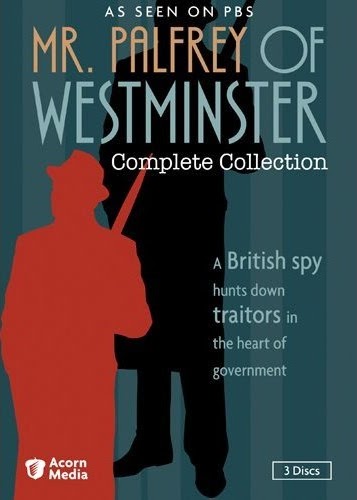
DVD Review: Mr. Palfrey of Westminster: Complete Collection (1984-1985)

DVD Review: Mr. Palfrey of Westminster: Complete Collection (1984-1985)

Mr. Palfrey of Westminster stars Alec McCowen (posh and prim and a million miles from his performance as Never Say Never Again’s errant Q, Algernon) as a likable but cooly calculating civil servant–the sort of civil servant who’s tasked with ferreting out traitors within Her Majesty’s Government, not the sort who budgets unemployment benefits. He’s the same sort of civil servant as George Smiley, and the sort readers of this blog like watching shows about. You know the sort. As of the series’ first episode, he finds himself reporting to a new boss known only as “the Co-ordinator,” a self-described “Iron Lady” for the Thatcher era played by the Iron Lady of the Star Wars universe, Caroline Blakisten (Mon Mothma in Return of the Jedi). I suppose in 1984, long before Judi Dench became M and before Stella Rimington became the first publicly acknowledged Director General of MI5, this alone made Mr. Palfrey of Westminster somewhat unique. It doesn’t now, but luckily the show has other distinctions, foremost among them being McCowen himself, who makes for a mesmerizing lead. Rounding out his tiny department, Mr. Palfrey relies on a perpetually tardy secretary named Caroline (Briony Thorne) to help with research and an antisocial, scarily helmet-haired hard man named Blair (Clive Wood) to do his legwork.

Mr. Palfrey of Westminster: The Complete Series occupies an interesting place in the history of spy pop culture. It was the 1980s genre contribution from some powerful creative forces behind a few of the more serious spy classics of the Sixties and Seventies, who seemed keen to revisit the genre each decade. George Markstein (who in his day logged some secret service of his own for Her Majesty) and Phillip Broadly, both of whom worked on Danger Man, each contribute to Mr. Palfrey of Westminster. Markstein also worked (rather briefly, owing to a disagreement with Patrick McGoohan) on The Prisoner and, more relevantly, on Callan. Mr. Palfrey can be seen as the logical 1980s extension of Danger Man and, particularly, Callan, though it is really nothing like either of those shows. For one thing, it doesn’t focus on a field man, as they both did. Instead, the hero is a desk man, a relative rarity in the world of spy TV. (Alec Guinness’s George Smiley is the obvious antecedent.) For another, Mr. Palfrey’s operations seldom end in violence the way that Callan’s inevitably do–which isn’t to say that they all end happily for everyone concerned. But that’s because the unnamed department for which Mr. Palfrey works is not the one tasked with such dirty tricks. That, in fact, is still “the Section,” as it was in Callan’s day. The Section is fully operational in Mr. Palfrey’s world as well, suggesting that the two series in fact occupy a shared universe. The Section is mentioned in the first episode, “Once Your Card Is Marked” (penned by Markstein), and it appears to have adjusted to the changing times of the 1980s as well as any other branch of British Intelligence; for a start, it now employs female assassins. It’s just as deadly as ever, though, and Mr. Palfrey doesn’t seem to agree with their methods. I would have loved to see the new Hunter make an appearance and go toe-to-toe with Mr. Palfrey’s formidable boss, the Co-ordinator, but sadly that doesn’t happen. Oh well.

Even if his office does have a window and he doesn’t shoot targets or light bulbs or people, Mr. Palfrey does share some common characteristics with David Callan. Foremost among them, he is never satisfied with the meager bits of information provided by his superiors. Like Callan, Palfrey asks questions and demands answers he isn’t entitled to. Like Callan, he likes to know the reasons that he’s asked to do the things he does. He doesn’t seem to be afflicted by the same bouts of conscience that Callan wrestles with, but then his particular methods aren’t likely to leave him with a conscience as guilty as Callan’s. He is conscientious to a degree, but he’s also practical. His own reasoning for demanding all the facts from his higher-ups is that if he’s not in possession of those facts, however damning to Her Majesty’s Government, then he can’t perform his job to the high standards he and his masters hold him to. The problem is, there are a lot of damning facts, and a lot of factions in the Government and intelligence community, and they never want anyone knowing all of those facts.

The series may have technically begun with a pilot (“The Traitor”) that aired as part of Storyboard (which is included in Network’s Region 2 release), but I can’t imagine what happened in that pilot as Mr. Palfrey meets all the key players for the first time in the first proper episode of the show. His world (established as quiet and ordered in a mis-representative credits sequence so subdued that it must have alienated all but the staunchest PBS devotees when it first aired in America, and will no doubt turn off any modern viewer) is turned upside down when Mr. Palfrey’s old superior interrupts his vacation by recalling him to London and explaining that there’s been a shake-up in the Secret Service hierarchy. Palfrey has a new superior, the female Co-ordinator (a Thatcherian personality capped by an immovable Princess Diana hairdo), a new secretary and by the end of the episode a new helper, in the person of Blair. At first it looks like his relationship with the Co-ordinator will be a rocky one, but after some sparks in the premiere it rather disappointingly settles into generic convention. There’s something intangible missing from Palfrey’s relationship with the Co-ordinator during the show’s first season, a certain spark we expect from spy and spymaster whether their relationship is generally cordial (007 and M) or strained (Callan and most of the Hunters). I think it may be because the producers saw the mere act of casting a woman in that role as earthshattering enough on its own that they didn’t feel the need to add any further elements. Perhaps in its day it was earthshattering (although I rather doubt it), but today–especially after a decade and a half of a woman playing the most famous fictional spy boss of all–it isn’t. Or perhaps I’m just too tempted to put their frigid yet polite relationship up against Edward Woodward’s tension-laden encounters with William Squire, which isn’t really fair, but there you are. Fortunately, Mr. Palfrey’s relationship with his superior becomes more interesting in the second season–particularly in the final couple of episodes.

Mr. Palfrey himself is quite a compelling character, though, and certainly not dependent his boss as a foil. It’s tempting to compare him to Smiley because of their similar job descriptions and similar ages (and, personally, because I mixed up the two characters when I was a kid), but Palfrey is better dressed and more smug than Le Carré’s hero, even if he’s equally unassuming in appearance and disarming in nature. He shares with Smiley a classical education and a gift for tradecraft and strategy (and I suspect he could quote some German poetry were it ever demanded of him), but he’s more of a showoff who would rather let his co-workers and superiors know how he achieves his brilliant victories than keep those victories and methods from the world like the paranoid and secretive George Smiley. In “Once Your Card Is Marked,” he’s handed a traitor on a platter, already identified and investigated by another department, and asked to deal with him. Palfrey is appalled because that’s not what he does; he’s used to conducting the investigations himself. He starts off his relationship with his new boss by demanding answers he’s not allowed to have (and which even she may not be privy to), and unsatisfied by the field work of the other department, begins his own rogue investigation of the subject. Sure enough, all is not what it seems.
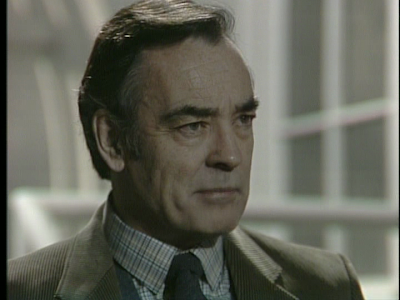
Genre veteran Richard Johnson (Deadlier Than the Male) guest stars as a general having an affair with a young Czech student (and friend of his daughter’s) in the second episode, “The Honeypot and the Bees.” Is she an agent? Is he being used? Is he turning traitor? Or is it something else entirely? Once again, Mr. Palfrey isn’t satisfied with easy answers and goes well beyond his brief to divine the truth. Truth is important to Palfrey. How it’s used is not his business, but he likes to be sure of things for himself. “The Honeypot and the Bees” doesn’t exactly boil over with excitement, but it does manage to feel realistic and offers an interesting insight into the sometimes surprising purview and methodology of the world of counterintelligence.

A genuine Bond villain adds star power to the third episode, “The Defector,” when Julian Glover guest stars as a famous Soviet writer who wants to defect to the West. The Co-ordinator is eager to hold a press conference and use his defection as a coup, but it doesn’t smell right to Palfrey. Fearing embarrassment, he pleads with her to hold off on such formalities while he conducts an investigation of his own and an interview with the subject. He finds himself in one of those classic spy scenarios often explored on Callan of trying to identify whether a potential defector is for real or not. If he’s not, in this case, the result won’t compromise the intelligence services, but it could prove exceedingly embarrassing for the United Kingdom from a diplomatic standpoint. The dialogue-heavy cat-and-mouse game between McCowen and Glover makes this the best episode of the first season.

Episode 4, “A Present From Leipzig,” turns out to have quite an interesting plot as well, even if it’s set into motion by a highly unlikely coincidence. The Co-ordinator’s acquisition (for a pittance) of a priceless Russian ikon at a Portabello Road stall leads Palfrey to the trail of a wealthy businessman with a taste for fine living and pretty young men. When those young men are from the East (where the tycoon makes frequent business trips), questions are raised.

There are only four episodes in Season 1, so Disc 2 of Acorn’s 3-disc Complete Collection kicks off the second season. If the first season was good, but fairly inconsequential, the second really takes it up a notch. The second season of Mr. Palfrey of Westminster goes from merely compelling television to essential television for fans of the more cerebral side of the spy genre.

“Freedom From Longing” kicks things off by finally injecting a small bit of humanity into the formerly unknowable Blair, who’s loath to offer it. None from Mr. Palfrey, though, who while outwardly more sociable than Blair remains as cool and calculating as ever. When the Co-ordinator dares to intimate that he might have be too personally involved in a case directly involving his subordinate to be objective, Mr. Palfrey says she knows him as little as Bunny Kingston, the clueless head of a rival department investigating Blair for possible treason.

While investigating a defense contractor with high security clearance who’s engaging in an affair with a suspicious Czech woman, Martina, Kingston discovers that the same woman was once involved with Blair. That throws suspicion on him as well, but rather than coming right out and sharing his suspicions with Mr. Palfrey or the Co-ordinator, Kingston follows a more oblique strategy and requests that Blair be temporarily seconded to his department, claiming he’s short of staff. Palfrey sees through the ruse at once, sure that Kingston’s up to something but not yet certain what. When Blair reluctantly reveals his connection to the subject of the investigation over drinks, Palfrey begins to formulate a picture of what Kingston’s up to, and he doesn’t like it. He doesn’t like it because Kingston cut him out of the loop, though, not because Kingston suspected a trusted employee of his to be a traitor. On that count, Palfrey disappoints Blair by asking him flat out if he became compromised in any way. Blair, inhuman as he usually is, takes offense at his superior’s apparent lack of trust, but Mr. Palfrey is, as always, pragmatic. He posits that in his view, one can never trust anyone completely in this profession.

It’s fascinating to watch these two consummate, nearly robotic professionals having a conversation on matters of the heart (“I think I loved her, whatever that means,” Blair clinically reports). They are not men accustomed to emotion. Nor is the Co-ordinator, despite her sex, and she sums up the episode’s theme neatly: “Sexuality and emotions. What dangerous things they are.” The spycatchers–er, civil servants–of Mr. Palfrey of Westminster have trained themselves to be immune to such human weaknesses–and largely to the humanity that normally accompanies them.

“Freedom From Longing” plays a bit like one of the more personal episodes of Mission: Impossible that the show experimented with in its fourth and fifth seasons, but goes for an honest exploration of spooks’ emotions instead of melodrama. Palfrey makes an odd decision at the end of the episode, effectively sabotaging another department’s operation on a hunch that is never borne out. It’s kind of rare to see the hero of one of these Desk Spy stories–be they TV or book–be the one responsible for that sort of childish political in-fighting. From the point of view of the story, it’s a kind of frustrating decision because we never find out if he was right or not, but from a character perspective it adds another interesting dimension to Mr. Palfrey.

“Return to Sender” guest stars Leslie Phillips as a sort of Guy Burgess-like defector, Rupert Styles. Actually evoking each of the Cambridge spies in some way, Styles is charming, artistic, upper-class (naturally), homosexual (or occasionally bi-), Cambridge educated (again, naturally) and quintessentially English. This last quality, which supposedly made it impossible for Philby or Blunt to ever fully adjust to retirement in Moscow (despite importing The Times), draws Styles back to Britain. He figures that he’ll be too much of an embarrassment to certain Government officials to face arrest, and expects to fade unnoticed back into a louche life in the English countryside. What he doesn’t count on is that his new situation is actually equally embarrassing to London and Moscow, and the Co-ordinator ends up collaborating with her Soviet counterpart to make sure Styles is returned to Russia–one way or another. It’s up to Palfrey, of course, to figure out what way that is, and the episode becomes a battle of wills between him and Styles, with the latter foolishly calling Palfrey’s every bluff. The ultimate resolution is disappointingly predictable, but the story is more about the two men’s interaction than the actual operational technique.

Episode 7, “Music of a Dead Prophet,” is one of the show’s best. A Marxist historian has written a new book supposedly exposing a British-backed assassination plot from the 1950s, against an Iranian general. The Government doesn’t want the book to come out, and it comes down to Mr. Palfrey to apply pressure and make sure it doesn’t. But someone beats him to the punch, and tries to kill the author–rather publicly–before he can do anything. The author, naturally, starts making rather loud noises, making Palfrey’s job that much tougher. How do you put toothpaste back in the tube? The secrets seem to be getting out. But who is behind the attempts on the academic’s life? Is it another faction within the British Intelligence establishment? And if so, is the action official–or unsanctioned? Could it be some slick politician carefully covering his own tracks? Or is it the CIA, who seem to have their own reasons for interest in this affair? The mysterious Arab factions poking around? Or someone else entirely? Palfrey is convinced that in order to answer that question, he must know if the allegations are true or not. But those in the know are reluctant to reveal that information, and claim that it is irrelevant to his job, which is to follow orders and not to ask questions–and suppress the book at all costs. You’d think the Co-ordinator would have learned by now that Mr. Palfrey does, indeed, tend to have a very good reason for demanding the answers he does.

“Music of a Dead Prophet” serves up one of the more outlandish plot twists in the series (one that would be perfectly at home on Mission: Impossible or The Avengers), but remains within the realm of plausibility. The high stakes and somewhat over-the-top methodology on display make it stand out, in a good way, from all the other decidedly more sedate episodes. When you apply restraint across the board, things that play as commonplace in less realistic espionage shows suddenly carry a lot more weight. It’s a good trick, and one which would make this episode a rewarding–if not entirely representative–watch on its own for any spy fan. But it works much better in the context of its series at large.

The eighth episode, “Official Secrets,” is equally strong, but much more down-to-earth, back in Le Carré territory. (Seriously, it plays like a mini-Le Carré adaption in just one hour, which would be impossible with any of the author’s actual works ) It’s not surprising that it’s one of the best, as it’s written by Geroge Markstein. In fact, the plot could easily have come from an unused Callan outline: a retired spy-hunter is kicking up a fuss and threatening to go public with some allegations he lodged in secret two decades earlier concerning the loyalty of certain public figures. The general consensus around Whitehall seems to be that the old coot’s gone nuts, and many agree that he needs to be silenced before he does any real damage. As usual, Mr. Palfrey’s not so sure. He grants a bit more credence to the retired spook’s wild claims, and insists on picking up the man’s old investigation–against orders–even if he has to do it on his own. But even if the Angleton-like figure is correct, will it do more harm than good exposing a traitor now?

It’s notable that Palfrey has far more personnel at his disposal in this episode than usual. In fact, the Co-ordinator balls him out for calling in five surveillance teams at once to track a particularly slippery customer. Up until this point, Blair has appeared to be a team of one when it comes to surveillance for Mr. Palfrey’s department.

One thing that separates Mr. Palfrey from some of his Serious Spy brethren is that he is an unapologetic member of the upper class. The Serious side of the genre seems to generally favor lower class heroes like Callan or Harry Palmer, often exposing traitors of the same elite society that produced Kim Philby and his ilk. To do so, these heroes often must contend with irritating Old Etonian bosses, eager to protect the reputations of their own. Even George Smiley, an Oxford man himself and a member of the genuine upper class by marriage, sometimes seems positively cockney in comparison to the slick Etonian politicians who surround him, flaunting their CBEs and OBEs and all viciously scrapping for the elusive KBE. Mr. Palfrey, on the other hand, makes no excuses for his own upper class status. In fact, though we know little about his background, he seems to aspire to a slightly higher station than that of a mere civil servant. This episode celebrates his inner snob, from its beginning which finds Palfrey shopping for walking sticks in his favorite haberdashery/umbrella store, clinging to that last Steed-like vestige of the proper English gentleman. And when confronted with the prospect of bringing in a member of his own club, he exclaims, “Good Heavens, man; we can’t arrest you in here. This is a gentlemen’s club ” One can’t help speculate that George Smiley mightn’t have been quite so accommodating. Callan and Palmer would have downright relished making such an arrest!

The winning streak continues through the end of the set. There really isn’t a bad episode in the entire second season. “Spygame” might generate a few unintentional chuckles inherent in any plot dealing with computers (as such plots always become dated almost as soon as they’ve gone to air), but it’s solid stuff, and the computer aspect actually proved prescient, not only in the future of spying but in the future of recreation as well. Mr. Palfrey finds himself investigating a Ministry of Defense engineer with a penchant for war gaming. (Like Callan, Palfrey himself appears to enjoy the hobby as well.) But the young man under suspicion, Thruxton, uses–get this–computers for his gaming. Hooked up to “modems” that communicate with other gamers’ computers! “Fascinating!” beams Palfrey. Imagine that.

The wargaming looks awfully suspicious to the CIA, who claim that Thruxton is leaking secrets via his modem. Mr. Palfrey isn’t so sure. Is it just innocent gaming that looks bad in the eyes of the Security Services when coming from an MOD employee? Or has a ruthless spy ring figured out the perfect way to smuggle secrets disguised as innocent gaming? Or is something else entirely going on? With the CIA, a suspicious West German and an international hitman involved, there’s definitely something going on, and it’s up to Mr. Palfrey, as usual, to discern exactly what.

If there is a spy in their midst, the Co-ordinator would certainly prefer that the British (meaning Palfrey) clean house themselves rather than letting the CIA do it for them. But Mr. Palfrey suspects that the Americans have their own agenda, and are using his service to achieve its ends. It certainly seems like they might be running a messy wetworks operation in London behind the backs of British Intelligence.... As those ingredients alone (which are mixed very well indeed) should probably convince most readers, “Spygame” is a pretty terrific episode.

The series goes out on a high note with Episode 10, “The Baited Trap,” which finds the Russians playing classic espionage games as their charming London Station Chief, Baliev (Clive Francis, with whom the Co-ordinator has occasionally collaborated since “Return to Sender”) feeds Palfrey’s chief information about a British double agent. But can the KGB man or his intel be trusted? And is the Co-ordinator human after all–and susceptible to Baliev’s charms? Palfrey’s caught in the middle, and stuck investigating an old friend–a very wily old friend with a neat trick for protecting his drawer of secrets that ensnares even Blair. Things come to a head between Palfrey and Co-ordinator in “The Baited Trap,” and he even assigns Blair to follow her. He’s ultimately uncharacteristically forgiving, though, and at one point in the course of the episode tries to talk the Co-ordinator out of resigning–and even compliments her. “There are times, Madame,” he admits,’” when you’re quite heroic.”

Mr. Palfrey of Westminster is certainly an entertaining spy series, particularly for fans of the Smiley school, and its place in the annals of spy TV history is assured by its connection to Callan. But is it essential, like that show? No, not quite essential, but it’s certainly enjoyable. Desk men, I think, work best either in conjunction with strong field counterparts (as on The Sandbaggers) or else in more complex stories that stretch out over multiple episodes (Tinker, Tailor, Soldier, Spy). I love the notion of “Smiley meets Mission: Impossible,” which is not an inaccurate description of the series, but Mr. Palfrey’s more realistic, down-to-earth methods of entrapment simply lack the pizzazz of Jim Phelps’ outlandish plans which propel so many standalone hours of television. It’s rather difficult to make the unrelated, weekly adventures of a Desk Man seem all that essential, but by Season 2 of Mr. Palfrey of Westminster, Markstein and his colleagues certainly come close. Your enjoyment of the series will ultimately depend on what kind of spy fan you are, and what you look for in a good spy show. If you’re only after Bondian action and adventure, stick with The Man From U.N.C.L.E. and its ilk. If you prefer your spies on the surreal side, stick with The Avengers and The Prisoner and The Wild Wild West. But if you also enjoy the sly games of oneupsmanship and subtle political maneuvers, if you like the serious side of the genre and particularly if you enjoy the British upper crust setting so ripe for spy stories, then you’ll find a lot to like on Mr. Palfrey of Westminster. I wholeheartedly recommend it to fans of Callan or George Smiley. It might not quite rank essential spy television, but it’s definitely compelling spy television, near the top of the heap.

Oct 18, 2010

Upcoming Spy(ish) DVDs: Edward Woodward In Whodunnit?

It's not "Wet Job," but it's a Callan reunion of sorts in Whodunnit?, a unique panel gameshow from the Seventies hosted by Edward Woodward on which Russell Hunter (Lonely on Callan) is one of the guests.  And it's coming to Region 2 DVD this fall from NetworkWhodunnit? challenged celebrity contestants to solve a fictional murder mystery.  I'm not familiar with the show myself, but UK readers who were around in the Seventies probably remember it.  Here's Network's description: "The show’s brilliantly original formula, devised by comedians Lance Percival and Jeremy Lloyd (and revived in the 1990s for Cluedo), presented short dramas laden with clues to be pieced together by the panellists, who would then question the characters involved and finally point the finger at the most likely suspect; lively repartee was the order of the day." Other guests appearing on the first season (which is what you get, along with the pilot, on this 2-disc set) include James Bond author Kingsley Amis and real-life private eye Anne Summer.  The PAL Region 2 DVD comes out on November 29 and retails for £19.99, though it will be available from Network's website discounted to just £11.99.

Jun 17, 2010

Upcoming Spy DVDs: Edward Woodward In Codename: Kyril

Wow, this is a very pleasant surprise!  I only ever happened upon the existence of Codename: Kyril while researching Edward Woodward for my obituary of the great Callan actor.  From the title, it was clear that it was a spy movie, so I read about it on the IMDb and immediately wanted to see it, but that wasn't possible as it's not currently on DVD anywhere, apparently.  Well, that changes on July 26 when the spy fan's savior Network releases it on Region 2 DVD in Britain!  But that's not the surprise.  The surprise for me was learning that Codename: Kyril was not merely a TV movie, as stated on the IMDb, but a four-part miniseries!  And that is the version that Network is releasing, Codename: Kyril: The Compete Series, not the truncated movie version.  Which means that there is now a whole other Edward Woodward spy series to look forward to, one whose existence I never even knew about!  (It originally aired in 1989, while he was still The Equalizer.) Regular readers will know that I've long loved Network for their uncanny ability to resuscitate even the most obscure long-dead spy series on DVD.  But I had no idea that it was within their power to actually create new old spy shows out of the ether, as they appear to have done here!  I know next to nothing about Codename: Kyril, but I'm suddenly over the moon anticipating it!  Since I've confessed such ignorance, however, I'll let Network's own copy do the talking in describing the show: 
The KGB has a particularly evasive spy to eliminate: a high-ranking Kremlin traitor who has been leaking crucial secrets to London. Bucharensky, code-name Kyril, is ordered to defect to catch the attention of the intelligence services of both East and West, setting himself up as a target and drawing fi re from all sides as he makes his way across Europe to London; the object of his mission is to panic the traitor into making a mistake. But waiting in London is Kyril’s deadliest enemy: Royston, a KGB mole whose life now depends upon silencing Kyril before he can disclose Royston’s identity as a Soviet double agent...
Now check out the cast: besides Woodward, we have such spy stalwarts and pillars of British television as Joss Ackland, Denholm Elliott, Peter Vaughn, Hugh Fraser, Ian Charleson and Richard E. Grant!  It's written by John Hopkins (based on a novel by John Trenhaile), who also adapted Smiley's People and The Holcroft Covenant, and directed by Ian Sharp, second unit director on GoldenEye.  Yesterday I had only a vague notion of the existance of Codename: Kyril, and today it is suddenly one of my most eagerly-anticipated DVD releases of the summer.

Codename: Kyril, a Region 2 PAL DVD, is a Network web exclusive.  It retails for £14.99 but can currently be pre-ordered at a discount.

May 11, 2010

New Spy DVDs Out This Week

The only major spy release this week in the United States (on DVD and Blu-ray) is Casino Royale director Martin Campbell's Edge of Darkness, the 2010 film remake of his own brilliant 1985 miniseries.  While the spy angle has diminished since the Cold War setting of the original, it is certainly still present in the new version.  Mel Gibson plays a Boston cop investigating the murder of his only daughter.  His investigation leads him into murky waters as he encounters private security operatives, agents of nebulous government intelligence branches, shady congressmen and CEOs of massive, seemingly evil corporations—the 21st Century's most ubiquitous villains.  While the story is neither as complex nor as weird as that of the original British miniseries, Campbell delivers a very effective thriller nonetheless, punctuated with moments of brutal action.  Par for the course for Warner Home Video, the DVD doesn't appear to contain any bonus features.  The Blu-ray/DVD Combo, however, includes additional and alternate scenes and featurettes on Gibson, Campbell, "Boston as a Character" and "Revisiting the Edge of Darkness Miniseries."

Meanwhile, in England, Region 2 spy fans get the remainder of one of the best spy television shows of all time with Callan: The Colour Years from Network.  This set, which follows Callan: The Monochrome Years (containing the surviving episodes from the first two seasons), includes all twenty-two colour episodes from the Thames Television-produced seasons (or "series," as they say in Britain) three and four.  Callan stars Edward Woodward as the titular agent of "The Section," the branch of British Intelligence that gets all the dirtiest assignments.  It's grim and gritty (very much the anti-Bond) but certainly never boring!  In fact, Callan features far more action than other "serious" Seventies spy shows like The Sandbaggers or Tinker, Tailor, Soldier, Spy, and the color seasons lay it on even thicker than the monochrome ones. In keeping with the show’s spirit, though, the action is messy, brutal and often surprisingly grisly for Seventies television. Does the extra gunplay in the color years taint the show's trademark realism? Perhaps, ever so slightly, though certainly not in its occurrence but in its frequency. But does it make the show more exciting? Undoubtedly. This is a serious spy show that depresses and entertains in equal measure, and the latter cancels out the former. Callan is a series that can satisfy both serious-minded and escapist spy tastes. Hardcore realists who scoff at James Bond can nod along at the extistentialism of it all and secretly enjoy action they might otherwise disparage in acceptable doses. And escapists who prefer 007 to Smiley can enjoy that action while at the same time being exposed to the realistic tradecraft, backstabbing politics and masterful manipulations that Le Carré fans are so familiar with. It’s a win/win scenario. Callan is compelling, terrific spy television for every taste. Callan: The Colour Years, a six-disc set, retails for £79.99, but can currently be had for just £51.99 from Network's website or for £56.99 from Amazon.co.uk.

Read my review of the US release of the first color season here.
Read my review of the US release of the second color season here.
Read my review of Network's UK release of Callan: The Monochrome Years here.

Apr 22, 2010

Upcoming Spy DVDs: Brits Get Color Callan

Following on their world-premiere release of the surviving episodes of Callan's first two black and white seasons, UK company Network has now announced the series' complete color (sorry, colour) episodes, comprising the entirety of Seasons 3 and 4. Callan: The Colour Years, a six-disc set, will be released on May 10 and retail for £79.99 (although it can currently be preordered from Network at the discounted price of £51.99 and for slightly more at Amazon.co.uk).  The first color season was once available in Britain from a different company, but has been out of print for some time.  In the interem, these seasons have seen release from Umbrella in Australia and, more recently, from Acorn in the United States.  Now Callan's native country finally catches up with the rest of the world!  The UK also will also have the distinction of being the only place in the world where you can buy every existing episode of the series.  (The remaining episodes from the first two seasons have yet to be released in America or Australia.) Unfortunately, Network's release is atypically bereft of bonus features.  It lacks the commentary tracks and Woodward interview from the Acorn and Umbrella releases, and, like those ones, omits the 1974 Callan feature film and the TV reunion movie Wet Job due to rights issues.  (The movie is available in England, though, on its own.)

I've said it many times before, but I'll say it again: Callan is an exceptional show, and absolutely essential spy television–especially for fans of the grittier side of the genre.  Edward Woodward has a commanding presence in the title role of an unglamorous government assassin, Russell Hunter returns as his shady underworld contact Lonely, and Patrick Mower and William Squire bring vital new blood to the show's color years as Callan's boss and colleague, respectively.  Anthony Valentine, who made such a lasting impression in the black and white seasons as the psychotic Toby Meres, returns for the final season as well.  Callan is a show that never faded, and these two color seasons are every bit as good as their monochrome predecessors. 

Read my review of Acorn's Callan: Set 1 (comprising the first color season) here.
Read my review of Acorn's Callan: Set 2 (comprising the second color season) here.
Read my review of Network's Callan: The Monochrome Years (comprising the two original black and white seasons) here.

Mar 11, 2010

CONTEST REMINDER:
Last Day To Enter To Win Callan: Set 2 On DVD

Remember to get your entries in by midnight tonight (Pacific Time) if you want to win one of three copies of Acorn's recent release, Callan: Set 2!  It's one of the greatest spy series ever, and if you read this blog, chances are you'll like it.  Click here for all the details on how to enter. 

Read my review of Callan: Set 1 here.
Read my review of Callan: Set 2 here.